


Possible therapeutic effects of Crocus sativus stigma and its petal flavonoid, kaempferol, on respiratory disorders
- PMID: 33295229
- PMCID: PMC7746242
- DOI: 10.1080/13880209.2020.1844762
Possible therapeutic effects of Crocus sativus stigma and its petal flavonoid, kaempferol, on respiratory disorders
Abstract
Context: Crocus sativus L. (Iridaceae), or saffron, has been used as food additives and spices. In the traditional medicine of Iran, C. sativus has been used for the treatment of liver disorders, coughs, and as an anti-inflammatory agent for eyes.
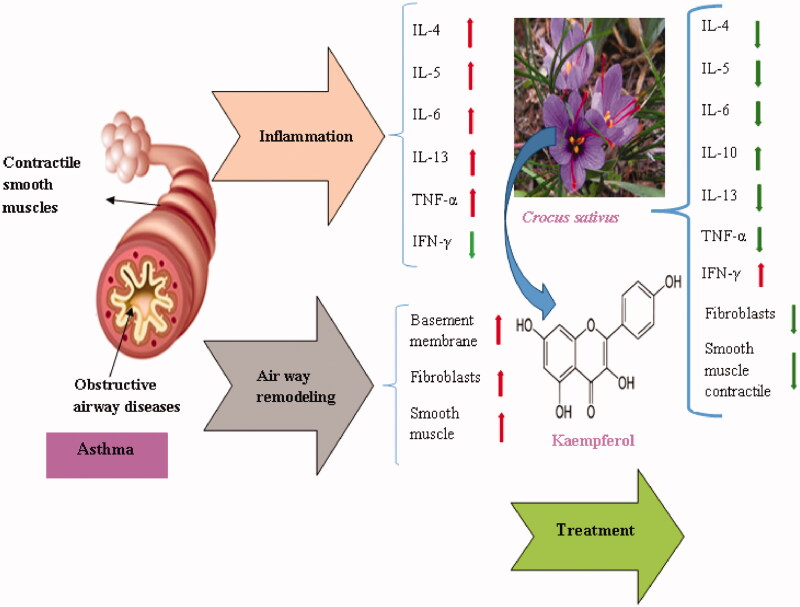
Objective: The current study reviewed the possible therapeutic effects of C. sativus stigma and its petal flavonoid (kaempferol) on respiratory disorders with several mechanisms such as anti-inflammatory, and smooth muscle relaxant effects.
Materials and methods: This review article searched databases including PubMed, Google Scholar, and ScienceDirect, up to November 2019. The keywords including; 'Crocus sativus', 'saffron', 'kaempferol', 'airway inflammation', and 'smooth muscle relaxant' were searched.
Results: C. sativus reduced nitric oxide (NO), inducible nitric oxide synthase (iNOS) levels and inflammatory cytokines in the lung tissue. Saffron and kaempferol reduced white blood cells (WBCs) and the percentage of neutrophils and eosinophils in bronchoalveolar lavage fluid. Moreover, saffron reduced tracheal responsiveness to methacholine and ovalbumin on tracheal smooth muscles. In addition, kaempferol reduced the total leukocyte and eosinophil counts similar to the effect of dexamethasone and also showed relaxant effects on smooth muscle.
Discussion and conclusion: Crocus sativus and its petal flavonoid, kaempferol, showed relatively potent therapeutic effects on respiratory disorders by relaxation of tracheal smooth muscles via stimulatory or blocking effects on β-adrenoceptor and muscarinic receptors, respectively. Saffron and kaempferol also decreased production of NO, inflammatory cytokines and chemokines in respiratory systems.
Keywords: Saffron; airway inflammation; smooth muscle relaxant effect.
Conflict of interest statement
No potential conflict of interest was reported by the author(s).
Figures
References
-
- Abo-Salem OM. 2014. Kaempferol attenuates the development of diabetic neuropathic pain in mice: Possible anti-inflammatory and anti-oxidant mechanisms. Open Access Maced J Med Sci. 2(3):424–430.
-
- Abrishami MH. 1987. Understanding of Iranian saffron. 1st ed. Tehran (Iran): Tous.
-
- Amin A, Hamza AA, Daoud S, Khazanehdari K, Hrout AA, Baig B, Chaiboonchoe A, Adrian TE, Zaki N, Salehi-Ashtiani K, et al. 2016. Saffron-based crocin prevents early lesions of liver cancer: in vivo, in vitro and network analyses. Recent Pat Anticancer Drug Discov. 11(1):121–133. - PubMed
-
- Amin B, Abnous K, Motamedshariaty V, Hosseinzadeh H.. 2014. Attenuation of oxidative stress, inflammation and apoptosis by ethanolic and aqueous extracts of Crocus sativus L. stigma after chronic constriction injury of rats. An Acad Bras Cienc. 86(4):1821–1832. - PubMed
-
- Anderson GP, Coyle AJ.. 1994. TH2 and ‘TH2-like’cells in allergy and asthma: pharmacological perspectives. Trend Pharm Sci. 15(9):324–332. - PubMed
MeSH terms
Substances
LinkOut - more resources
Full Text Sources
Medical
