The maturation changes of sleep-related respiratory abnormalities in infants with laryngomalacia
- PMID: 33295276
- PMCID: PMC8020689
- DOI: 10.5664/jcsm.9046
The maturation changes of sleep-related respiratory abnormalities in infants with laryngomalacia
Abstract
Study objectives: Obstructive sleep apnea (OSA) and central sleep apnea (CSA) are common in infants with laryngomalacia. The purpose of this study was to evaluate developmental changes in sleep-related breathing disorders over time in infants with laryngomalacia and understand the effect of supraglottoplasty (SGP) and nonsurgical treatment.
Methods: This is a retrospective review of infants with laryngomalacia who had at least 2 diagnostic polysomnography studies performed from January 2000 and May 2015. We included infants who had either OSA or CSA. Comparison of sleep and respiratory parameters by age group (0-6, 6-12, and >12 months old) was performed in both SGP and non-SGP groups using a mixed-effect regression model. A log-normal mixed model was used to explore the changes in sleep and respiratory parameters with age. The time to resolution of CSA and OSA was analyzed using nonparametric survival analysis.
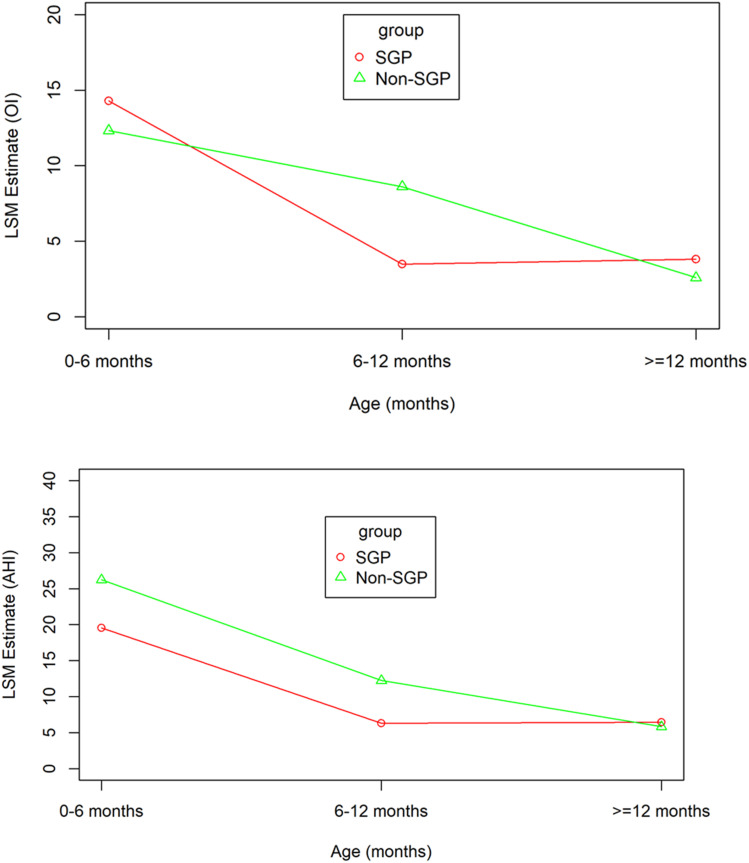
Results: A total of 102 infants were included; 57 had only OSA and 45 had both CSA and OSA. There were significant decreases in apnea-hypopnea index, obstructive index, central apnea index, and arousal index with increasing age in both SGP and non-SGP groups. The mean age at resolution of CSA (central apnea index < 5) was 7.60 months old for SGP and 12.57 months old for non-SGP (P < .05). There were no significant differences in the mean age at resolution of OSA (obstructive index < 1; 35.18 [SGP] vs 41.55 months [non-SGP]; P = .60) between SGP and non-SGP groups. Infants with neurologic disease, congenital anomalies, or genetic syndromes required significantly more time to resolve OSA (28.12 [normal] vs 53.13 [neurological] vs 59.53 months [congenital anomalies and genetic]; P < .01).
Conclusions: Both OSA and CSA improve in infants with laryngomalacia with increasing age regardless of SGP. The mechanism underlying these changes may involve airway growth and maturation of respiratory control. Time to resolution of OSA is affected by the presence of neurologic diseases, congenital anomalies, and genetic syndromes. Further studies are needed to confirm these findings and to evaluate long-term outcomes in this population.
Keywords: central sleep apnea; developmental changes of sleep apnea; laryngomalacia; obstructive sleep apnea.
© 2021 American Academy of Sleep Medicine.
Conflict of interest statement
All authors have seen and approved the manuscript. The study was funded by the Cincinnati Children’s Research Foundation. Part of this research was presented as an abstract at the International conference of the American Thoracic Society 2017. The authors report no conflicts of interest.
Figures


Comment in
-
Laryngomalacia in infancy improves with increasing age irrespective of treatment.J Clin Sleep Med. 2021 Apr 1;17(4):619-620. doi: 10.5664/jcsm.9128. J Clin Sleep Med. 2021. PMID: 33551020 Free PMC article.
References
Publication types
MeSH terms
LinkOut - more resources
Full Text Sources
Other Literature Sources