. 2021 Jan 20;32(1):82-87.
doi: 10.1021/acs.bioconjchem.0c00557. Epub 2020 Dec 9.

Semisynthesis of Human Ribonuclease-S

Affiliations

Semisynthesis of Human Ribonuclease-S

Jessica Sayers et al. Bioconjug Chem. .

Abstract

Since its conception, the ribonuclease S complex (RNase S) has led to historic discoveries in protein chemistry, enzymology, and related fields. Derived by the proteolytic cleavage of a single peptide bond in bovine pancreatic ribonuclease (RNase A), RNase S serves as a convenient and reliable model system for incorporating unlimited functionality into an enzyme. Applications of the RNase S system in biomedicine and biotechnology have, however, been hindered by two shortcomings: (1) the bovine-derived enzyme could elicit an immune response in humans, and (2) the complex is susceptible to dissociation. Here, we have addressed both limitations in the first semisynthesis of an RNase S conjugate derived from human pancreatic ribonuclease and stabilized by a covalent interfragment cross-link. We anticipate that this strategy will enable unprecedented applications of the "RNase-S" system.


Figures
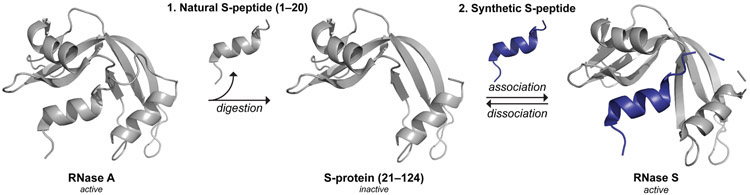
Figure 1.
Figure 1.
Traditional production of semisynthetic RNase S. Step 1: Proteolytic digestion of RNase A to cleave S-peptide (residues 1–20) and yield catalytically inactive S-protein (residues 21–124). Step 2: Reversible association of S-protein and a synthetic S-peptide variant to produce catalytically active, semisynthetic RNase S. Images were produced with PyMOL software and PDB entries 1jvt and 1rnu.
Figure 2.
Figure 2.
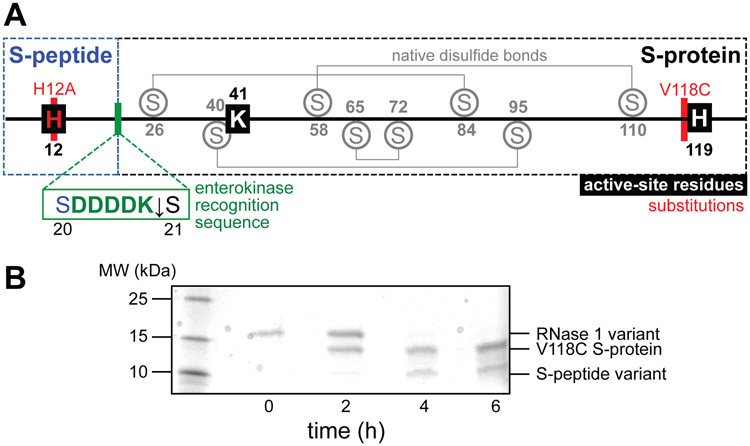
(A) Map of the amino acid sequence of the RNase 1 variant. The locations of the enzymic active-site residues, native disulfide bonds, substitutions, and the inserted enterokinase recognition sequence are shown. (B) SDS–PAGE analysis of the digestion of the RNase 1 variant with enterokinase (1 U per 0.1 mg) to yield V118C S-protein and a variant peptide.
Figure 3.
Figure 3.
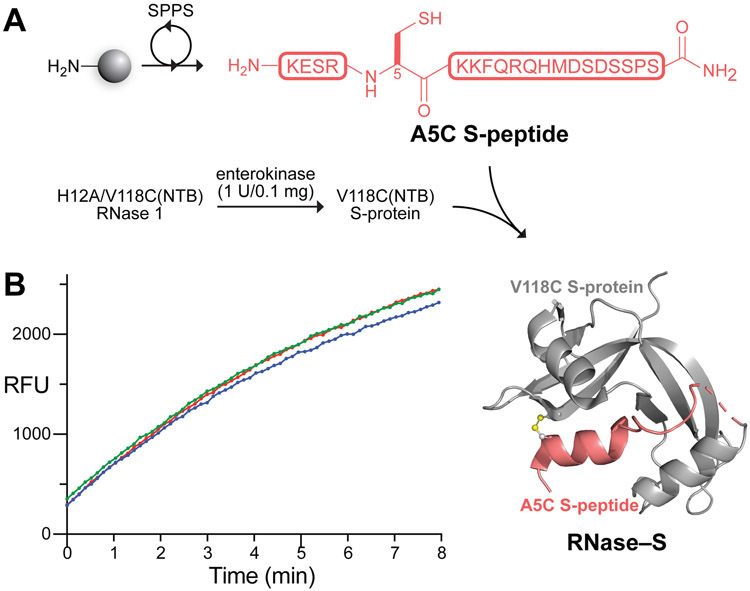
(A) Scheme for the semisynthesis of human RNase–S. Image was produced with PyMOL software and PDB entry 1z7x. (B) Graph showing the ribonucleolytic activity of RNase–S (5 nM) with a fluorogenic substrate, 6-FAM–dArUdAdA–6-TAMRA (200 nM), in 0.10 M DEPC-treated OVS-free MES–NaOH buffer, pH 6.0, containing NaCl (0.10 M); λex 493 nm, λem 515 nm. The assay was performed in triplicate.
Figure 4.
Figure 4.
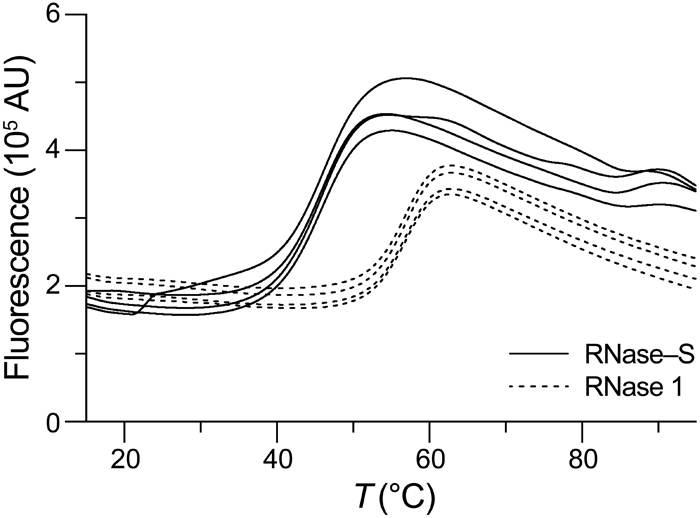
Thermal denaturation profiles of human RNase–S and human RNase 1 obtained by differential scanning fluorimetry using SYPRO Orange, λex (470 ± 15) nm, and λem (586 ± 10) nm. Assays were performed in quadruplicate.
Figure 5.
Figure 5.
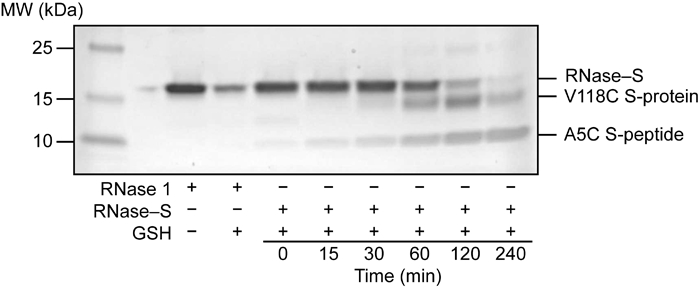
SDS–PAGE analysis of the reduction stability of human RNase–S.
Figure 6.
Figure 6.
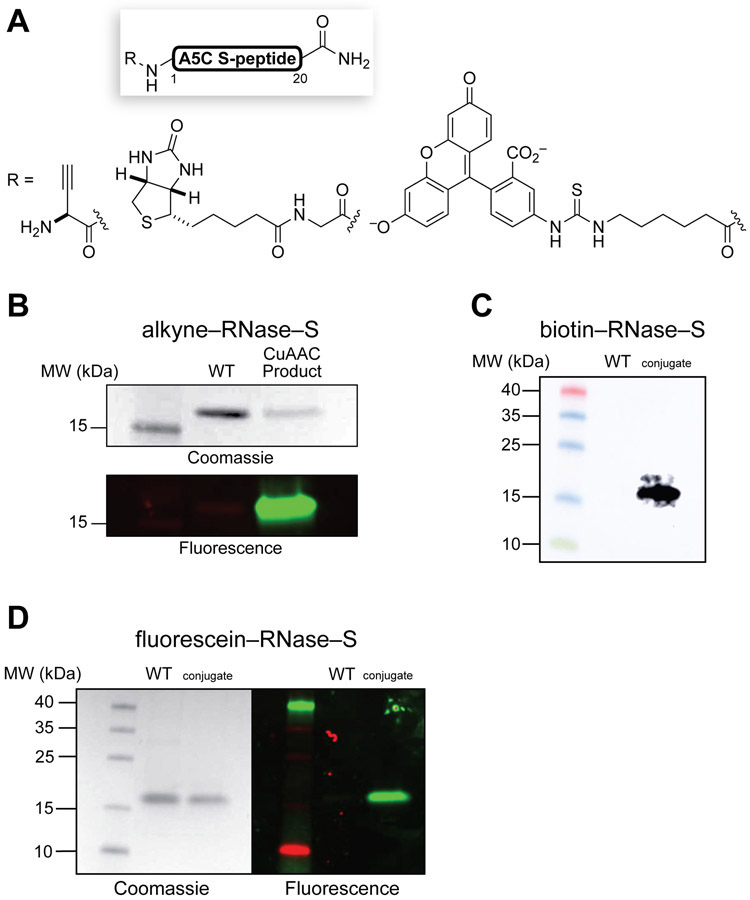
(A) A5C S-peptide bearing N-terminal pendants. (B) Coomassie staining and fluorescence imaging of alkynyl RNase–S following CuAAC with 5-TAMRA–azide and SDS–PAGE. (C) Antibiotin immunoblot analysis of biotinylated RNase–S. (D) Coomassie staining and fluorescence imaging of fluorescein-tagged RNase–S after SDS–PAGE. WT, wild-type RNase 1.

References

    1. Thompson RE; Muir TW Chemoenzymatic semisynthesis of proteins. Chem. Rev 2020, 120, 3051–3126. - PMC - PubMed
    1. Richards FM; Vithayathil PJ The preparation of subtilisin-modified ribonuclease and the separation of the peptide and protein components. J. Biol. Chem 1959, 234, 1459–1465. - PubMed
    1. Richards FM; Wyckoff HW Bovine pancreatic ribonuclease. The Enzymes 1971, 4, 647–806.
    1. Richards FM Linderstrøm-Lang and the Carlsberg Laboratory: The view of a postdoctoral fellow in 1954. Protein Sci. 1992, 1, 1721–1730. - PMC - PubMed
    1. Richards FM Whatever happened to the fun? An autobiographical investigation. Annu. Rev. Biophys. Biomol. Struct 1997, 26, 1–25. - PubMed

Publication types

MeSH terms