


COVID-19 mortality risk assessment: An international multi-center study
- PMID: 33296405
- PMCID: PMC7725386
- DOI: 10.1371/journal.pone.0243262
COVID-19 mortality risk assessment: An international multi-center study
Abstract
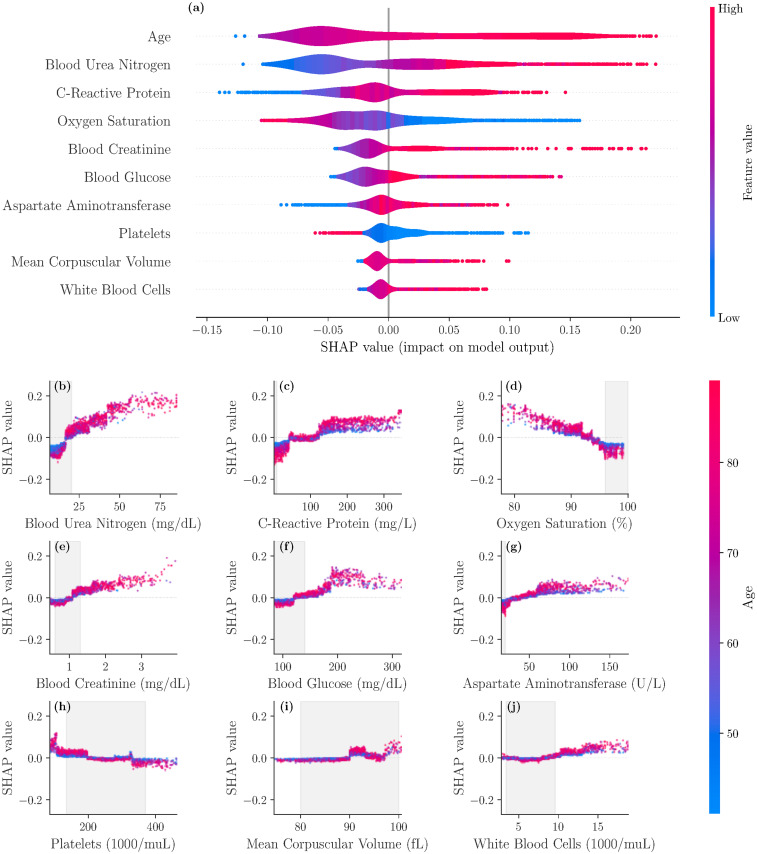
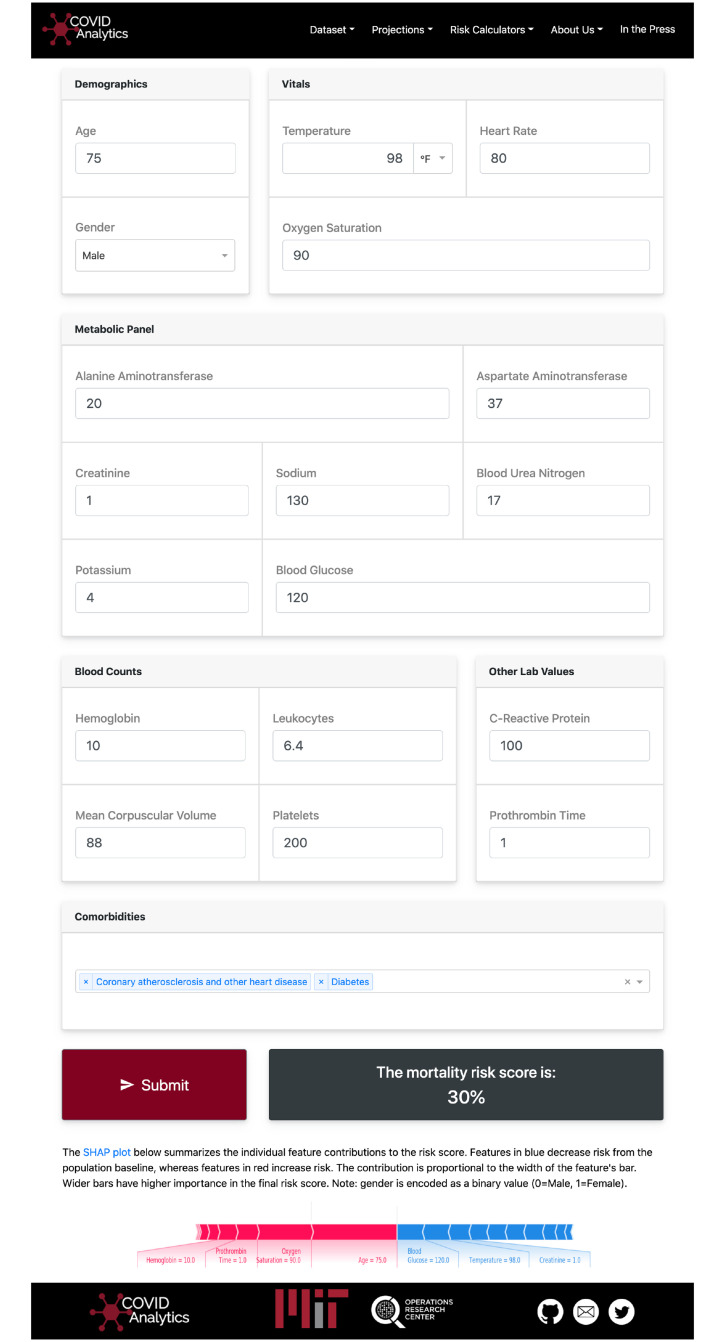
Timely identification of COVID-19 patients at high risk of mortality can significantly improve patient management and resource allocation within hospitals. This study seeks to develop and validate a data-driven personalized mortality risk calculator for hospitalized COVID-19 patients. De-identified data was obtained for 3,927 COVID-19 positive patients from six independent centers, comprising 33 different hospitals. Demographic, clinical, and laboratory variables were collected at hospital admission. The COVID-19 Mortality Risk (CMR) tool was developed using the XGBoost algorithm to predict mortality. Its discrimination performance was subsequently evaluated on three validation cohorts. The derivation cohort of 3,062 patients has an observed mortality rate of 26.84%. Increased age, decreased oxygen saturation (≤ 93%), elevated levels of C-reactive protein (≥ 130 mg/L), blood urea nitrogen (≥ 18 mg/dL), and blood creatinine (≥ 1.2 mg/dL) were identified as primary risk factors, validating clinical findings. The model obtains out-of-sample AUCs of 0.90 (95% CI, 0.87-0.94) on the derivation cohort. In the validation cohorts, the model obtains AUCs of 0.92 (95% CI, 0.88-0.95) on Seville patients, 0.87 (95% CI, 0.84-0.91) on Hellenic COVID-19 Study Group patients, and 0.81 (95% CI, 0.76-0.85) on Hartford Hospital patients. The CMR tool is available as an online application at covidanalytics.io/mortality_calculator and is currently in clinical use. The CMR model leverages machine learning to generate accurate mortality predictions using commonly available clinical features. This is the first risk score trained and validated on a cohort of COVID-19 patients from Europe and the United States.
Conflict of interest statement
KN, MS, BS are employed by Hartford HealthCare. ON is employed by Benefits Science Technologies. This does not alter our adherence to PLOS ONE policies on sharing data and materials.
Figures
References
-
- Chen T, Guestrin C. XGBoost: A scalable tree boosting system. Proceedings of the ACM SIGKDD International Conference on Knowledge Discovery and Data Mining. 2016. pp. 785–794.
Publication types
MeSH terms
LinkOut - more resources
Full Text Sources
Medical
Research Materials
