


Dengue Seroprevalence and Seroconversion in Urban and Rural Populations in Northeastern Thailand and Southern Laos
- PMID: 33297445
- PMCID: PMC7731008
- DOI: 10.3390/ijerph17239134
Dengue Seroprevalence and Seroconversion in Urban and Rural Populations in Northeastern Thailand and Southern Laos
Erratum in
-
Correction: Doum, D., et al. Dengue Seroprevalence and Seroconversion in Urban and Rural Populations in Northeastern Thailand and Southern Laos. Int. J. Environ. Res. Public Health 2020, 17, 9134.Int J Environ Res Public Health. 2021 Feb 4;18(4):1439. doi: 10.3390/ijerph18041439. Int J Environ Res Public Health. 2021. PMID: 33557444 Free PMC article.
Abstract
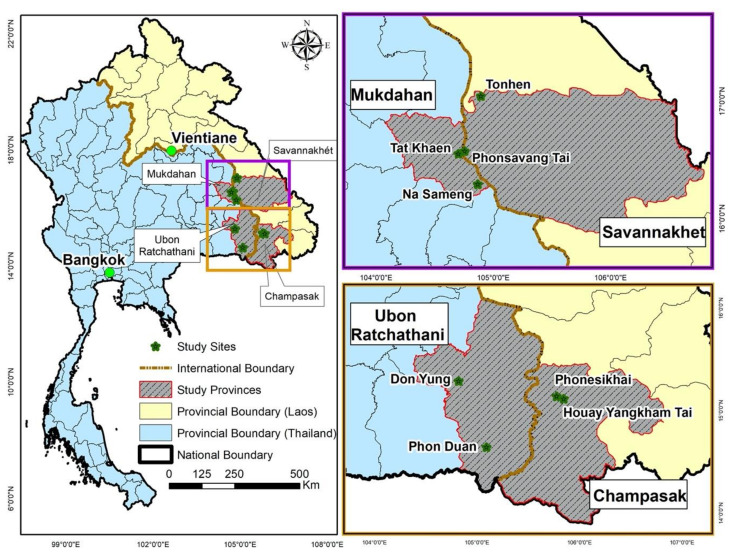
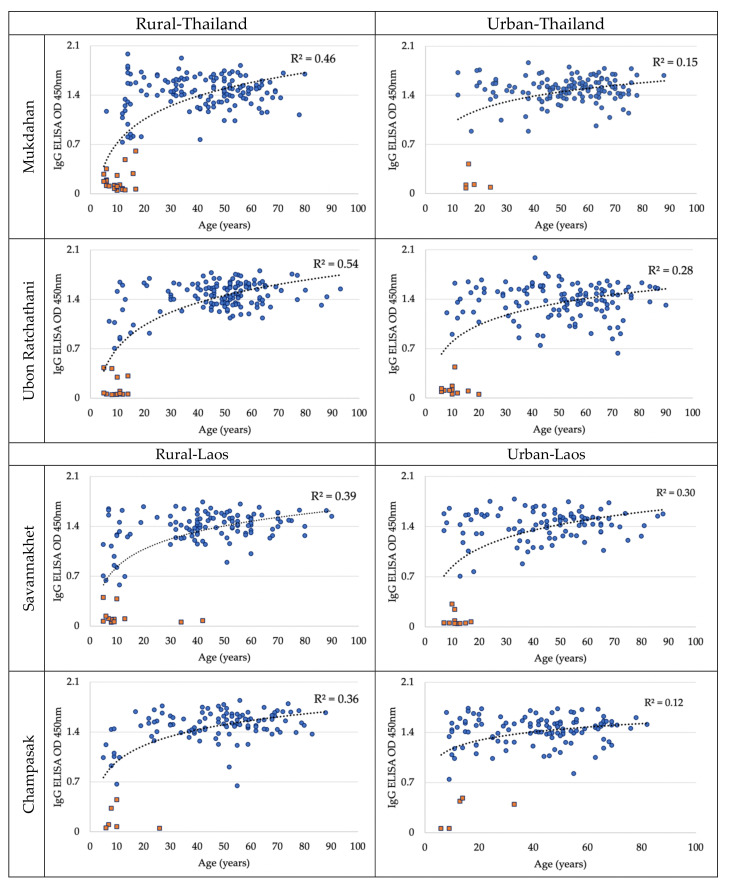
Dengue is the most rapidly spreading mosquito-borne viral disease in the world. The detection of clinical cases enables us to measure the incidence of dengue infection, whereas serological surveys give insights into the prevalence of infection. This study aimed to determine dengue seroprevalence and seroconversion rates in northeastern Thailand and southern Laos and to assess any association of mosquito control methods and socioeconomic factors with dengue virus (DENV) infection. Cross-sectional seroprevalence surveys were performed in May and November 2019 on the same individuals. Blood samples were collected from one adult and one child, when possible, in each of 720 randomly selected households from two urban and two rural sites in both northeastern Thailand and southern Laos. IgG antibodies against DENV were detected in serum using a commercial enzyme-linked immunosorbent assay (ELISA) kit. Overall, 1071 individuals participated in the study. The seroprevalence rate was high (91.5%) across all 8 study sites. Only age and province were associated with seroprevalence rates. There were 33 seroconversions during the period from May to November, of which seven reported fever. More than half of the seroconversions occurred in the rural areas and in Laos. Dengue seroconversion was significantly associated with young age (<15 years old), female gender, province, and duration of living in the current residence. No socioeconomic factors or mosquito control methods were found to be associated with seroprevalence or seroconversion. Notably, however, the province with most seroconversions had lower diurnal temperature ranges than elsewhere. In conclusion, our study has highlighted the homogeneity of dengue exposure across a wide range of settings and most notably those from rural and urban areas. Dengue can no longer be considered to be solely an urban disease nor necessarily one linked to poverty.
Keywords: DENV; dengue; seroconversion; seroprevalence; socioeconomic factors.
Conflict of interest statement
The authors declare no conflict of interest.
Figures
References
-
- World Health Organization . Dengue: Guidelines for Diagnosis, Treatment, Prevention and Control. World Health Organization; Geneva, Switzerland: 2009. - PubMed
-
- Lopez A.D. Global Burden of Disease and Risk Factors. The World Bank; Washington, DC, USA: 2006. - PubMed
-
- World Health Organization . Global Strategy for Dengue Prevention and Control 2012–2020. World Health Organization; Geneva, Switzerland: 2012.
-
- Stanaway J., Shepard D.S., Undurraga E.A., Halasa Y., Yara A., Coffeng L.E., Brady O., Oliver J., Hay S., Simon I., et al. The global burden of dengue: An analysis from the Global Burden of Disease Study 2013. Lancet Infect. Dis. 2016;16:712–723. doi: 10.1016/S1473-3099(16)00026-8. - DOI - PMC - PubMed
Publication types
MeSH terms
Substances
LinkOut - more resources
Full Text Sources
Medical
