Occupation and risk of severe COVID-19: prospective cohort study of 120 075 UK Biobank participants
- PMID: 33298533
- PMCID: PMC7611715
- DOI: 10.1136/oemed-2020-106731
Occupation and risk of severe COVID-19: prospective cohort study of 120 075 UK Biobank participants
Erratum in
-
Correction: Occupation and risk of severe COVID-19: prospective cohort study of 120 075 UK Biobank participants.Occup Environ Med. 2022 Feb;79(2):e3. doi: 10.1136/oemed-2020-106731corr1. Occup Environ Med. 2022. PMID: 35027462 No abstract available.
Abstract
Objectives: To investigate severe COVID-19 risk by occupational group.
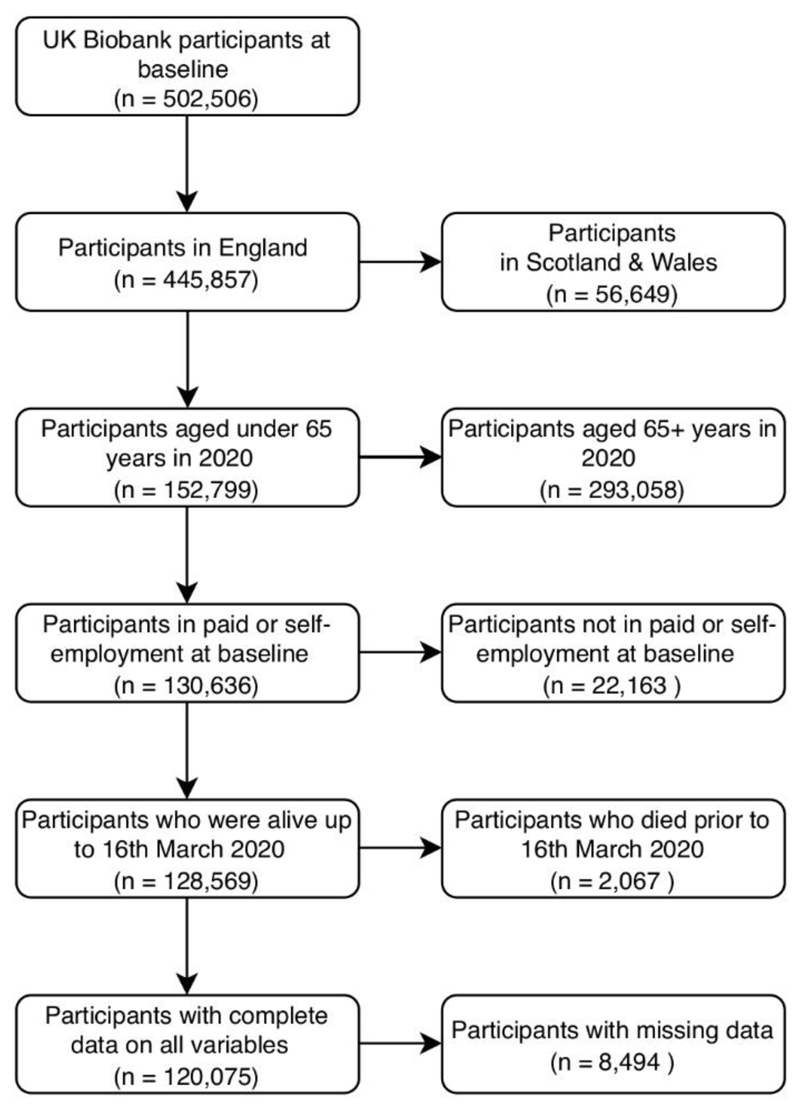
Methods: Baseline UK Biobank data (2006-10) for England were linked to SARS-CoV-2 test results from Public Health England (16 March to 26 July 2020). Included participants were employed or self-employed at baseline, alive and aged <65 years in 2020. Poisson regression models were adjusted sequentially for baseline demographic, socioeconomic, work-related, health, and lifestyle-related risk factors to assess risk ratios (RRs) for testing positive in hospital or death due to COVID-19 by three occupational classification schemes (including Standard Occupation Classification (SOC) 2000).
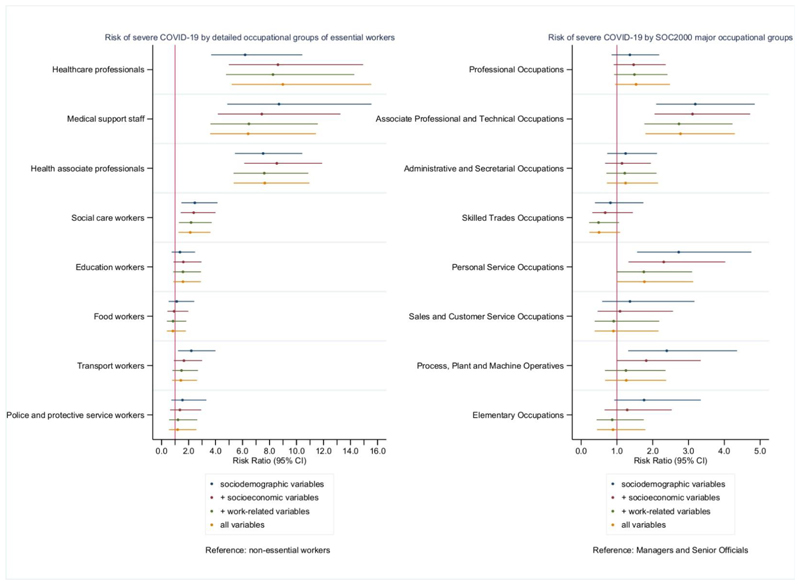
Results: Of 120 075 participants, 271 had severe COVID-19. Relative to non-essential workers, healthcare workers (RR 7.43, 95% CI 5.52 to 10.00), social and education workers (RR 1.84, 95% CI 1.21 to 2.82) and other essential workers (RR 1.60, 95% CI 1.05 to 2.45) had a higher risk of severe COVID-19. Using more detailed groupings, medical support staff (RR 8.70, 95% CI 4.87 to 15.55), social care (RR 2.46, 95% CI 1.47 to 4.14) and transport workers (RR 2.20, 95% CI 1.21 to 4.00) had the highest risk within the broader groups. Compared with white non-essential workers, non-white non-essential workers had a higher risk (RR 3.27, 95% CI 1.90 to 5.62) and non-white essential workers had the highest risk (RR 8.34, 95% CI 5.17 to 13.47). Using SOC 2000 major groups, associate professional and technical occupations, personal service occupations and plant and machine operatives had a higher risk, compared with managers and senior officials.
Conclusions: Essential workers have a higher risk of severe COVID-19. These findings underscore the need for national and organisational policies and practices that protect and support workers with an elevated risk of severe COVID-19.
Keywords: exposure assessment; health care workers; investigation of outbreaks of illness; physicians; public health.
© Author(s) (or their employer(s)) 2020. No commercial re-use. See rights and permissions. Published by BMJ.
Conflict of interest statement
Competing interests: JPP is a member of the UK Biobank Scientific Steering Committee.
Figures
Comment in
-
COVID-19: are not all workers 'essential'?Occup Environ Med. 2021 May;78(5):305-306. doi: 10.1136/oemed-2020-107272. Epub 2021 Apr 2. Occup Environ Med. 2021. PMID: 33811176 No abstract available.
References
-
- Office of National Statistics. Which occupations have the highest potential exposure to the coronavirus (COVID-19)? 2020
-
- Office for National Statistics. Coronavirus (COVID-19) related deaths by occupation, England and Wales: deaths registered between 9 March and 25 May 2020. 2020 May