


Evaluation of potential miticide toxicity to Varroa destructor and honey bees, Apis mellifera, under laboratory conditions
- PMID: 33299084
- PMCID: PMC7726572
- DOI: 10.1038/s41598-020-78561-2
Evaluation of potential miticide toxicity to Varroa destructor and honey bees, Apis mellifera, under laboratory conditions
Abstract
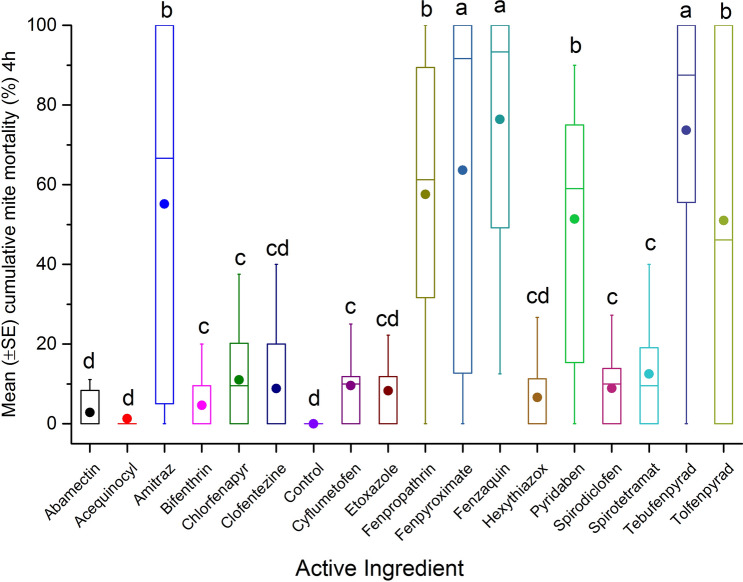
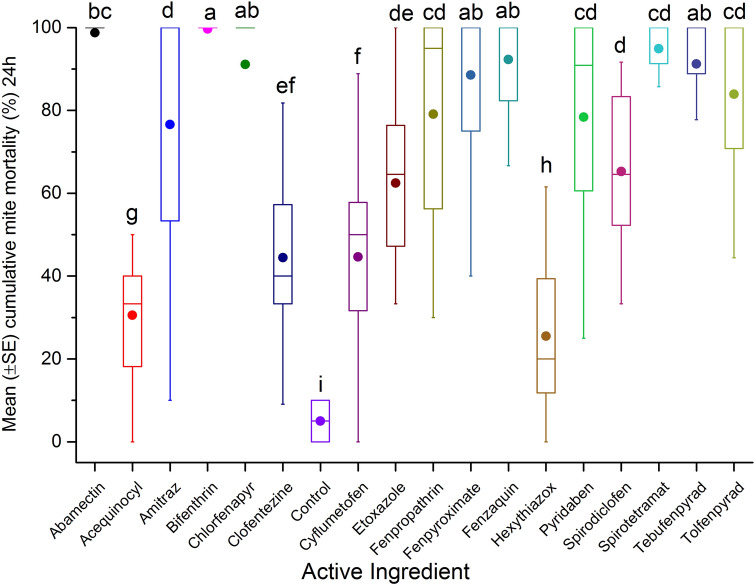
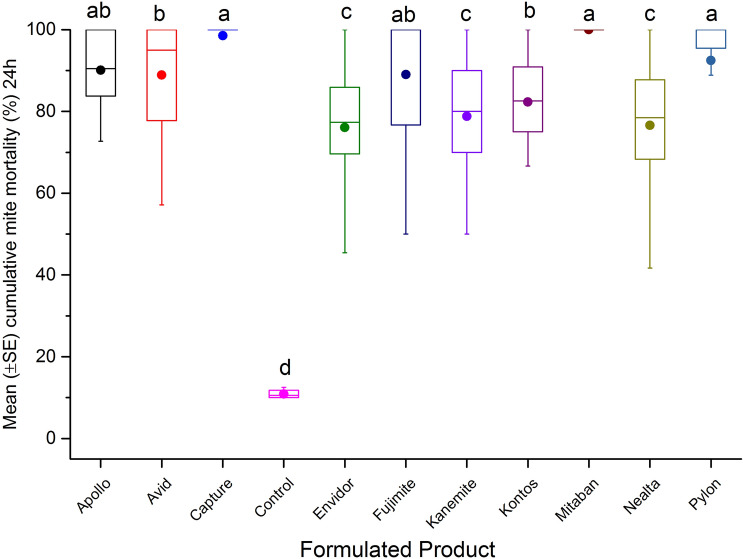
The honey bee, Apis mellifera L., is the world's most important managed pollinator of agricultural crops, however, Varroa mite, Varroa destructor Anderson and Trueman, infestation has threatened honey bee survivorship. Low efficacy and development of Varroa mite resistance to currently used Varroacides has increased the demand for innovative, effective treatment tool options that exhibit high efficacy, while minimizing adverse effects on honey bee fitness. In this investigation, the toxicity of 16 active ingredients and 9 formulated products of registered miticides for use on crops from 12 chemical families were evaluated in comparison to amitraz on Varroa mites and honey bees using contact surface and topical exposures. It was found that fenpyroximate (93% mortality), spirotetramat (84% mortality) and spirodiclofen (70% mortality) had greater toxicity to Varroa mites, but high dose rates caused high bee mortality (> 60%). With this in mind, further research is needed to investigate other options to minimize the adverse effect of these compounds on bees. The results also found high toxicity of fenazaquin and etoxazole against Varroa mites causing 92% and 69% mortality, respectively; and were found to be safe on honey bees. Collectively, it is recommended that fenazaquin and etoxazole are candidates for a potential Varroacide and recommended for further testing against Varroa mites at the colony level.
Conflict of interest statement
The authors declare no competing interests.
Figures


References
-
- Currie RW, Pernal SF, Guzman-Novoa E. Honey bee colony losses in Canada. J. Apicult. Res. 2010;49(1):104–106. doi: 10.3896/IBRA.1.49.1.18. - DOI
-
- van Engelsdorp D, Hayes J, Underwood R, Pettis JS. A survey of honey bee losses in the United States, fall 2008 to spring 2009. J. Apicult. Res. 2010;49(1):7–14. doi: 10.3896/IBRA.1.49.1.03. - DOI
-
- LeConte Y, Ellis M, Ritter W. Varroa mites and honey bee health: can Varroa explain part of the colony losses? Apidologie. 2010;41(3):353–363. doi: 10.1051/apido/2010017. - DOI
-
- Carreck N, Neumann P. Honey bee colony losses. J. Apicult. Res. 2010;49(1):1–6. doi: 10.1080/00218839.2017.1412565. - DOI
Publication types
MeSH terms
Substances
LinkOut - more resources
Full Text Sources
Other Literature Sources
