


Developing sustainable prehospital trauma education in Rwanda
- PMID: 33299755
- PMCID: PMC7700902
- DOI: 10.1016/j.afjem.2020.07.015
Developing sustainable prehospital trauma education in Rwanda
Abstract
Introduction: Every year, >5 million people worldwide die from trauma. In Kigali, Rwanda, 50% of prehospital care provided by SAMU, the public prehospital system, is for trauma. Our collaboration developed and implemented a context-specific, prehospital Emergency Trauma Care Course (ETCC) and train-the-trainers program for SAMU, based on established international best practices.
Methods: A context-appropriate two-day ETCC was developed using established best practices consisting of traditional 30-minute lectures followed by 20-minute practical scenario-based team-driven simulation sessions. Also, hands-on skill sessions covered intravenous access, needle thoracostomy and endotracheal intubation among others. Two cohorts participated - SAMU staff who would form an instructor core and emergency staff from ten district, provincial and referral hospitals who are likely to respond to local emergencies in the community. The instructor core completed ETCC 1 and a one-day educator course and then taught the second cohort (ETCC2). Pre and post course assessments were conducted and analyzed using Student's t-test and matched paired t-tests.
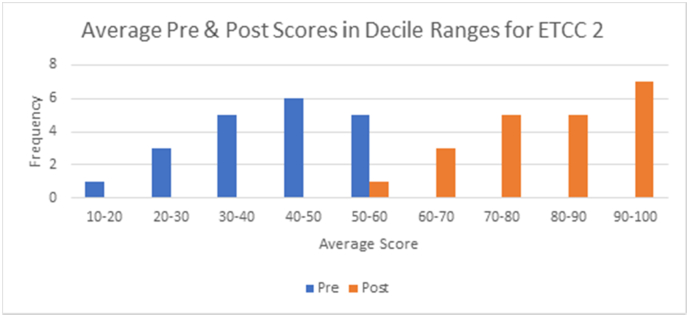
Results: ETCC 1 had 17 SAMU staff and ETCC 2 had 19 hospital staff. ETCC 1 mean scores increased from 40% to 63% and ETCC 2 increased from 41% to 78% after the course (p < 0.001 using matched pair analysis). A one-way ANOVA mean square analysis showed that regardless of the baseline level of training for each participant, all trainees reached similar post-course assessment scores, F (1) = 15.18, p = 0.0004.
Discussion: This study demonstrates effective implementation of a context-appropriate prehospital trauma training program for prehospital staff in Kigali, Rwanda. The course resulted in improved knowledge for an instructor core and for staff from district and provincial hospitals confirming the effectiveness of a train-the-trainers model. This program may be effective to support capacity development for prehospital trauma care in the country using a qualified local source of instructors.
Keywords: Africa; Education; Prehospital; Rwanda; Trauma.
© 2020 African Federation for Emergency Medicine. Publishing services provided by Elsevier.
Conflict of interest statement
The authors declare no conflict of interest.
Figures

References
-
- Injury and violence: the facts 2014. 2014. http://apps.who.int/iris/bitstream/10665/149798/1/9789241508018_eng.pdf
-
- Chen Simiao, Kuhn Michael, Prettner Klaus, Bloom David E. The global macroeconomic burden of road injuries: estimates and projections for 166 countries. Lancet Planet Health. 2019;3(9):e390–e398. - PubMed
-
- Organization, W. H . World Health Organization; Geneva: 2005. Prehospital trauma care systems.
-
- Aekka A. Prehospital trauma care education for first responders in India. J Surg Res. 2015;197:331–338. - PubMed
-
- Oliver G.J., Walter D.P., Redmond A.D. Are prehospital deaths from trauma and accidental injury preventable? A direct historical comparison to assess what has changed in two decades. Injury. 2017;48:978–984. - PubMed
LinkOut - more resources
Full Text Sources
