


Mapping risk of ischemic heart disease using machine learning in a Brazilian state
- PMID: 33301451
- PMCID: PMC7728276
- DOI: 10.1371/journal.pone.0243558
Mapping risk of ischemic heart disease using machine learning in a Brazilian state
Abstract
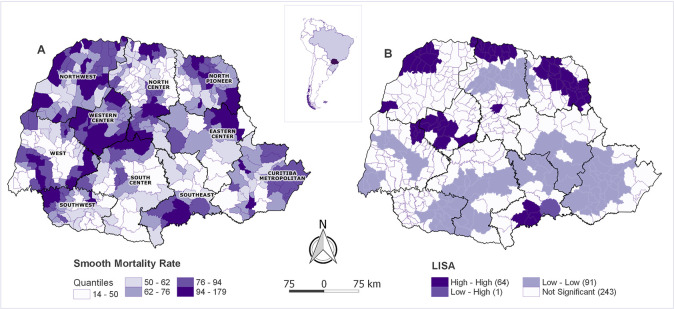
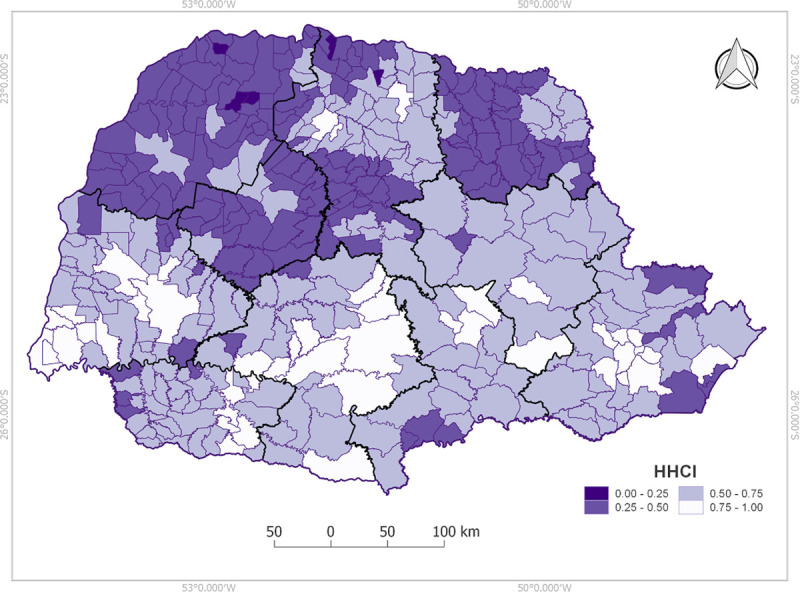
Cardiovascular diseases are the leading cause of deaths globally. Machine learning studies predicting mortality rates for ischemic heart disease (IHD) at the municipal level are very limited. The goal of this paper was to create and validate a Heart Health Care Index (HHCI) to predict risk of IHD based on location and risk factors. Secondary data, geographical information system (GIS) and machine learning were used to validate the HHCI and stratify the IHD municipality risk in the state of Paraná. A positive spatial autocorrelation was found (Moran's I = 0.6472, p-value = 0.001), showing clusters of high IHD mortality. The Support Vector Machine, which had an RMSE of 0.789 and error proportion close to one (0.867), was the best for prediction among eight machine learning algorithms after validation. In the north and northwest regions of the state, HHCI was low and mortality clusters patterns were high. By creating an HHCI through ML, we can predict IHD mortality rate at municipal level, identifying predictive characteristics that impact health conditions of these localities' guided health management decisions for improvements for IHD within the emergency care network in the state of Paraná.
Conflict of interest statement
The authors have declared that no competing interests exist.
Figures
References
-
- WHO, International Statistical Classification of Diseases and Related Health Problems 10th Revision (ICD-10); Version 2016. Disponível online: https://icd.who.int/browse10/2016/en#/I20-I25 (Acesso: 30 de janeiro).
-
- DATASUS–Departamento de Informática do SUS. Informações de Saúde, Epidemiológicas e Morbidade: banco de dados. Disponível em: http://www2.datasus.gov.br/DATASUS/index.php?area=0203 (Acesso: 14 jul. 2018).
-
- Hertz JT, Fu T, Vissoci JR, Augusto T, Rocha H, Carvalho E, et al. The distribution of cardiac diagnostic testing for acute coronary syndrome in the Brazilian healthcare system : A national geospatial evaluation of health access. PLoS One. 2019;14(1):1–16. 10.1371/journal.pone.0210502 - DOI - PMC - PubMed
Publication types
MeSH terms
LinkOut - more resources
Full Text Sources
