


Age- and sex-dependent clinical equations to estimate glomerular filtration rates in children and young adults with chronic kidney disease
- PMID: 33301749
- PMCID: PMC9083470
- DOI: 10.1016/j.kint.2020.10.047
Age- and sex-dependent clinical equations to estimate glomerular filtration rates in children and young adults with chronic kidney disease
Abstract
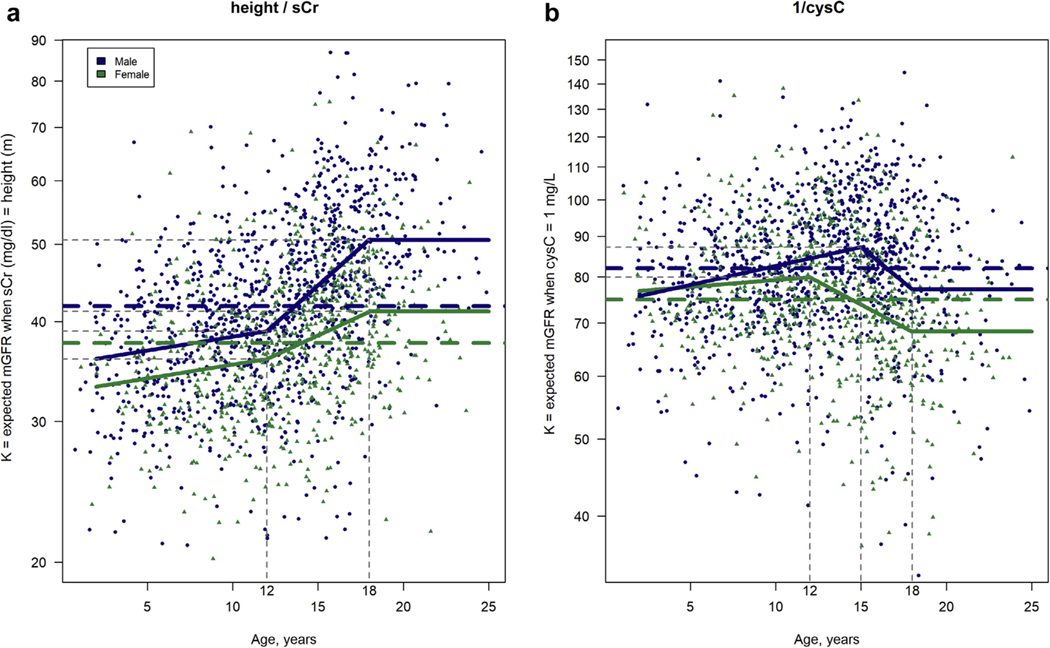
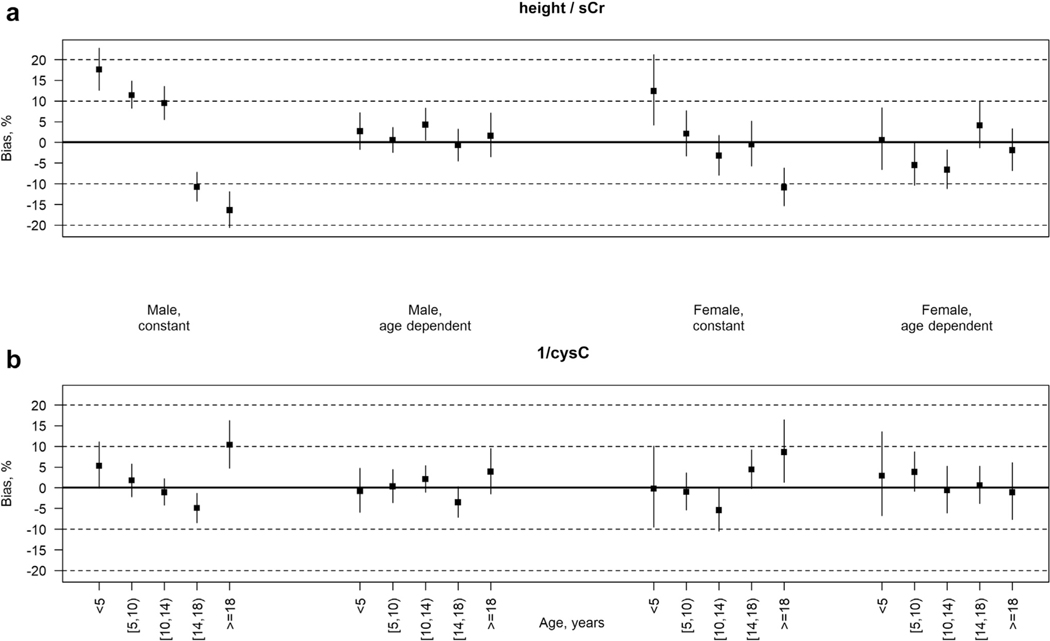
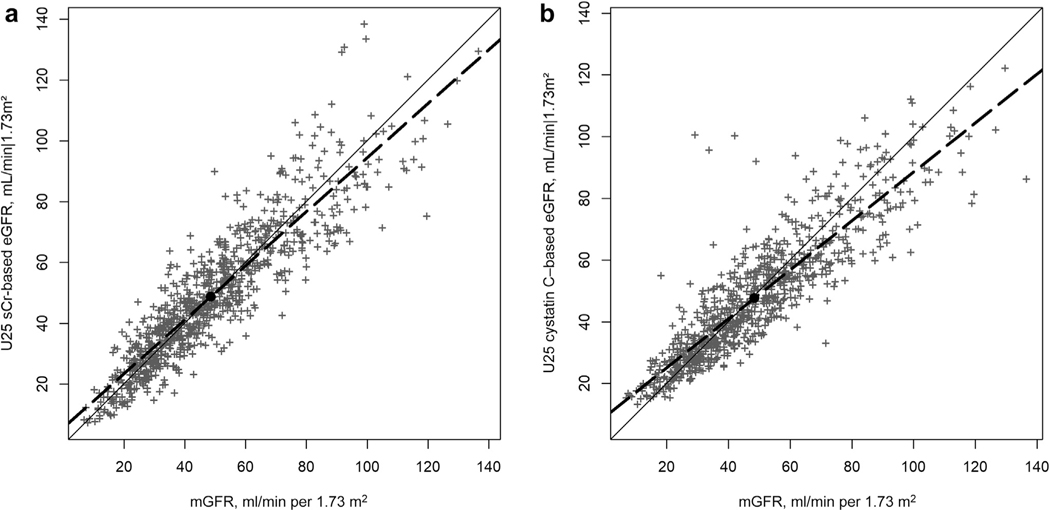
Using data (2655 observations from 928 participants) from the Chronic Kidney Disease in Children Study, we developed and internally validated new glomerular filtration rate estimating equations for clinical use in children and young adults: two forms of K × [heigh(ht) / serum creatinine(sCr)] and two forms of K × [1 / cystatin C(cysC)]. For each marker, one equation used a sex-dependent K; in the other, K is sex-and age-dependent. Glomerular filtration rate (GFR) was measured directly by plasma iohexol disappearance. The equations using ht⁄sCr had sex-specific constants of 41.8 for males and 37.6 for females. In the age- dependent models, K increased monotonically for children 1-18 years old and was constant for young adults 18-25 years. For males, K ranged from 35.7 for one-year-olds to 50.8 for those 18 and older. For females, the values of K ranged from 33.1 to 41.4. Constant K values for cystatin-C equations were 81.9 for males and 74.9 for females. With age-dependency, K varied non-monotonically with the highest values at age 15 for males (K of 87.2) and 12 years for females (K of 79.9). Use of an age-dependent K with ht/sCr models reduced average bias, notably in young children and young adults; age-dependent cystatin-C models produced similar agreement to using a constant K in children under 18 years, but reduced bias in young adults. These age-dependent proposed equations were evaluated alongside estimated GFRs from 11 other published equations for pediatrics and young adults. Only our proposed equations yielded non- significant bias and within 30% accuracy values greater than 85% in both the pediatric and young adult subpopulations.
Keywords: chronic kidney disease; clinical nephrology; glomerular filtration rate; pediatric nephrology; young adults.
Copyright © 2020 International Society of Nephrology. Published by Elsevier Inc. All rights reserved.
Figures
Comment in
-
New GFR-estimating equations for children and young adults in North America and Europe.Kidney Int. 2021 Apr;99(4):808-811. doi: 10.1016/j.kint.2020.12.032. Kidney Int. 2021. PMID: 33745546 Free PMC article.
References
-
- Schwartz GJ, Haycock GB, Edelmann CM, Spitzer A. A simple estimate of glomerular filtration rate in children derived from body length and plasma creatinine. Pediatrics. 1976;58:259–263. - PubMed
Publication types
MeSH terms
Substances
Grants and funding
LinkOut - more resources
Full Text Sources
Other Literature Sources
Medical
