


Mandatory Physical Education Classes of Two Hours per Week Can Be Comparable to Losing More than Five Kilograms for Chinese College Students
- PMID: 33302604
- PMCID: PMC7763176
- DOI: 10.3390/ijerph17249182
Mandatory Physical Education Classes of Two Hours per Week Can Be Comparable to Losing More than Five Kilograms for Chinese College Students
Abstract
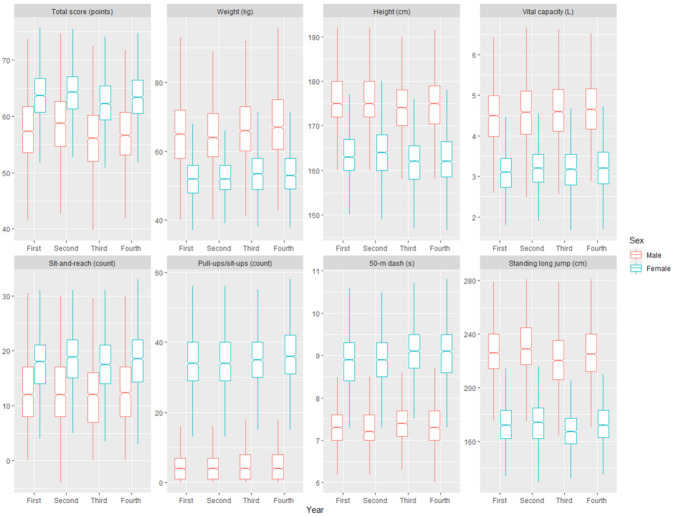
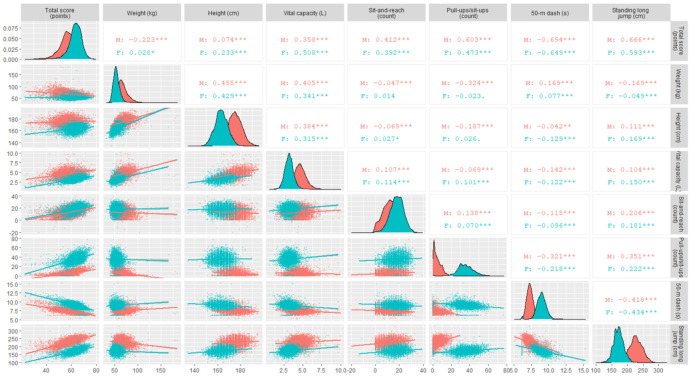
Despite releases of governmental guidelines for promoting physical fitness among the youth in China, the performance of college students in fitness tests has been declining over the past three decades. Obesity and physical inactivity have been proposed as two main causes. However, their relative importance for improving physical fitness remains unclear. To address this knowledge gap, we collected longitudinal data spanning four consecutive years on the physical fitness test for students from Nanjing University, China. Physical education classes of two hours per week were mandatory for the first two years. Using mixed effects models, we quantify the within-subject effects of weight, muscular endurance, sex, and mandatory physical education courses, among other variables, on physical fitness total score. We found that, in spite of the dominance of normal weight among the students, losing weight was positively associated with the total score, with significant sex differences in the associations. Compulsory exercise provided by physical education classes per week had strong positive impacts on the total score, comparable to losing weight of roughly 15-17 kg for males and 5-10 kg for females. Half sex difference in the total score was explained by male students' poor performance in the muscular endurance represented by pull-ups. Our results suggest that college students in China should engage in physical activity of higher levels to improve their physical fitness, with a heightened awareness of extra fat under normal weight and insufficient muscular endurance.
Keywords: institutional interventions; muscular endurance; physical fitness tests; physical inactivity; sex differences; within-subject effects.
Conflict of interest statement
The authors declare no conflict of interest.
Figures
References
-
- Research Group on Chinese School Students Physical Fitness and Health . Reports on the Physical Fitness and Health Research of Chinese School Students. Higher Education Press; Beijing, China: 2012. (In Chinese)
-
- Research Group on Chinese School Students Physical Fitness and Health . Reports on the Physical Fitness and Health Research of Chinese School Students. Higher Education Press; Beijing, China: 2016. (In Chinese)
-
- State Council of China . Suggestions on Promoting Physical Exercise and Improving the Fitness of Children and Adolescents. State Council of China; Beijing, China: 2007. (In Chinese)
-
- State Council of China . Healthy China 2030 Blueprint Guide. State Council of China; Beijing, China: 2016. (In Chinese)
-
- Wang X. Ph.D. Thesis. Jilin University; Changchun, China: 2018. A Study on the Physical Quality of Chinese College Students Population.
Publication types
MeSH terms
LinkOut - more resources
Full Text Sources
Medical
Miscellaneous
