Review
. 2020 Dec 10;21(1):326.
doi: 10.1186/s12931-020-01591-x.

Airway immunometabolites fuel Pseudomonas aeruginosa infection

Affiliations
Review

Airway immunometabolites fuel Pseudomonas aeruginosa infection

Sebastián A Riquelme et al. Respir Res. .

Abstract

Pulmonary infections are associated with a brisk inflammatory reaction to bacterial surface components. Lipopolysaccharides (LPS) trigger macrophage activation and release of mitochondrial metabolites that control the intensity of the immune response. Whereas succinate induces oxidative stress (ROS), HIF1α stabilization, glycolysis and IL-1β release, itaconate suppresses inflammation by inhibiting succinate oxidation, glycolytic flux and promoting anti-oxidant Nrf2-HO-1 functions. P. aeruginosa is a major pathogen associated with acute and chronic lung infection. Although both secreted toxins, LPS and proteases are key factors to establish acute P. aeruginosa pneumonia, lack of these components in chronic P. aeruginosa isolates suggest these organisms exploit other mechanisms to adapt and persist in the lung. Upon inhalation, P. aeruginosa strains trigger airway macrophage reprograming and bacterial variants obtained from acutely and chronically infected subjects exhibit metabolic adaptation consistent with succinate and itaconate assimilation; namely, high expression of extracellular polysaccharides (EPS), reduced lptD-LPS function, increased glyoxylate shunt (GS) activity and substantial biofilm production. In this review we discuss recent findings illustrating how P. aeruginosa induces and adapts to macrophage metabolites in the human lung, and that catabolism of succinate and itaconate contribute to their formidable abilities to tolerate oxidative stress, phagocytosis and immune clearance.

Keywords: Adaptation; Biofilm; Cystic fibrosis; Immunometabolism; Itaconate; Metabolic stress; Pneumonia; Pseudomonas aeruginosa; ROS; Succinate.


Conflict of interest statement

Authors declare no conflicts of interest exist.

Figures
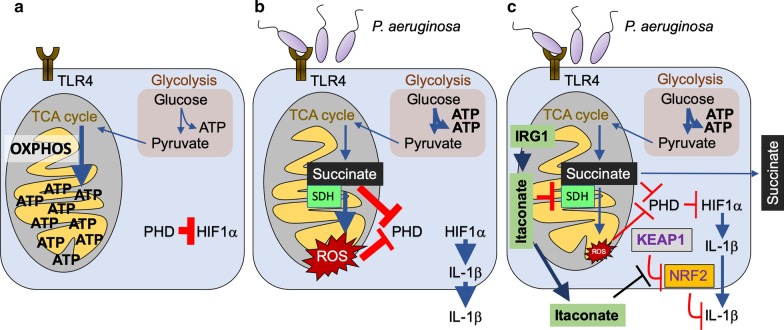
Fig. 1
Fig. 1
Immunometabolites succinate and itaconate are released during airway macrophage infection. a During homeostasis, airway macrophages employ the TCA cycle and OXPHOS to generate energy (ATP) in the mitochondria. In these conditions, the pro-inflammatory transcription factor HIF1α is inhibited in the cytoplasm by prolylhydroxylases (PHD). b Upon bacterial LPS detection by toll-like receptor 4 (TLR4), cells exhibit metabolic reprograming. Mitochondria become a major source for reactive oxygen species (ROS), which is mostly derived from succinate accumulation and its oxidation by succinate dehydrogenase (SDH). Succinate and ROS inhibits PHD, which release HIF1α to promote transcription of pro-inflammatory cytokines like IL-1β. Glycolysis becomes the major ATP source. c To avoid excessive tissue oxidation, macrophages also upregulate Immunoresponsive Gene 1 (IRG1), which synthetizes the SDH and KEAP1 inhibitor itaconate. SDH blockade induces succinate accumulation, which is excreted from the cell together with itaconate. Reduced SDH function by IRG1 regulates airway HIF1α and IL-1β activity. Itaconate is bactericidal
Fig. 2
Fig. 2
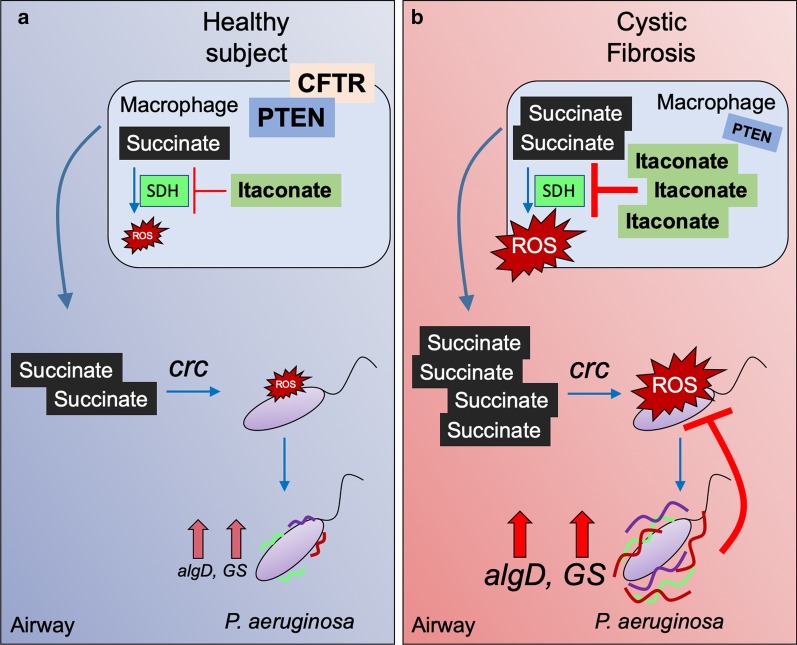
The CFTR-PTEN complex controls airway succinate accumulation and P. aeruginosa metabolic reprograming. a In healthy subjects, the CFTR-PTEN complex controls the amount of succinate released into the airway during P. aeruginosa infection. The catabolite control repressor crc locus induces succinate assimilation and its oxidation in P. aeruginosa. These succinate levels are associated neither with high oxidative stress nor selection of P. aeruginosa strains overexpressing algD or anti-oxidant glyoxylate shunt (GS) components. b In cystic fibrosis (CF) subjects, lack of the CFTR-PTEN complex compromises the oxidant response to infection promoting increased succinate release into the airway. These high succinate levels induce more crc activity, which is associated with elevated oxidative stress in P. aeruginosa. Succinate-stressed P. aeruginosa overexpresses the anti-oxidant algD and GS components, which bypasses the pro-oxidant TCA cycle to reduce internal ROS production. These strains are more protected from oxidative stress and form biofilm in response to succinate. Color lines on P. aeruginosa are extracellular polysaccharides, such as algD-mediated alginate
Fig. 3
Fig. 3
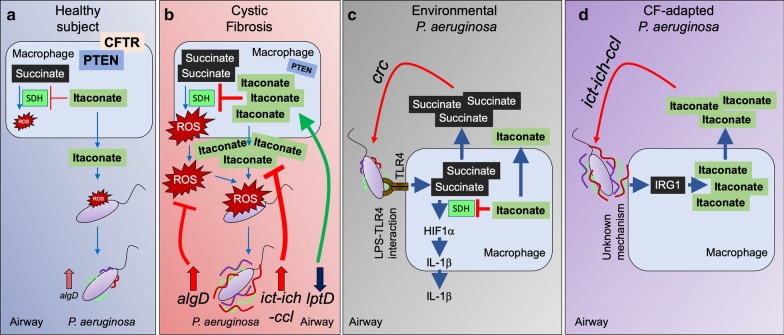
Itaconate fuels P. aeruginosa adaptive changes and chronic infection. a In healthy subjects, itaconate is produced during P. aeruginosa infection to control SDH activity, oxidative stress and inflammation. This itaconate levels are tolerated by P. aeruginosa during acute infection. b In CF individuals lacking CFTR-PTEN complex activity, elevated succinate oxidation induces synthesis and release of the anti-oxidant molecule itaconate as a compensatory mechanism. Airway itaconate induces P. aeruginosa outer membrane stress, which induces ict-ich-ccl locus overexpression to degrade itaconate. Itaconate also induces downregulation of lptD, which suppresses surface exposure of LPS. Lack of surface-exposed endotoxin causes bacterial membrane deregulation and permeability, which is compensated by activation of the algT-algD membrane stress response to produce more protective alginate. Through an unknown mechanism, alginate induces more itaconate release by host macrophages, which fuels biofilm production, adaptation and long-term infection. c Environmental P. aeruginosa strains expressing LPS induce the TLR4-succinate-HIF1α-IL-1β axis, inducing release of succinate and regulatory itaconate. Succinate released fuels P. aeruginosa infection through the crc locus during acute infection. d Host-adapted P. aeruginosa isolates, which lack surface LPS and overproduce alginate, induce IRG1 expression and high itaconate production in macrophages. IRG1 induction is mediated by alginate. Itaconate released fuels host-adapted P. aeruginosa through the ict-ich-ccl locus activity. Color lines on P. aeruginosa are extracellular polysaccharides, such as algD-mediated alginate

References

    1. Riquelme SA, Ahn D, Prince A. Pseudomonas aeruginosa and Klebsiella pneumoniae adaptation to innate immune clearance mechanisms in the lung. J Innate Immun. 2018;10:442–454. doi: 10.1159/000487515. - DOI - PMC - PubMed
    1. Riquelme SA, Wong Fok Lung T, Prince A. Pulmonary pathogens adapt to immune signaling metabolites in the airway. Front Immunol. 2020;11:385. doi: 10.3389/fimmu.2020.00385. - DOI - PMC - PubMed
    1. Fernandez-Barat L, Ferrer M, De Rosa F, Gabarrus A, Esperatti M, Terraneo S, Rinaudo M, Li Bassi G, Torres A. Intensive care unit-acquired pneumonia due to Pseudomonas aeruginosa with and without multidrug resistance. J Infect. 2017;74:142–152. doi: 10.1016/j.jinf.2016.11.008. - DOI - PubMed
    1. Hu Y, Ping Y, Li L, Xu H, Yan X, Dai H. A retrospective study of risk factors for carbapenem-resistant Klebsiella pneumoniae acquisition among ICU patients. J Infect Dev Ctries. 2016;10:208–213. doi: 10.3855/jidc.6697. - DOI - PubMed
    1. Bauer PR, Sampathkumar P. Methicillin-resistant Staphylococcus aureus infection in ICU: what is the best prevention strategy? Crit Care Med. 2017;45:1413–1414. doi: 10.1097/CCM.0000000000002516. - DOI - PubMed

MeSH terms

Substances

LinkOut - more resources