Prevalence and Molecular Epidemiology of Extended-Spectrum-β-Lactamase (ESBL)-Producing Escherichia coli From Multiple Sectors of the Swine Industry in Korea: A Korean Nationwide Monitoring Program for a One Health Approach to Combat Antimicrobial Resistance
- PMID: 33303713
- PMCID: PMC7748096
- DOI: 10.3343/alm.2021.41.3.285
Prevalence and Molecular Epidemiology of Extended-Spectrum-β-Lactamase (ESBL)-Producing Escherichia coli From Multiple Sectors of the Swine Industry in Korea: A Korean Nationwide Monitoring Program for a One Health Approach to Combat Antimicrobial Resistance
Abstract
Background: One health is a flexible concept with many facets, including the environment, community, and the nosocomial super-bacteria resistance network. We investigated the molecular prevalence of extended-spectrum-β-lactamase-producing Escherichia coli (ESBL-EC) in workers, livestock, and the farm environment in Korea.
Methods: ESBL-EC isolates were obtained from samples from 19 swine farms, 35 retail stores, seven slaughterhouses, and 45 related workers throughout Korea from August 2017 to July 2018, using ChromID ESBL (BioMérieux, Marcy l'Etoile, France) agar and enrichment broth. The presence of ESBL and mobilized colistin resistance (mcr) genes and antimicrobial resistance were determined. Clonality was evaluated with pulsed-field gel electrophoresis (PFGE) and multilocus sequence typing (MLST).
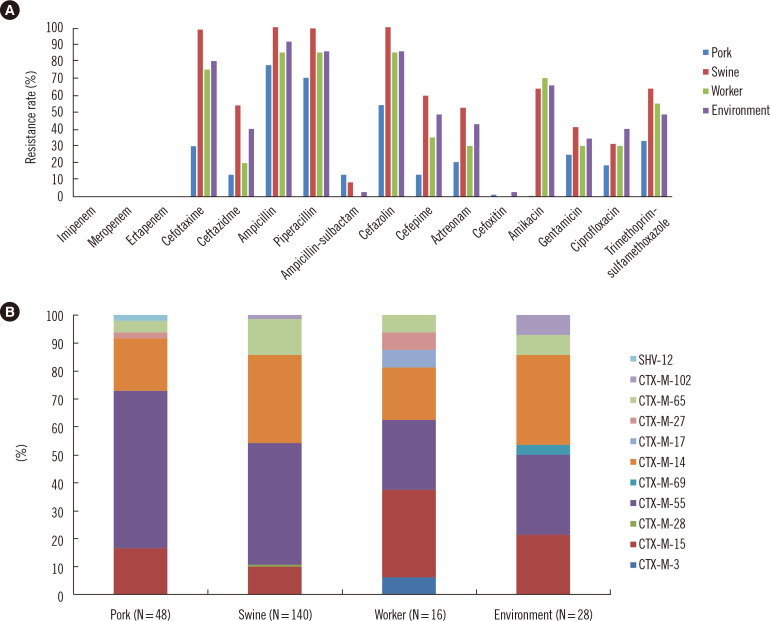
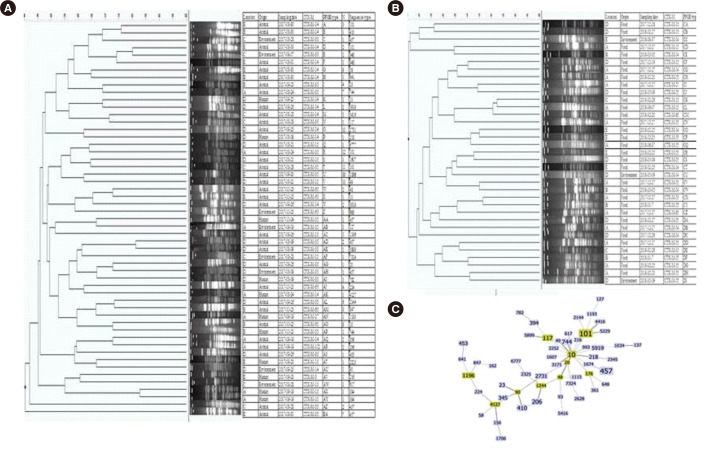
Results: In total, 232 ESBL-EC isolates were obtained from 1,614 non-duplicated samples (14.4% positive rate). The ESBL-EC isolates showed regional and source-related differences. blaCTX-M-55 (N=100), blaCTX-M-14 (N=65), blaCTX-M-15 (N=33), and blaCTX-M-65 (N=23) were common ESBL types. The ESBL-EC isolates showed high resistance rates for various antimicrobial classes; however, all isolates were susceptible to carbapenem. One swine-originating colistin-resistant isolate did not carry any known mcr gene. PFGE was successful for 197 of the 232 isolates, and most PFGE types were heterogeneous, except for some dominant PFGE types (O, R, T, U, and V). MLST of 88 isolates was performed for representative PFGE types; however, no dominant sequence type was observed.
Conclusions: The proportion of ESBL-EC in swine industry-related samples was significant, and the isolates harbored common clinical ESBL gene types. These molecular epidemiologic data could provide important evidence for antimicrobial-resistance control through a one health approach.
Keywords: Antimicrobial resistance; Escherichia coli; Extended-spectrum-β-lactamase; Mobilized colistin resistance; One health; Swine.
Conflict of interest statement
No potential conflicts of interest relevant to this paper were reported.
Figures
References
-
- CLSI. CLSI M100. 27th ed. Clinical and Laboratory Standards Institute; Wayne, PA: 2017. Performance standards for antimicrobial susceptibility testing.
-
- Ryoo NH, Kim E-C, Hong SG, Park YJ, Lee K, Bae IK, et al. Dissemination of SHV-12 and CTX-M-type extended-spectrum β-lactamases among clinical isolates of Escherichia coli and Klebsiella pneumoniae and emergence of GES-3 in Korea. J Antimicrob Chemother. 2005;56:698–702. doi: 10.1093/jac/dki324. - DOI - PubMed
MeSH terms
Substances
LinkOut - more resources
Full Text Sources
Other Literature Sources
Medical