. 2020 Dec 10;10(1):21706.
doi: 10.1038/s41598-020-78730-3.

Comparison of the amniotic fluid and fetal urine peptidome for biomarker discovery in renal developmental disease

Affiliations

Comparison of the amniotic fluid and fetal urine peptidome for biomarker discovery in renal developmental disease

Camille Fédou et al. Sci Rep. .

Abstract

Production of amniotic fluid (AF) is view as predominately driven by excretion of fetal urine (FU). However, the origin of AF peptides, often considered as potential biomarkers of developmental diseases, has never been investigated. Here, we evaluated the FU origin of AF peptides and if the AF peptide content can be used as a surrogate of FU. The abundance of endogenous peptides was analyzed by capillary electrophoresis coupled to mass spectrometry in 216 AF and 64 FU samples. A total of 2668 and 3257 peptides was found in AF and FU respectively. The AF peptidome largely overlapped with the FU peptidome, ranging from 54% in the second pregnancy trimester to 65% in the third trimester. Examination of a subset of 16 paired AF and FU samples revealed that 67 peptides displayed a significant positively correlated abundance in AF and FU, strongly suggesting that their presence in AF was directly associated to FU excretion. As proof-of-concept we showed that measuring the AF abundance of these 67 peptides of FU origin allowed prediction of postnatal renal survival in fetuses with posterior urethral valves. These results demonstrate that the AF peptidome can be considered as a good surrogate of the FU peptidome.


Conflict of interest statement

I. Golovko, P. Magalhães and P. Zürbig and are employed by Mosaiques Diagnostics GmbH. The other authors declare no competing interests.

Figures
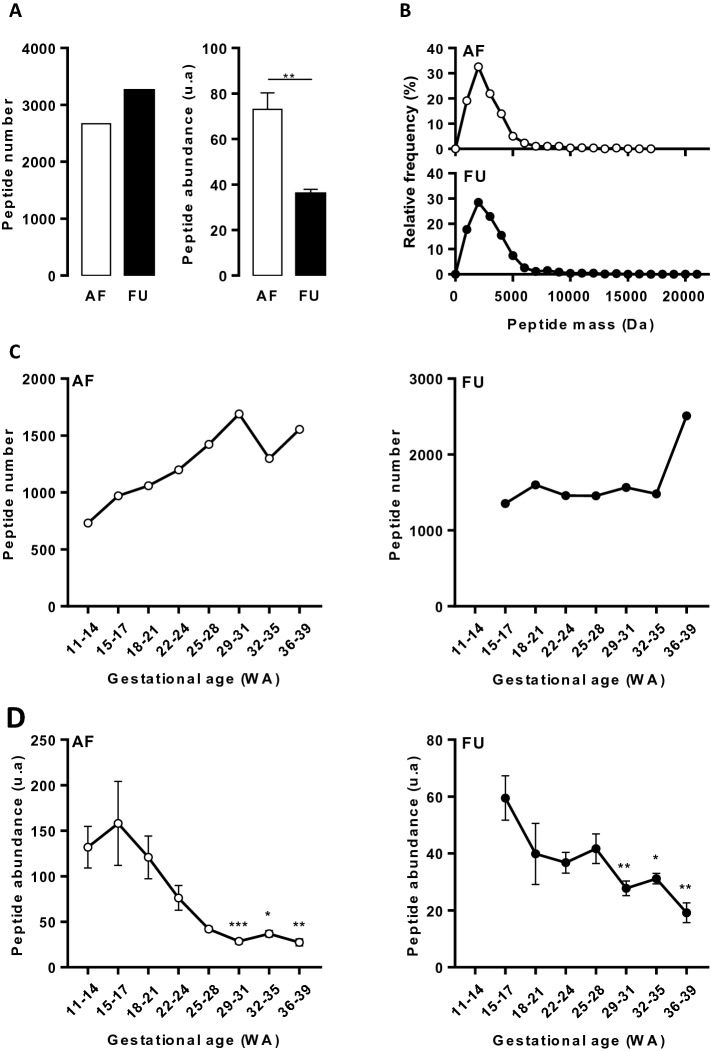
Figure 1
Figure 1
Amniotic fluid and fetal urine peptidome and evolution with gestational age. (A) Number and abundance of peptides in amniotic fluid (AF) and fetal urine (FU) irrespective of gestational age. (B) Weight distribution of peptides present in AF and FU. The mean and the median were respectively 2945 Da and 2425 Da for AF peptidome and 3110 Da and 2647 Da for FU peptidome. (C) Gestational age evolution of peptide number in AF (left panel) and FU (right panel). (D) Gestational age evolution of peptide abundance in AF (left panel) and FU (right panel). Data are means ± SEM. *p < 0.05, **p < 0.01, ***p < 0.001 versus 11–14 WA (AF) or 15–17 WA (FU), according to Mann–Whitney test (A) or One-way Anova (D).
Figure 2
Figure 2
Overlap in the amniotic fluid and fetal urine peptidome. (A) Overlapping peptides in both amniotic fluid (AF) and fetal urine (FU), irrespective of gestational age. The total number of peptides identified is indicated in parentheses. (B) Protein origin of common peptides. (C) Gestational age evolution in the number of overlapping peptides (left) and percentage represented in the AF peptide content (right). (D) Gestational age evolution in the abundance in AF of overlapping peptides (left) and its percentage represented in the AF peptide abundance (right).
Figure 3
Figure 3
Analysis of matched amniotic fluid and fetal urine samples. (A) Correlation of the average abundance in AF of all, collagen, collagen alpha-1(I) and non-collagen overlapping peptides with their average abundance in FU irrespective of gestational age. r, Spearman correlation coefficient. (B) Number of common peptides whose abundance is correlated in matched amniotic fluid (AF) and fetal urine (FU) from a subset of 16 fetuses. The total number of peptides in the overlap is indicated in parentheses. (C) Correlation between abundance of 4 representative overlapping peptides. r, Spearman correlation coefficient. 18627, fragment of collagen alpha-1(I) chain; 5116, fragment of collagen alpha-1(I) chain; 48151 and 28320, non-sequenced peptides. Coll, collagen.
Figure 4
Figure 4
Potential of amniotic peptides for the prediction of renal survival in PUV fetuses. (A) Scatter dot plots showing AF7cPUV and (FU)12PUV classifier-based scores in 16 PUV patients from the validation cohort. The dotted horizontal line indicates the cutoff score (0 for both AF7cPUV and (FU)12PUV). A score > cutoff suggested early development of ESRD whereas a score < cutoff predicted fetus in the noESRD group. Data are means ± SEM. ***p < 0.001 versus noESRD according to Mann–Whitney test. (B) Compared ROC curves of AF7cPUV and (FU)12PUV. Brackets indicated confidence intervals for AUC. (C) Correlation between AF7cPUV and (FU)12PUV based scores.

References

    1. Good DM, et al. Naturally occurring human urinary peptides for use in diagnosis of chronic kidney disease. Mol. Cell. Proteom. MCP. 2010;9:2424–2437. doi: 10.1074/mcp.M110.001917. - DOI - PMC - PubMed
    1. Klein J, Bascands JL, Mischak H, Schanstra JP. The role of urinary peptidomics in kidney disease research. Kidney Int. 2016;89:539–545. doi: 10.1016/j.kint.2015.10.010. - DOI - PubMed
    1. Metzger J, et al. Urinary excretion of twenty peptides forms an early and accurate diagnostic pattern of acute kidney injury. Kidney Int. 2010;78:1252–1262. doi: 10.1038/ki.2010.322. - DOI - PubMed
    1. Schanstra JP, Mischak H. Proteomic urinary biomarker approach in renal disease: from discovery to implementation. Pediatr. Nephrol. 2015;30:713–725. doi: 10.1007/s00467-014-2790-y. - DOI - PubMed
    1. Brown CE, et al. Urinary proteomic biomarkers to predict cardiovascular events. Proteom. Clin. Appl. 2015;9:610–617. doi: 10.1002/prca.201400195. - DOI - PubMed

Publication types
