


Local Tranexamic Acid for Local Hemostasis in an Animal Liver Injury Model
- PMID: 33304069
- PMCID: PMC7717464
- DOI: 10.4103/JETS.JETS_17_19
Local Tranexamic Acid for Local Hemostasis in an Animal Liver Injury Model
Abstract
Background: Hyperfibrinolysis is a state of increased clot resolution often seen in trauma patients with ongoing hemorrhage. Tranexamic acid (TXA) inhibits fibrinolysis preventing clot resolution affecting hemorrhage continuation and is used by intravenous administration.
Aims: The purpose of this study was to evaluate the local tranexamic acid application for hemostatic control in an experimental animal liver injury model.
Settings and design: This study was an experimental prospective treatment study to check the local TXA effects on liver injury. This study was approved by the Ethics Committee.
Materials and methods: Twenty adult male Sprague-Dawley white rats were equally randomized to two groups after a standardized liver injury was conducted under anesthesia. One group were "liver-packed" with gauze (TXA [-]) and the other group with gauze soaked in TXA (TXA [+]). Bleeding from the injured middle liver lobe was measured at 2 and 15 min, and at 48h second-look surgery, with euthanasia conducted at 14 days. The liver was sent for histopathological and stereological analysis.
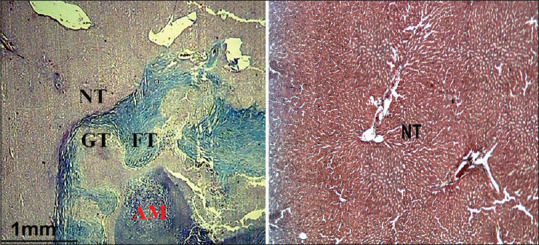
Statistical analysis and results: There was no difference in bleeding at 2 or 15 min after packing; however, larger amount of free blood at 48 h in the TXA (-) group was noticed. Five animals in the TXA (-) were alive at 14 days compared to eight animals in the TXA (+) group. Significantly larger volume density of fibrosis, granulation tissue, and amorphous tissue were seen in the TXA (+) group compared to the TXA (-) group at the stereological analysis.
Conclusion: Local TXA application on the injured liver surface might offer better hemostatic control than packing alone. Further studies are mandated before the clinical application of our findings.
Keywords: Liver injury; local hemostasis; tranexamic acid.
Copyright: © 2020 Journal of Emergencies, Trauma, and Shock.
Conflict of interest statement
There are no conflicts of interest.
Figures
References
-
- Sauaia A, Moore FA, Moore EE, Moser KS, Brennan R, Read RA, et al. Epidemiology of trauma deaths: A reassessment. J Trauma. 1995;38:185–93. - PubMed
-
- Teixeira PG, Inaba K, Hadjizacharia P, Brown C, Salim A, Rhee P, et al. Preventable or potentially preventable mortality at a mature trauma center. J Trauma. 2007;63:1338–46. - PubMed
-
- Marsden M, Carden R, Navaratne L, Smith IM, Penn-Barwell JG, Kraven LM, et al. Outcomes following trauma laparotomy for hypotensive trauma patients: A UK military and civilian perspective. J Trauma Acute Care Surg. 2018;85:620–5. - PubMed
LinkOut - more resources
Full Text Sources