


Long-term impact of a school-based nutrition intervention on home nutrition environment and family fruit and vegetable intake: A two-year follow-up study
- PMID: 33304772
- PMCID: PMC7710647
- DOI: 10.1016/j.pmedr.2020.101247
Long-term impact of a school-based nutrition intervention on home nutrition environment and family fruit and vegetable intake: A two-year follow-up study
Abstract
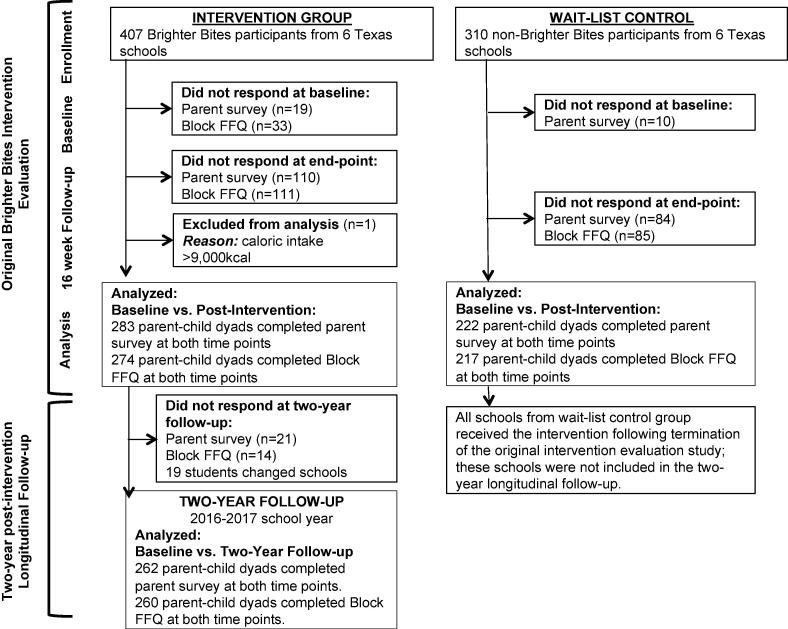
Long-term data on maintenance of intervention effects of health promotion programs targeting fruit and vegetable (F&V) intake in children is lacking. We conducted a two-year follow-up of Brighter Bites, a school-based nutrition education and food co-op intervention found to be effective in increasing child intake of F&V. A one-group, pre-post evaluation design was used to assess the two-year post intervention impact of the program on child and parent dietary intake and home nutrition environment. In 2016-2017 school year, we conducted a follow up of 262 parent-child dyads who had previously participated in Brighter Bites in a 2013-2015 evaluation study in six low-income Texas elementary schools. Child dietary intake was measured using a parent-reported food frequency questionnaire, and surveys measured parent F&V intake, and home nutrition environment. Results of a multi-level regression analysis showed that, two years post-intervention, as compared to baseline, there was a significant increase in child intake of fruit, vegetable, and fiber, and significant decreases in total fat intake and percent daily calories from sugary beverages (p < 0.05). Parent dietary data showed significant increases in fruit intake, and intake of F&V combined (p < 0.05). Changes in home nutrition environment included: increased frequency of cooking behaviors, increased usage of nutrition facts labels in making grocery purchasing decisions, and increased food availability of F&V (p < 0.05). This study demonstrates potential long-term sustained impact of a comprehensive school-based intervention among low-income children and their families.
Keywords: Dietary behavior; Fruit and vegetable intake; Low-income populations; School-based intervention; Sustained impact.
© 2020 The Authors.
Conflict of interest statement
Dr. Sharma is on the Board of Directors of Brighter Bites nonprofit organization, the goal of which is to improve access to fresh fruits and vegetables and nutrition education among underserved communities. This is an unpaid, advisory board position. The other authors have no conflicts of interest relevant to this article to disclose.
Figures
References
-
- US Department of Health and Human Services and U.S. Department of Agriculture. 2015-2020 dietary guidelines for Americans. 8th ed. Skyhorse Publishing Inc.; 2015. http://health.gov/dietaryguidelines/2015/guidelines/.
-
- Ogden, C.L., Lamb, M.M., Carroll, M.D., Flegal, K.M., 2010. Obesity and socioeconomic status in children and adolescents: United states, 2005-2008. NCHS data brief. Number 51. National Center for Health Statistics. - PubMed
-
- World Health Organization. Global strategy on diet, physical activity, and health: promoting fruit and vegetable consumption around the world. http://www.who.int/dietphysicalactivity/fruit/en/. Updated 2013. Accessed 09/17, 2013.
-
- Zarnowiecki D.M., Dollman J., Parletta N. Associations between predictors of children's dietary intake and socioeconomic position: a systematic review of the literature. Obes. Rev. 2014;15(5):375–391. - PubMed
LinkOut - more resources
Full Text Sources
Miscellaneous
