


Homogenous and Heterogenous Prognostic Factors for Patients with Bone Sarcoma
- PMID: 33305494
- PMCID: PMC7862145
- DOI: 10.1111/os.12851
Homogenous and Heterogenous Prognostic Factors for Patients with Bone Sarcoma
Abstract
Objective: The aim of this study was to examine the survival rate of patients with different bone sarcomas and to investigate homogenous and heterogenous prognostic factors for different types of bone sarcomas.
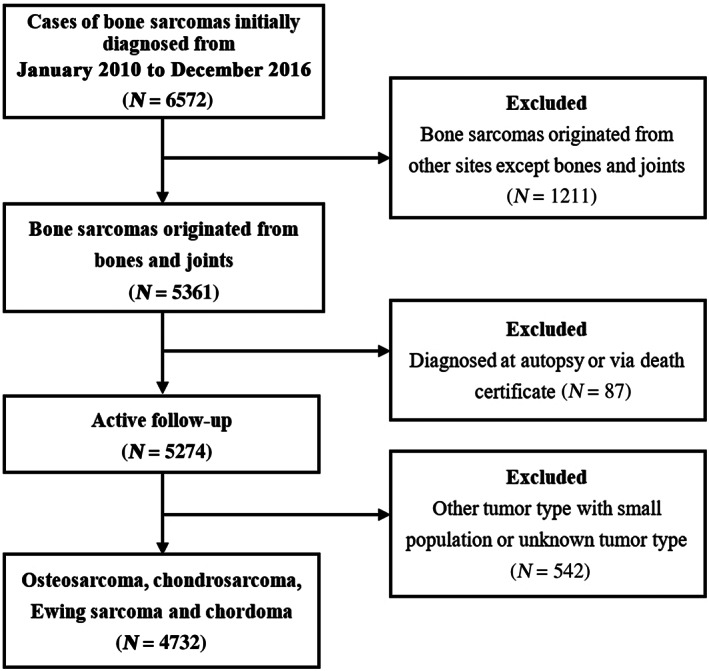
Methods: This is a retrospective analysis of records from the Surveillance, Epidemiology, and End Result (SEER) database. Clear information on the distant metastasis of cancer is provided in the SEER database for patients diagnosed between January 2010 and December 2016. Data for the four types of malignant bone sarcomas were extracted, including osteosarcoma, chondrosarcoma, Ewing sarcoma, and chordoma. Patients with bone sarcomas originated from other sites, diagnosed at autopsy, or indicated in death certification were excluded. The overall survival was calculated for the entire cohort and across different bone sarcomas using the Kaplan-Meier method. A subgroup analysis of the different survival rates of four types of bone sarcomas in various levels of each variable was conducted and the differences were tested with the log-rank test. Cox proportional hazard regression analysis was performed to determine the prognostic factors. Variables with P < 0.05 in the univariate Cox regression analysis were further analyzed using a multivariate Cox regression analysis. The prognostic factors in four groups of bone sarcomas were compared to determine the homogenous and heterogenous factors.
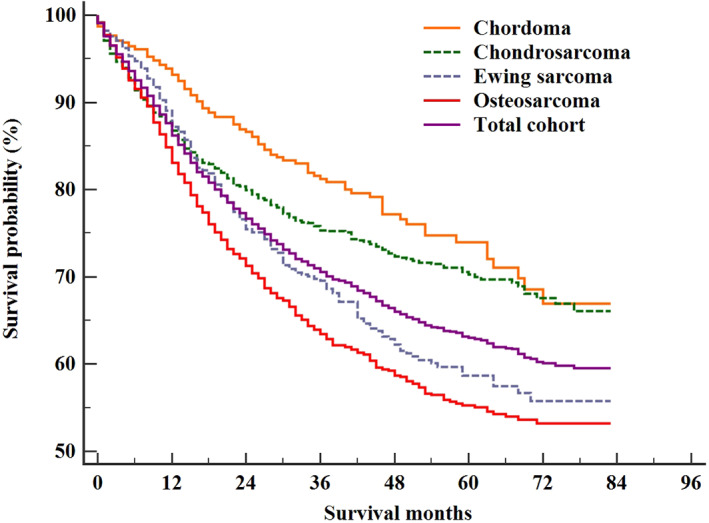
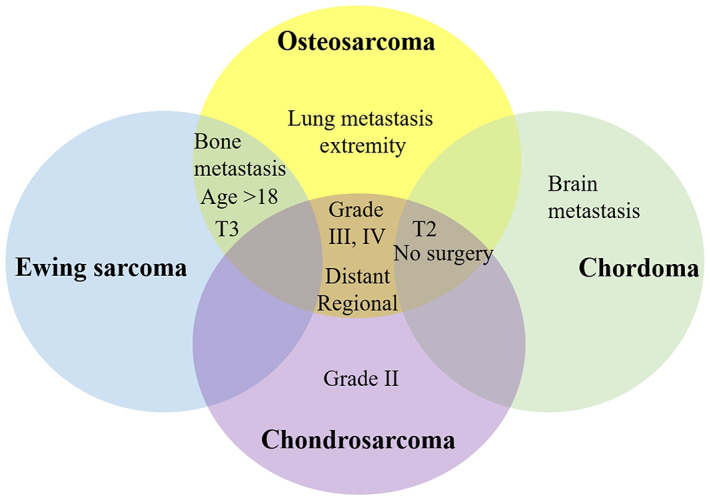
Results: A total of 4732 patients were included with a follow up of 25 (0-83) months. The mean age of patients was 39.7 ± 24.1 years. The 1-year, 3-year, and 5-year overall survival rate for the entire cohort was 86.2% (95% confidence interval [CI]: 85.2%-87.2%), 70.5% (95% CI: 68.9%-72.1%), and 63.0% (95% CI: 61.2%-64.8%), respectively. Factors including age older than 40 years, higher grade, regional and distant stage, tumor in the extremities, T2 stage, bone and lung metastases, and non-surgery were significantly associated with the poor survival of the entire cohort. The mean overall survival duration of patients with chordoma, chondrosarcoma, Ewing sarcoma, and osteosarcoma was 66.86 (95% CI: 64.06-69.66), 63.53 (95% CI: 61.81-65.25), 58.06 (95% CI: 55.49-60.62) and 54.91 (95% CI: 53.14-56.69) months, respectively. Compared with chordoma, the hazard ratio (HR) and 95% CI for patients with chondrosarcoma, Ewing sarcoma, and osteosarcoma were 1.30 (95% CI: 1.04-1.62; P = 0.023), 1.69 (95% CI: 1.33-2.14; P < 0.001), and 2.00 (95% CI: 1.61-2.48; P <0.001), respectively. Different bone sarcomas showed homogenous and heterogenous prognostic factors.
Conclusion: Different clinicopathological characteristics and prognoses were revealed in patients with osteosarcoma, chondrosarcoma, Ewing sarcoma, and chordoma. The risk factors can potentially guide prognostic prediction and sarcoma-specific treatment.
Keywords: Chondrosarcoma; Chordoma; Ewing sarcoma; Osteosarcoma; Prognosis.
© 2020 The Authors. Orthopaedic Surgery published by Chinese Orthopaedic Association and John Wiley & Sons Australia, Ltd.
Figures

References
-
- Mohammed KA, Hinyard L, Schoen MW, et al Description of venous thromboembolism in hospitalized patients with metastatic cancer: a national sample. J Natl Compr Canc Netw, 2018, 16: 136–143. - PubMed
-
- Worch J, Ranft A, DuBois SG, Paulussen M, Juergens H, Dirksen U. Age dependency of primary tumor sites and metastases in patients with Ewing sarcoma. Pediatr Blood Cancer, 2018, 65: e27251. - PubMed
-
- Bakker SH, Jacobs W, Pondaag W, et al Chordoma: a systematic review of the epidemiology and clinical prognostic factors predicting progression‐free and overall survival. Eur Spine J, 2018, 27: 3043–3058. - PubMed
MeSH terms
Grants and funding
LinkOut - more resources
Full Text Sources
Medical
