A novel TBX5 mutation predisposes to familial cardiac septal defects and atrial fibrillation as well as bicuspid aortic valve
- PMID: 33306779
- PMCID: PMC7783509
- DOI: 10.1590/1678-4685-GMB-2020-0142
A novel TBX5 mutation predisposes to familial cardiac septal defects and atrial fibrillation as well as bicuspid aortic valve
Abstract
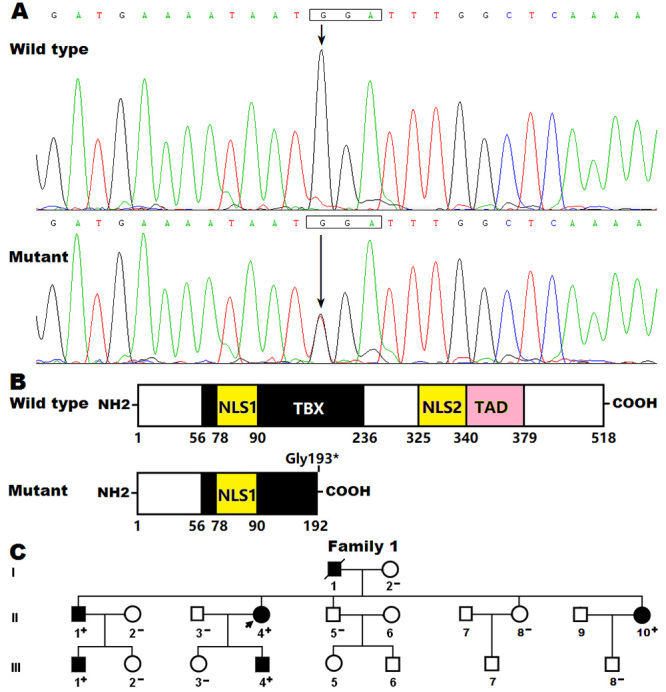
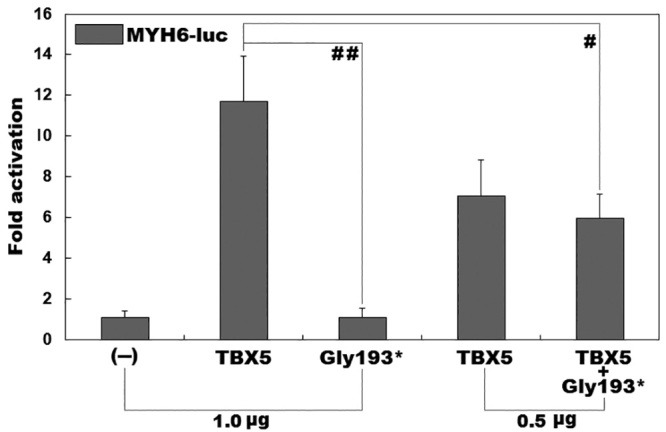
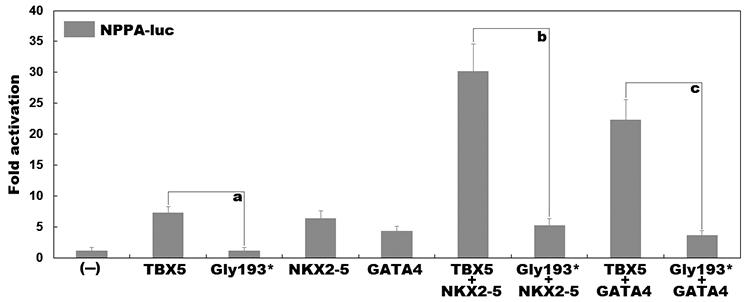
TBX5 has been linked to Holt-Oram syndrome, with congenital heart defect (CHD) and atrial fibrillation (AF) being two major cardiac phenotypes. However, the prevalence of a TBX5 variation in patients with CHD and AF remains obscure. In this research, by sequencing analysis of TBX5 in 178 index patients with both CHD and AF, a novel heterozygous variation, NM_000192.3: c.577G>T; p.(Gly193*), was identified in one index patient with CHD and AF as well as bicuspid aortic valve (BAV), with an allele frequency of approximately 0.28%. Genetic analysis of the proband's pedigree showed that the variation co-segregated with the diseases. The pathogenic variation was not detected in 292 unrelated healthy subjects. Functional analysis by using a dual-luciferase reporter assay system showed that the Gly193*-mutant TBX5 protein failed to transcriptionally activate its target genes MYH6 and NPPA. Moreover, the mutation nullified the synergistic transactivation between TBX5 and GATA4 as well as NKX2-5. Additionally, whole-exome sequencing analysis showed no other genes contributing to the diseases. This investigation firstly links a pathogenic variant in the TBX5 gene to familial CHD and AF as well as BAV, suggesting that CHD and AF as well as BAV share a common developmental basis in a subset of patients.
Conflict of interest statement
Figures
References
-
- Abassi H, Gavotto A, Picot MC, Bertet H, Matecki S, Guillaumont S, Moniotte S, Auquier P, Moreau J, Amedro P. Impaired pulmonary function and its association with clinical outcomes, exercise capacity and quality of life in children with congenital heart disease. Int J Cardiol. 2019;285:86–92. - PubMed
-
- Al-Qattan MM, Abou Al-Shaar H. Molecular basis of the clinical features of Holt-Oram syndrome resulting from missense and extended protein mutations of the TBX5 gene as well as TBX5 intragenic duplications. Gene. 2015;560:129–136. - PubMed
-
- Alankarage D, Ip E, Szot JO, Munro J, Blue GM, Harrison K, Cuny H, Enriquez A, Troup M, Humphreys DT, et al. Identification of clinically actionable variants from genome sequencing of families with congenital heart disease. Genet Med. 2019;21:1111–1120. - PubMed
-
- Amedro P, Bajolle F, Bertet H, Cheurfi R, Lasne D, Nogue E, Auquier P, Picot MC, Bonnet D. Quality of life in children participating in a non-selective INR self-monitoring VKA-education programme. Arch Cardiovasc Dis. 2018;111:180–188. - PubMed
-
- Amedro P, Gavotto A, Legendre A, Lavastre K, Bredy C, De La Villeon G, Matecki S, Vandenberghe D, Ladeveze M, Bajolle F, et al. Impact of a centre and home-based cardiac rehabilitation program on the quality of life of teenagers and young adults with congenital heart disease: The QUALI-REHAB study rationale, design and methods. Int J Cardiol. 2019;283:112–118. - PubMed
Internet Resources
-
- The 1000 Genomes Project database. [May 6, 2020]. The 1000 Genomes Project database, http://www.1000genomes.org.
-
- The Genome Aggregation Database. [May 6, 2020]. The Genome Aggregation Database, https://gnomad.broadinstitute.org.
-
- The Single Nucleotide Polymorphism database. [May 6, 2020]. The Single Nucleotide Polymorphism database, http://www.ncbi.nlm.nih.gov/snp.
LinkOut - more resources
Full Text Sources