. 2020 Dec 14;21(Suppl 17):527.
doi: 10.1186/s12859-020-03872-0.

In silico trial to test COVID-19 candidate vaccines: a case study with UISS platform

Affiliations

In silico trial to test COVID-19 candidate vaccines: a case study with UISS platform

Giulia Russo et al. BMC Bioinformatics. .

Abstract

Background: SARS-CoV-2 is a severe respiratory infection that infects humans. Its outburst entitled it as a pandemic emergence. To get a grip on this outbreak, specific preventive and therapeutic interventions are urgently needed. It must be said that, until now, there are no existing vaccines for coronaviruses. To promptly and rapidly respond to pandemic events, the application of in silico trials can be used for designing and testing medicines against SARS-CoV-2 and speed-up the vaccine discovery pipeline, predicting any therapeutic failure and minimizing undesired effects.

Results: We present an in silico platform that showed to be in very good agreement with the latest literature in predicting SARS-CoV-2 dynamics and related immune system host response. Moreover, it has been used to predict the outcome of one of the latest suggested approach to design an effective vaccine, based on monoclonal antibody. Universal Immune System Simulator (UISS) in silico platform is potentially ready to be used as an in silico trial platform to predict the outcome of vaccination strategy against SARS-CoV-2.

Conclusions: In silico trials are showing to be powerful weapons in predicting immune responses of potential candidate vaccines. Here, UISS has been extended to be used as an in silico trial platform to speed-up and drive the discovery pipeline of vaccine against SARS-CoV-2.

Keywords: Agent-based model; Human monoclonal antibodies; In silico trials; SARS-CoV-2; Vaccines.


Conflict of interest statement

The authors declare that they have no competing interests.

Figures
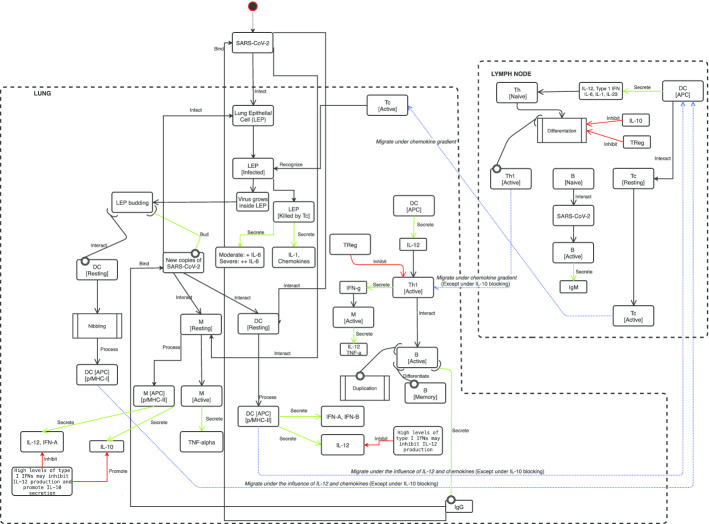
Fig. 1
Fig. 1
SARS-CoV-2 disease model implemented in UISS. Main compartments (lung, and lymph-nodes) are delimited with dashed lines. Peripheral blood compartment is seen as connecting duct, not explicitly represented. The starting point is the SARS-CoV-2 droplets entrance in the upper respiratory tract (not shown). Then, all the main infection dynamics is described. The immune system cascade is shown as it was implemented, based on the latest research results published in specialized literature. For each entity, the localization (i.e., the biological compartment in which the entities are present) and the status (i.e., the differentiation states that an entity can own) are defined. The results of the immune system mounting process is the killing of the infected lung epithelial cells by the cytotoxic T lymphocyte and the local release of both chemokine factors and cytokines. At the humoral level, specific IgM (first) and IgG (after) directed against SARS-CoV-2 virus are released by plasma B cells. Regulatory system is also involved in the process. If the immune system machinery works correctly, regulatory arm shutdowns excessive cytokines storm, avoiding the severe prognosis of COVID-19. All entities are allowed to move with a uniform probability between neighboring lattices in the grid with an equal diffusion coefficient (Brownian motion). If a chemokines gradient is present, then to mimic short-range chemotaxis effects, higher probabilities of being chosen are given to sites containing chemokines
Fig. 2
Fig. 2
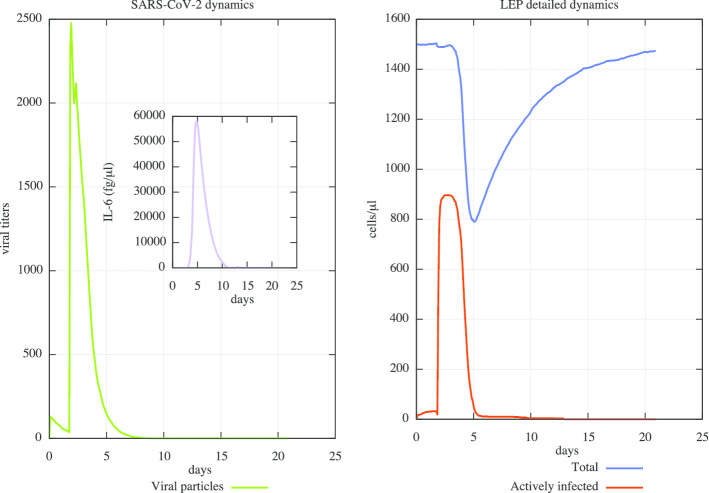
In silico SARS-CoV-2 viral dynamics and related CPE in a mild to moderate “mean in silico patient” scenario. In the left panel, one can observe the mild digital patient case in which a virus challenge dose of 0.1 multiplicity of infection (MOI) was administered at day 0 (green line). Peak viral titers are reached by 48 h post-inoculation. IL-6 dynamics and its related plasma levels (fg/μL) are also shown in the inner panel (purple line). In the right one, the dynamics of CPE on the lung infected cells is measured: they started at day 3.5 and peak around day 5. After 21 days, the simulated digital patient almost recovers from the infection. One can notice how UISS is capable to simulate, accordingly to the recent literature, the early viral clearance by day 10 post-onset in mild cases
Fig. 3
Fig. 3
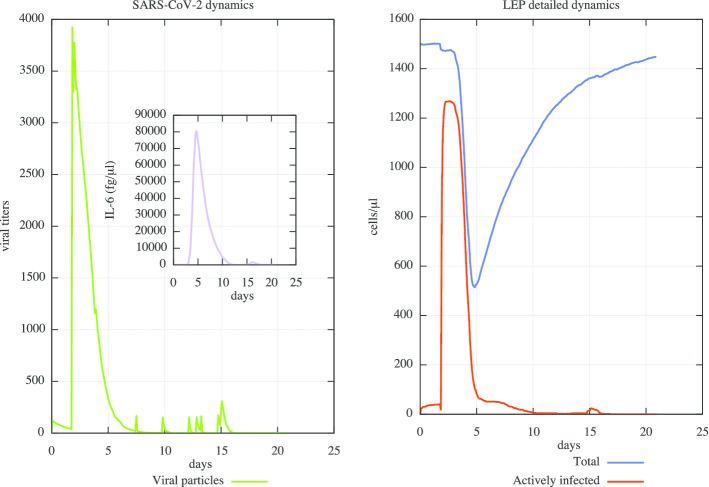
In silico SARS-CoV-2 viral dynamics and related CPE in a “mean in silico patient” severe scenario. In the left panel, one can observe the severe digital patient case in which a virus challenge dose of 0.1 multiplicity of infection (MOI) was administered at day 0 (green line). Peak viral titers are reached by 48 h post-inoculation. In addition, it is wort to note that virus persists after day 10, until day 15, and its complete clearance is around day 19. In the inner panel (purple line), IL-6 dynamics and its related plasma levels (fg/μL) are shown. IL-6 dynamics shows a much more prominent peak of values. This is in very good agreement with latest literature data, as explained within the manuscript. In the right panel, the dynamics of CPE on the lung infected cells is measured: in this case, CPE are much more severe and the recover from infection is clearly delayed. UISS is capable to simulate, accordingly to the recent literature, how the severe cases tend to have a higher viral load both at the beginning and later on
Fig. 4
Fig. 4
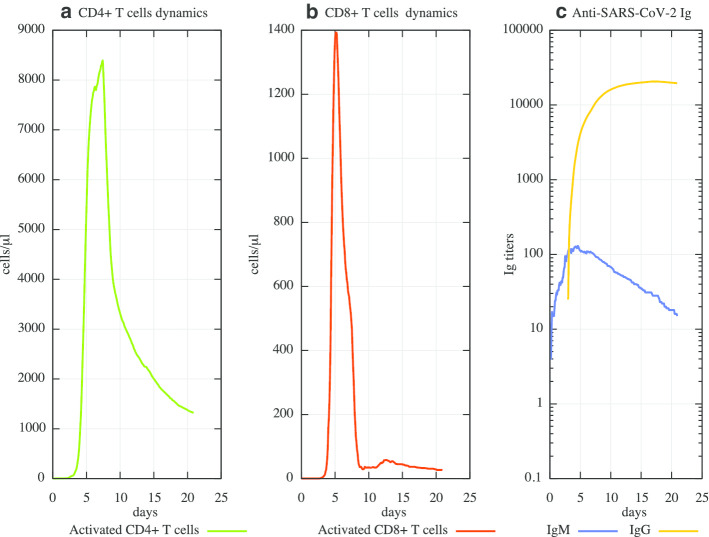
Cellular and humoral response mounted by the host immune system against SARS-CoV-2. Panel A shows the dynamics of CD4 + T cells, subtype 1 (Th1). Th1 are primed by dendritic cells that present the viral particles complexed with MHC-II of the host. Th1 cells help the activation of B cells, eventually favoring their iso-type switching to IgG producing plasma cell. B cells dynamics is depicted in panel B. Antigen activated B cells initially releases IgM; then, after interacting with Th1 and their released pro-inflammatory cytokines, they start to release specific IgG directed against SARS-CoV-2 virus
Fig. 5
Fig. 5
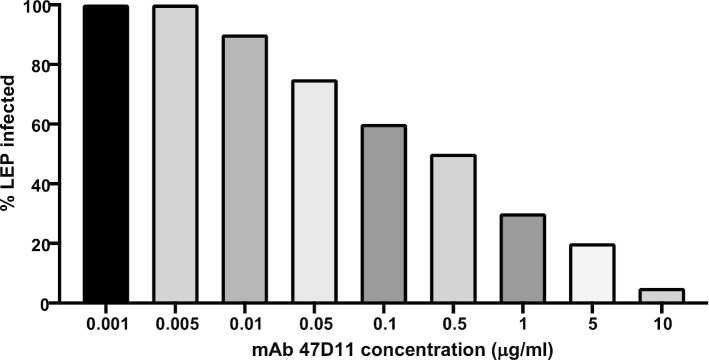
Antibody-mediated neutralization of SARS-CoV-2 infection on simulated lung epithelial cells. 10 ng/ml revealed the best concentration to obtain maximum clearance of the virus
Fig. 6
Fig. 6
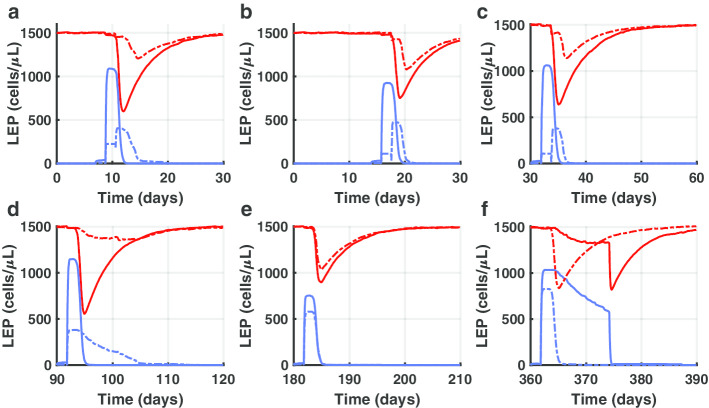
In silico trial of 47D11 to predict preventive efficacy. The overall prediction dynamics of LEP at the injection time of 47D11 mAb (day 1) at a concentration of 10 ng/ml after different SARS-CoV-2 challenge in time (af) is depicted. Specifically, one can observe the exposures at virus particles at day 7 (a), day 14 (b), month 1 (c), month 3 (d), month 6 (e) and after 1 year (f). Solid lines refer to the no-treated digital patient while dashed lines refer to mAb treated one. Blue lines depict actively infected LEP while red lines represent LEP to show the CPE. Panel A highlights that if a patient enters in contact with the virus just after 7 days post vaccination, he is fully protected from the infection (SARS-CoV-2 actively infected values of LEP are low). This is also true if a potential subject is being infected after 2 weeks (b), 1 month (c) or 3 months (d) after vaccination. Oppositely, in e (subject infected after 6 months) and f (subject infected after 1 year) mAb vaccination is practically ineffective in protecting the onset of the disease
Fig. 7
Fig. 7
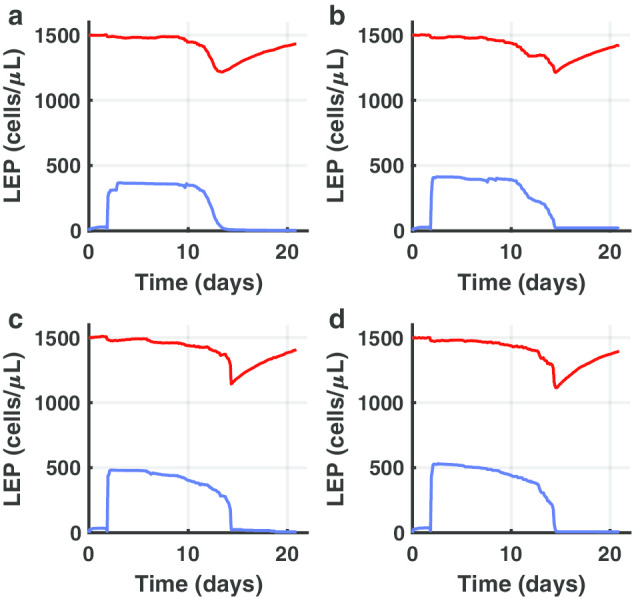
In silico trial of 47D11 to predict therapeutic efficacy. Different behaviors for both mild-moderate case (a, b) and severe case (c, d) are shown. In a mAb is injected 1 day after the onset of infection. In b mAb is injected 2 days after the onset of infection. In c mAb is injected 1 day after the onset of infection. In d mAb is injected 2 days after the onset of infection. Blue lines depict actively infected LEP while red lines represent LEP to show the CPE. As one can notice, mAb vaccine is effective in preventing or strongly limiting the CPE only by 2 days of the infection

References

    1. World Health Organization. Novel Coronavirus (2019-nCoV) situation reports. 2020.
    1. Wu F, Zhao S, Yu B, Chen YM, Wang W, Song ZG, et al. A new coronavirus associated with human respiratory disease in China. Nature. 2020;579:265–269. doi: 10.1038/s41586-020-2008-3. - DOI - PMC - PubMed
    1. Raoult D, Zumla A, Locatelli F, Ippolito G, Kroemer G. Coronavirus infections: epidemiological, clinical and immunological features and hypotheses. Cell Stress. 2020;4:66–75. doi: 10.15698/cst2020.04.216. - DOI - PMC - PubMed
    1. Peiris JSM, Guan Y, Yuen KY. Severe acute respiratory syndrome. Nat Med. 2004;10:S88–S97. doi: 10.1038/nm1143. - DOI - PMC - PubMed
    1. Wu J, Xu F, Zhou W, Feikin DR, Lin C-Y, He X, et al. Risk factors for SARS among persons without known contact with SARS patients, Beijing, China. Emerg Infect Dis. 2004;10:210–216. doi: 10.3201/eid1002.030730. - DOI - PMC - PubMed

Substances