


Novel gene variants in Polish patients with Leber congenital amaurosis (LCA)
- PMID: 33308271
- PMCID: PMC7731562
- DOI: 10.1186/s13023-020-01634-y
Novel gene variants in Polish patients with Leber congenital amaurosis (LCA)
Abstract
Background: Leber congenital amaurosis (LCA) is a rare retinal disease that is the most frequent cause of congenital blindness in children and the most severe form of inherited retinal dystrophies. To date, 25 genes have been implicated in the pathogenesis of LCA. As gene therapy is becoming available, the identification of potential treatment candidates is crucial. The aim of the study was to report the molecular basis of Leber congenital amaurosis in 22 Polish families.
Methods: Single Nucleotide Polymorphism-microarray for LCA genes or Next Generation Sequencing diagnostic panel for LCA genes (or both tests) were performed to identify potentially pathogenic variants. Bidirectional Sanger sequencing was carried out for validation and segregation analysis of the variants identified within the families.
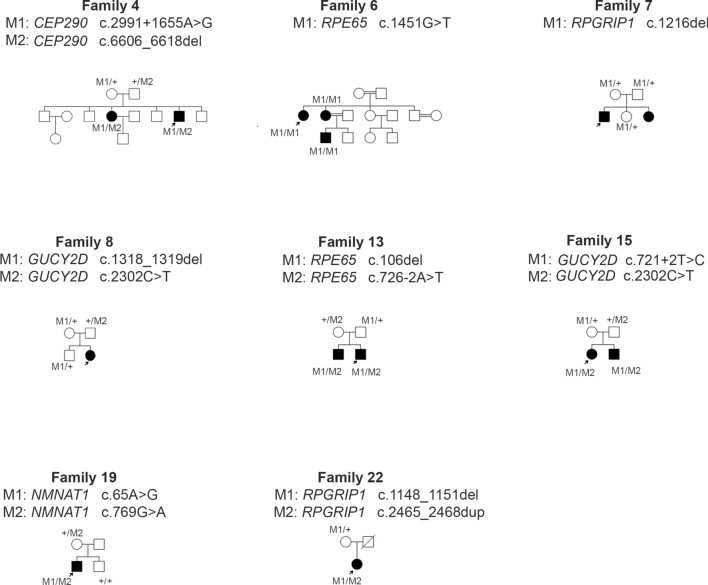
Results: The molecular background was established in 22 families. From a total of 24 identified variants, 23 were predicted to affect protein-coding or splicing, including 10 novel variants. The variants were identified in 7 genes: CEP290, GUCY2D, RPE65, NMNAT1, CRB1, RPGRIP1, and CRX. More than one-third of the patients, with clinical LCA diagnosis confirmed by the results of molecular analysis, appeared to be affected with a severe form of the disease: LCA10 caused by the CEP290 gene variants. Intronic mutation c.2991+1655A>G in the CEP290 gene was the most frequent variant identified in the studied group.
Conclusions: This study provides the first molecular genetic characteristics of patients with Leber congenital amaurosis from the previously unexplored Polish population. Our study expands the mutational spectrum as we report 10 novel variants identified in LCA genes. The fact that the most frequent causes of the disease in the studied group of Polish patients are mutations in one out of three genes that are currently the targets for gene therapy (CEP290, GUCY2D, and RPE65) strongly emphasizes the importance of the molecular background analyses of LCA in Polish patients.
Keywords: Leber congenital amaurosis (LCA); Novel variants; SNP-microarray for LCA genes; Targeted NGS panel for LCA genes.
Conflict of interest statement
The authors declare that they have no competing interests.
Figures

References
-
- Weleber RG, Francis PJ, Trzupek KM, Beattie C. Leber Congenital Amaurosis.2004 Jul 7 [updated 2013 May 2]. In: Adam MP, Ardinger HH, Pagon RA, Wallace SE, Bean LJH, Stephens K, Amemiya A, editors. GeneReviews® [Internet]. Seattle (WA): University of Washington, Seattle. 1993–2019. http://www.ncbi.nlm.nih.gov/books/NBK1298/PubMed.
-
- RetNet. https://sph.uth.edu/retnet/. Accessed 16 June 2020.
-
- Leiden Open Variation Database (LOVD). http://www.lovd.nl/3.0/home. Accessed 10 Apr 2020.
-
- Human Genome Mutation Database (HGMD). http://www.hgmd.cf.ac.uk/ac/index.php. Accessed 10 Apr 2020.
Publication types
MeSH terms
Substances
LinkOut - more resources
Full Text Sources
Research Materials
