Review
. 2020 Sep;27(5):365-376.
doi: 10.1053/j.ackd.2020.09.003. Epub 2020 Oct 20.

Pathophysiology and Pathology of Acute Kidney Injury in Patients With COVID-19

Affiliations
Review

Pathophysiology and Pathology of Acute Kidney Injury in Patients With COVID-19

Jia H Ng et al. Adv Chronic Kidney Dis. 2020 Sep.

Abstract

Acute kidney injury (AKI) is common among hospitalized patients with Coronavirus Infectious Disease 2019 (COVID-19), with the occurrence of AKI ranging from 0.5% to 80%. The variability in the occurrence of AKI has been attributed to the difference in geographic locations, race/ethnicity, and severity of illness. AKI among hospitalized patients is associated with increased length of stay and in-hospital deaths. Even patients with AKI who survive to hospital discharge are at risk of developing chronic kidney disease or end-stage kidney disease. An improved knowledge of the pathophysiology of AKI in COVID-19 is crucial to mitigate and manage AKI and to improve the survival of patients who developed AKI during COVID-19. The goal of this article is to provide our current understanding of the etiology and the pathophysiology of AKI in the setting of COVID-19.

Keywords: AKI; COVID-19; Collapsing GN; Kidney failure; Pathology.


Figures

Figure 1
Figure 1
Various pathophysiological mechanisms associated with COVID-19–related acute kidney injury. Dashed line, the association is less well understood. Dark green box and bolded font, acute tubular injury is the predominant mechanism for acute kidney injury. ACE2, angiotensin-converting enzyme 2; COVID-19, Coronavirus Infectious Disease 2019; SARS-CoV-2, severe acute respiratory virus-2. (Figure 1 was created using Biorender.com.)
Figure 2
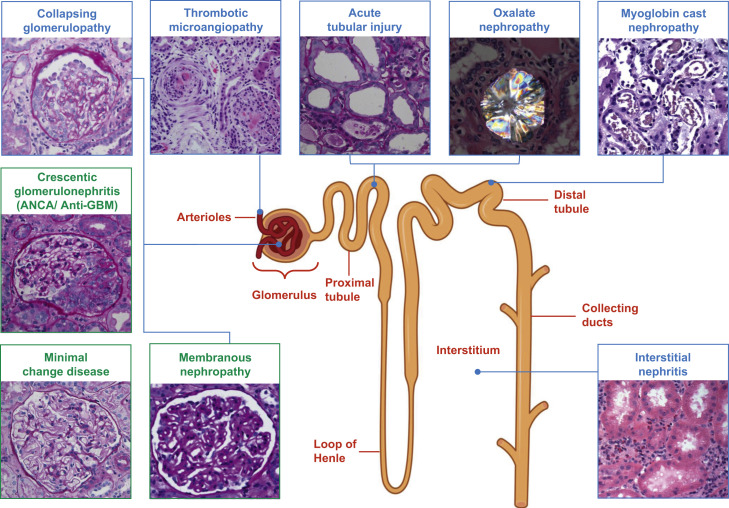
Figure 2
COVID-19–associated kidney disease: pathology findings. Green boxes, the association between COVID-19 and certain histopathological findings (crescentic glomerulonephritis, minimal change disease, and membranous nephropathy) are still putative. ANCA, antineutrophil cytoplasmic antibody; COVID-19, Coronavirus Infectious Disease 2019; GBM, glomerular basement membrane. (Figure 2 was created using Biorender.com.)

References

    1. Robbins-Juarez S.Y., Qian L., King K.L. Outcomes for patients with COVID-19 and acute kidney injury: a systematic review and meta-analysis. Kidney Int Rep. 2020;5(8):1149–1160. - PMC - PubMed
    1. Hirsch J.S., Ng J.H., Ross D.W. Acute kidney injury in patients hospitalized with COVID-19. Kidney Int. 2020;98(1):209–218. - PMC - PubMed
    1. Fisher M., Neugarten J., Bellin E. AKI in hospitalized patients with and without COVID-19: a comparison study. J Am Soc Nephrol. 2020;31(9):2145–2157. - PMC - PubMed
    1. Xia P., Wen Y., Duan Y. Clinicopathological features and outcomes of acute kidney injury in critically ill COVID-19 with prolonged disease course: a retrospective cohort. J Am Soc Nephrol. 2020;31(9):2205–2221. - PMC - PubMed
    1. Husain-Syed F., Wilhelm J., Kassoumeh S. Acute kidney injury and urinary biomarkers in hospitalized patients with coronavirus disease-2019. Nephrol Dial Transpl. 2020;35(7):1271–1274. - PMC - PubMed

Publication types

MeSH terms