


Association of Genetic Variation With Cirrhosis: A Multi-Trait Genome-Wide Association and Gene-Environment Interaction Study
- PMID: 33310085
- PMCID: PMC8035329
- DOI: 10.1053/j.gastro.2020.12.011
Association of Genetic Variation With Cirrhosis: A Multi-Trait Genome-Wide Association and Gene-Environment Interaction Study
Abstract
Background & aims: In contrast to most other common diseases, few genetic variants have been identified that impact risk of cirrhosis. We aimed to identify new genetic variants that predispose to cirrhosis, to test whether such variants, aggregated into a polygenic score, enable genomic risk stratification, and to test whether alcohol intake or body mass index interacts with polygenic predisposition.
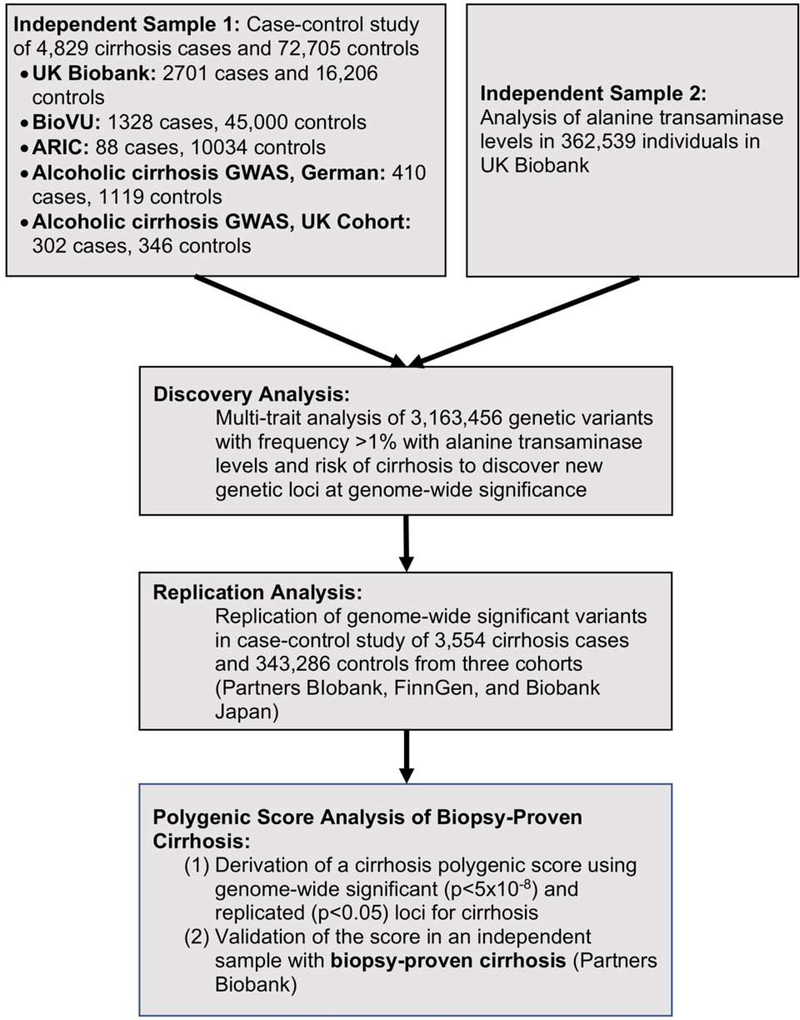
Methods: We conducted a multi-trait genome-wide association study combining cirrhosis and alanine aminotransferase levels performed in 5 discovery studies (UK Biobank, Vanderbilt BioVU, Atherosclerosis Risk in Communities study, and 2 case-control studies including 4829 individuals with cirrhosis and 72,705 controls and 362,539 individuals with alanine aminotransferase levels). Identified variants were replicated in 3 studies (Partners HealthCare Biobank, FinnGen, and Biobank Japan including 3554 individuals with cirrhosis and 343,826 controls). A polygenic score was tested in Partners HealthCare Biobank.
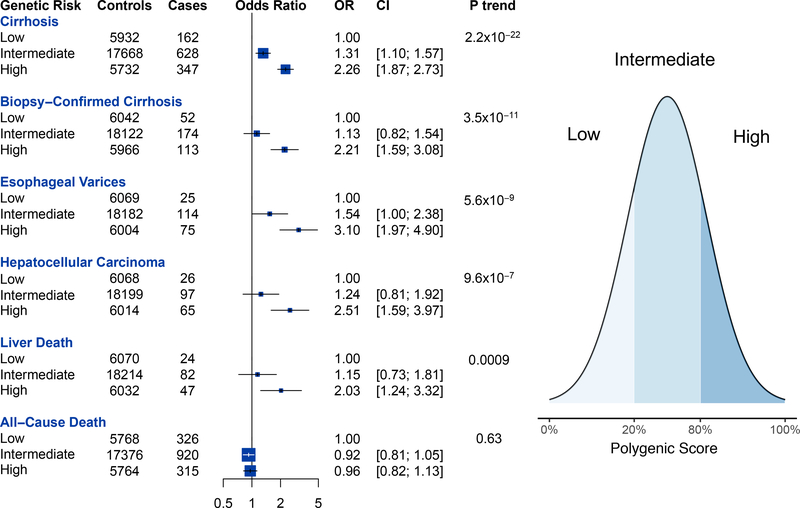
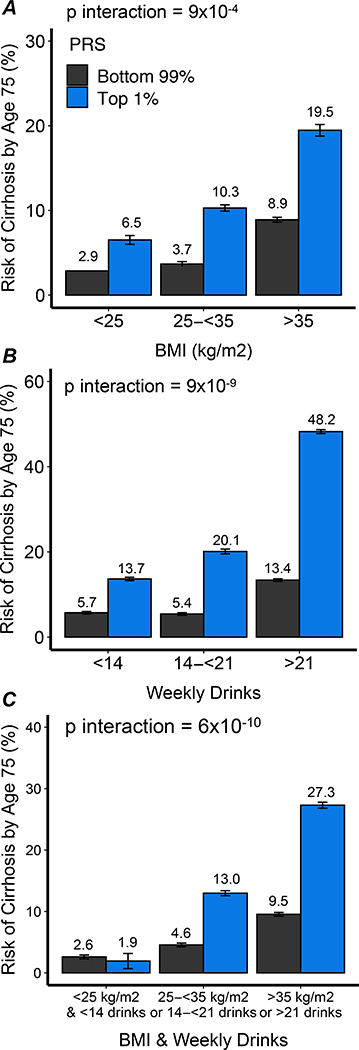
Results: Five previously reported and 7 newly identified genetic variants were associated with cirrhosis in both the discovery studies multi-trait genome-wide association study (P < 5 × 10⁻⁸) and the replication studies (P < .05), including a missense variant in the APOE gene and a noncoding variant near EFN1A. These 12 variants were used to generate a polygenic score. Among Partners HealthCare Biobank individuals, high polygenic score-defined as the top quintile of the distribution-was associated with significantly increased risk of cirrhosis (odds ratio, 2.26; P < .001) and related comorbidities compared with the lowest quintile. Risk was even more pronounced among those with extreme polygenic risk (top 1% of the distribution, odds ratio, 3.16; P < .001). The impact of extreme polygenic risk was substantially more pronounced in those with elevated alcohol consumption or body mass index. Modeled as risk by age 75 years, probability of cirrhosis with extreme polygenic risk was 13.7%, 20.1%, and 48.2% among individuals with no or modest, moderate, and increased alcohol consumption, respectively (Pinteraction < .001). Similarly, probability among those with extreme polygenic risk was 6.5%, 10.3%, and 19.5% among individuals with normal weight, overweight, and obesity, respectively (Pinteraction < .001).
Conclusions: Twelve independent genetic variants, 7 of which are newly identified in this study, conferred risk for cirrhosis. Aggregated into a polygenic score, these variants identified a subset of the population at substantially increased risk who are most susceptible to the hepatotoxic effects of excess alcohol consumption or obesity.
Keywords: Chronic Liver Disease; Cirrhosis; Genetics; Genome-Wide Association Study.
Copyright © 2021 AGA Institute. Published by Elsevier Inc. All rights reserved.
Figures


References
-
- Pearson TA, Manolio TA. How to interpret a genome-wide association study. JAMA. 2008;299(11):1335–1344. - PubMed
Publication types
MeSH terms
Grants and funding
LinkOut - more resources
Full Text Sources
Other Literature Sources
Medical
Miscellaneous
