


COVID-19: Forecasting confirmed cases and deaths with a simple time series model
- PMID: 33311822
- PMCID: PMC7717777
- DOI: 10.1016/j.ijforecast.2020.11.010
COVID-19: Forecasting confirmed cases and deaths with a simple time series model
Abstract
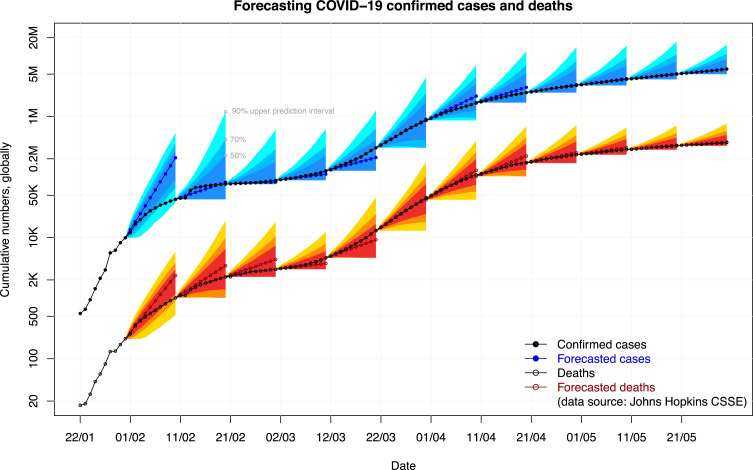
Forecasting the outcome of outbreaks as early and as accurately as possible is crucial for decision-making and policy implementations. A significant challenge faced by forecasters is that not all outbreaks and epidemics turn into pandemics, making the prediction of their severity difficult. At the same time, the decisions made to enforce lockdowns and other mitigating interventions versus their socioeconomic consequences are not only hard to make, but also highly uncertain. The majority of modeling approaches to outbreaks, epidemics, and pandemics take an epidemiological approach that considers biological and disease processes. In this paper, we accept the limitations of forecasting to predict the long-term trajectory of an outbreak, and instead, we propose a statistical, time series approach to modelling and predicting the short-term behavior of COVID-19. Our model assumes a multiplicative trend, aiming to capture the continuation of the two variables we predict (global confirmed cases and deaths) as well as their uncertainty. We present the timeline of producing and evaluating 10-day-ahead forecasts over a period of four months. Our simple model offers competitive forecast accuracy and estimates of uncertainty that are useful and practically relevant.
Keywords: COVID-19; Decision making; Exponential smoothing; Pandemic; Time series forecasting; Uncertainty.
© 2020 International Institute of Forecasters. Published by Elsevier B.V. All rights reserved.
Conflict of interest statement
The authors declare that they have no known competing financial interests or personal relationships that could have appeared to influence the work reported in this paper.
Figures
References
-
- Auquan . 2020. COVID-19 dashboard. https://covid19-infection-model.auquan.com/
-
- Best R., Boice J. 2020. Where the latest COVID-19 models think we’re headed — And why they disagree. FiveThirtyEight. https://projects.fivethirtyeight.com/covid-forecasts/?ex_cid=rrpromo.
LinkOut - more resources
Full Text Sources