Review
. 2020 Dec 9;12(12):3696.
doi: 10.3390/cancers12123696.

Extracellular Vesicles Orchestrate Immune and Tumor Interaction Networks

Affiliations
Review

Extracellular Vesicles Orchestrate Immune and Tumor Interaction Networks

Kevin Ho Wai Yim et al. Cancers (Basel). .

Abstract

Extracellular vesicles (EVs) are emerging as potent and intricate intercellular communication networks. From their first discovery almost forty years ago, several studies have bolstered our understanding of these nano-vesicular structures. EV subpopulations are now characterized by differences in size, surface markers, cargo, and biological effects. Studies have highlighted the importance of EVs in biology and intercellular communication, particularly during immune and tumor interactions. These responses can be equally mediated at the proteomic and epigenomic levels through surface markers or nucleic acid cargo signaling, respectively. Following the exponential growth of EV studies in recent years, we herein synthesize new aspects of the emerging immune-tumor EV-based intercellular communications. We also discuss the potential role of EVs in fundamental immunological processes under physiological conditions, viral infections, and tumorigenic conditions. Finally, we provide insights on the future prospects of immune-tumor EVs and suggest potential avenues for the use of EVs in diagnostics and therapeutics.

Keywords: extracellular vesicles; immune signaling; non-coding RNA; tumor microenvironment.


Conflict of interest statement

The authors declare no competing interests.

Figures
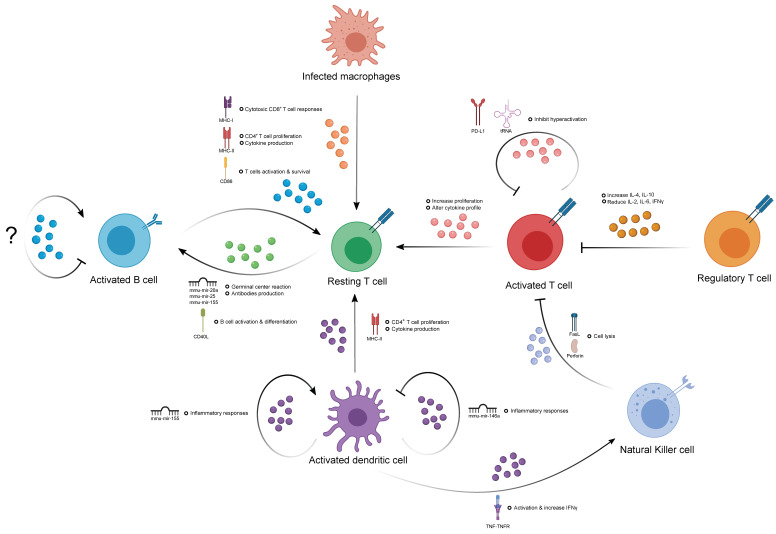
Figure 1
Figure 1
Extracellular vesicle (EV)-mediated immune–immune regulation. This figure depicts the intra- and inter-cellular communications between different immune cells via the exchange or delivery of the specific EV molecular cargo indicated and how these could exert positive or negative regulatory effects in certain immune cells.
Figure 2
Figure 2
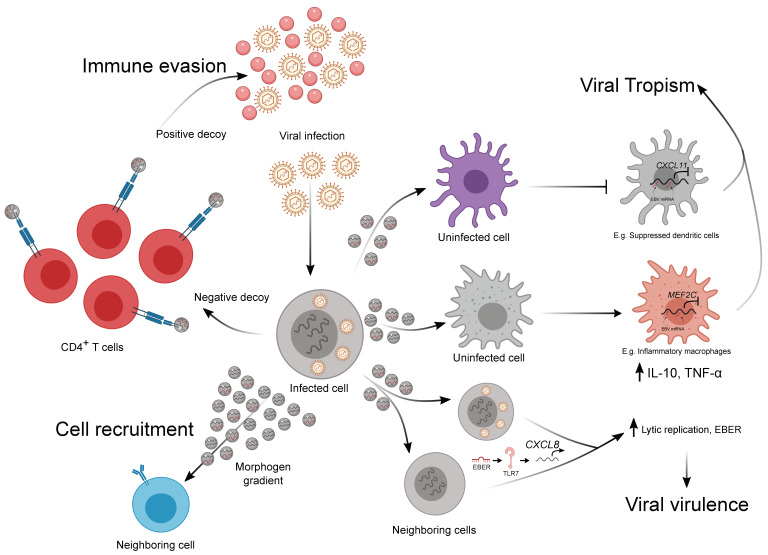
Extracellular vesicle-mediated immune–viral regulation during infection. This figure depicts the potential mechanisms by which virus-encoding EVs could alter virus–host interactions mediated by specific viral EV molecular cargo as indicated. These include the regulation of immune evasion, viral tropism, viral virulence, and potentially immune cell recruitment.
Figure 3
Figure 3
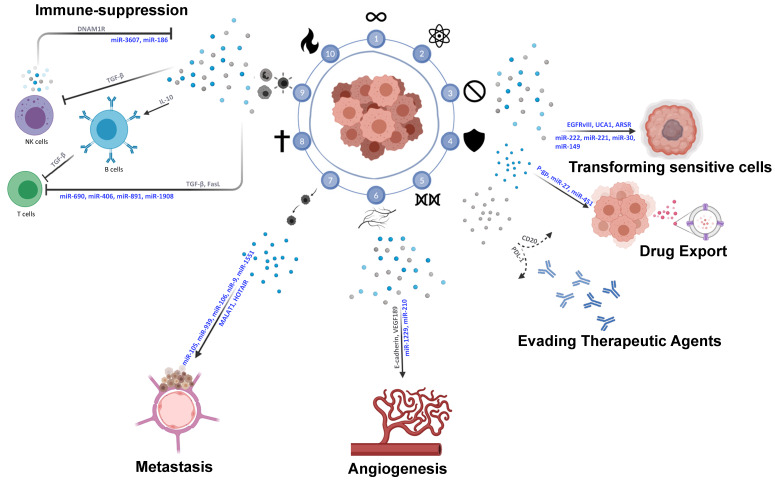
Extracellular vesicle-mediated tumor microenvironment (TME) communication. Schematic depiction of interactions in the TME between the tumor and surrounding cells promoting immune-suppression, angiogenesis, metastasis, and therapy-resistance. Factors and EVs in blue denote uptake-dependent processes; factors and EVs in grey denote uptake-independent processes.

References

    1. Kilchert C., Wittmann S., Vasiljeva L. The regulation and functions of the nuclear RNA exosome complex. Nat. Rev. Mol. Cell Biol. 2016;17:227–239. doi: 10.1038/nrm.2015.15. - DOI - PubMed
    1. Edgar J.R. Q&A: What are exosomes, exactly? BMC Biol. 2016;14:1–7. doi: 10.1186/s12915-016-0268-z. - DOI - PMC - PubMed
    1. Robbins P.D., Morelli A.E. Regulation of immune responses by extracellular vesicles. Nat. Rev. Immunol. 2014;14:195–208. doi: 10.1038/nri3622. - DOI - PMC - PubMed
    1. Ricklefs F.L., Alayo Q., Krenzlin H., Mahmoud A.B., Speranza M.C., Nakashima H., Hayes J.L., Lee K., Balaj L., Passaro C., et al. Immune evasion mediated by PD-L1 on glioblastoma-derived extracellular vesicles. Sci. Adv. 2018;4:eaar2766. doi: 10.1126/sciadv.aar2766. - DOI - PMC - PubMed
    1. Chaput N., Théry C. Exosomes: Immune properties and potential clinical implementations. Semin. Immunopathol. 2011;33:419–440. doi: 10.1007/s00281-010-0233-9. - DOI - PubMed

LinkOut - more resources