. 2020 Dec 29;117(52):33028-33033.
doi: 10.1073/pnas.2010365117. Epub 2020 Dec 14.

Rapid dark aging of biomass burning as an overlooked source of oxidized organic aerosol

Affiliations

Rapid dark aging of biomass burning as an overlooked source of oxidized organic aerosol

John K Kodros et al. Proc Natl Acad Sci U S A. .

Abstract

Oxidized organic aerosol (OOA) is a major component of ambient particulate matter, substantially impacting climate, human health, and ecosystems. OOA is readily produced in the presence of sunlight, and requires days of photooxidation to reach the levels observed in the atmosphere. High concentrations of OOA are thus expected in the summer; however, our current mechanistic understanding fails to explain elevated OOA during wintertime periods of low photochemical activity that coincide with periods of intense biomass burning. As a result, atmospheric models underpredict OOA concentrations by a factor of 3 to 5. Here we show that fresh emissions from biomass burning exposed to NO2 and O3 (precursors to the NO3 radical) rapidly form OOA in the laboratory over a few hours and without any sunlight. The extent of oxidation is sensitive to relative humidity. The resulting OOA chemical composition is consistent with the observed OOA in field studies in major urban areas. Additionally, this dark chemical processing leads to significant enhancements in secondary nitrate aerosol, of which 50 to 60% is estimated to be organic. Simulations that include this understanding of dark chemical processing show that over 70% of organic aerosol from biomass burning is substantially influenced by dark oxidation. This rapid and extensive dark oxidation elevates the importance of nocturnal chemistry and biomass burning as a global source of OOA.

Keywords: air pollution; biomass burning; nighttime; oxidation; secondary organic aerosol.


Conflict of interest statement

The authors declare no competing interest.

Figures
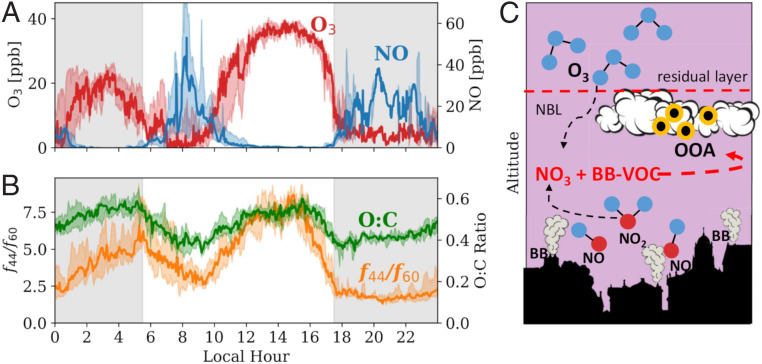
Fig. 1.
Fig. 1.
Field observations from an urban center in wintertime Greece show an increasing trend in chemical aging of bbOA at night, roughly correlated with transport of O3 into the NBL. Diurnal profiles calculated from 16 d of ambient observations from ambient observations taken in Patras, Greece, on January 14−30, 2020 of (A) O3 and NO mixing ratios and (B) the ratio of oxygen to carbon (O:C) and the ratio of the fraction of OA mass present at m/z 44 (f44) to m/z 60 (f60). The solid lines represent the median of all measurements taken at the given time of day from the 16-d sampling period. The shaded region around the line represents the 25th and 75th percentiles of measurements across the sampling period. The gray shaded regions represent night. (C) Schematic representation of oxidation of bbOA in an urban area due to reactions with the NO3 radical produced through O3 mixing into the NBL and subsequent reactions with NOx.
Fig. 2.
Fig. 2.
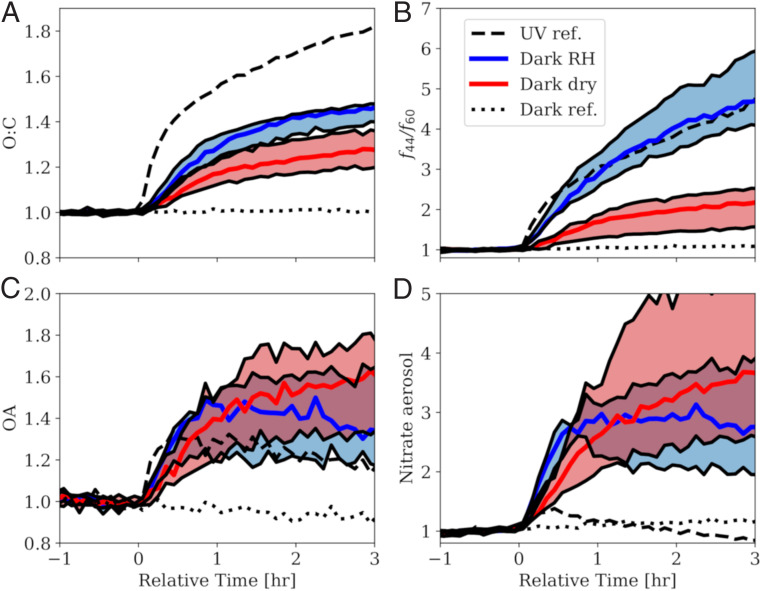
In the presence of NO2 and O3, BB emissions age rapidly under dark conditions, producing a similar amount of secondary aerosol as under photochemical conditions. Enhancement in (A) O:C ratio, (B) f44/f60, (C) OA, and (D) total (inorganic and organic) aerosol nitrate for the dark reference (experiment 1 in SI Appendix, Table S1) and UV reference (experiment 2) experiments as well as the dark aging experiments under dry (experiments 3 to 6) and high RH (experiments 7 to 9) conditions. The shaded region corresponds to the variability across all experiments (see SI Appendix, Table S1) due to differences in injected NO2 and O3 concentration (dark dry experiments) or RH (dark RH experiments), while the solid blue and red lines are the median across the experiments. Time is relative to the initiation of oxidation (at hour 0). The calculation of enhancement in OA and nitrate aerosol is normalized to sulfate to account for particle wall losses and collection efficiency.
Fig. 3.
Fig. 3.
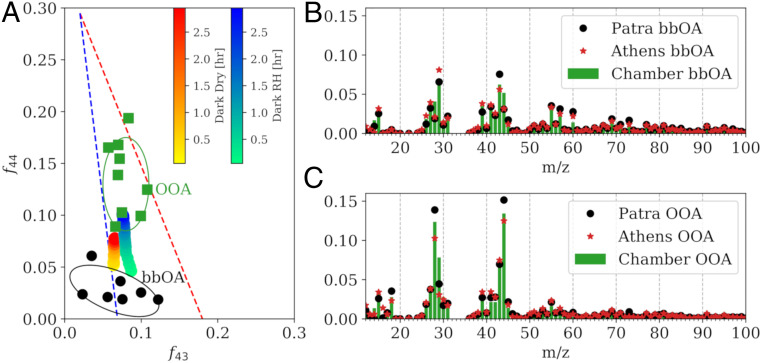
The evolution of OA experimentally under dark conditions compares well to ambient observations of bbOA and OOA factors. (A) Oxidation pathway of a representative dark dry (experiment 3) and high RH (experiment 8) experiment compared to ambient observations of bbOA and OOA factors (SI Appendix, Tables S2 and S3). (B) The OA mass spectra in the dark dry experiment as measured by the HR-ToF-AMS of the fresh bbOA in the chamber compared to the bbOA in Athens and Patras, and (C) the produced OOA in the chamber compared to OOA factors in Athens and Patras.
Fig. 4.
Fig. 4.
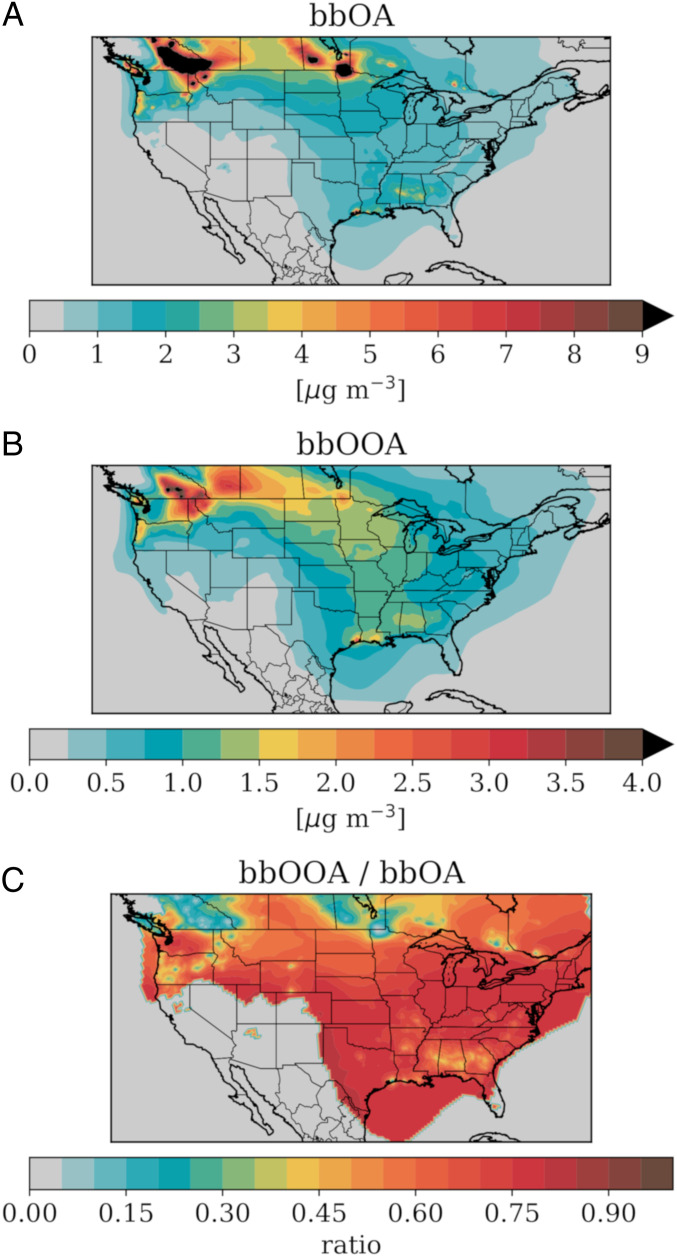
Model simulations predict that more than 75% of total OA from BB sources over the United States is influenced by dark aging. Concentrations of simulated (A) total bbOA mass (both primary and secondary) and (B) OOA mass from BB sources that has undergone at least one nighttime NO3 reaction, as well as (C) the ratio of bbOOA mass (where bbOA is greater than 0.5 μg⋅m−3) influenced by dark aging to total bbOA.

References

    1. Pandis S. N., et al. , Urban particulate matter pollution: A tale of five cities. Faraday Discuss. 189, 277–290 (2016). - PubMed
    1. Zhang Q., et al. , Ubiquity and dominance of oxygenated species in organic aerosols in anthropogenically-influenced Northern Hemisphere midlatitudes. Geophys. Res. Lett. 34, L13801 (2007).
    1. Zhang Q., Worsnop D. R., Canagaratna M. R., Jimenez J. L., Hydrocarbon-like and oxygenated organic aerosols in Pittsburgh: Insights into sources and processes of organic aerosols. Atmos. Chem. Phys. 5, 3289–3311 (2005).
    1. Jimenez J. L., et al. , Evolution of organic aerosols in the atmosphere. Science 326, 1525–1529 (2009). - PubMed
    1. Kanakidou M., et al. , Organic aerosol and global climate modelling: A review. Atmos. Chem. Phys. 5, 1053–1123 (2005).

Publication types