. 2020 Dec 9;13(2):2519-2538.
doi: 10.18632/aging.202285. Epub 2020 Dec 9.

Identification of key modules and genes associated with breast cancer prognosis using WGCNA and ceRNA network analysis

Affiliations

Identification of key modules and genes associated with breast cancer prognosis using WGCNA and ceRNA network analysis

Xin Yin et al. Aging (Albany NY). .

Abstract

Breast cancer is one of the leading causes of cancer-associated mortality in women worldwide and has become a major public health problem. Although the definitive cause of breast cancer is not known, many genes sensitive to breast cancer have been detected using advanced technologies. Our study identified 3301 differentially expressed lncRNAs and mRNAs between tumor and normal samples from The Cancer Genome Atlas database. Based on the gene expression analysis and clinical traits as well as weighted gene co-expression network analysis, the co-expression Brown module was found to be key for breast cancer prognosis. A total of 453 genes in the Brown module were used for functional enrichment, protein-protein interaction analysis, lncRNA-miRNA-mRNA ceRNA network, and lncRNA-RNA binding protein-mRNA network construction. GRM4, SSTR2, PARD6B, PRR15, COX6C, and lncRNA DSCAM-AS1 were the hub genes according to protein-protein interaction, lncRNA-miRNA-mRNA and lncRNA-RNA binding protein-mRNA network. Their high expression was found to be correlated with breast cancer development, according to multiple databases. In conclusion, this study provides a framework of the co-expression gene modules of breast cancer and identifies several important biomarkers in breast cancer development and prognosis.

Keywords: PPI network; WGCNA; breast cancer; differential expression analysis; lncRNA.


Conflict of interest statement

CONFLICTS OF INTEREST: There were no conflicts of interests between the authors.

Figures

Figure 1
Figure 1
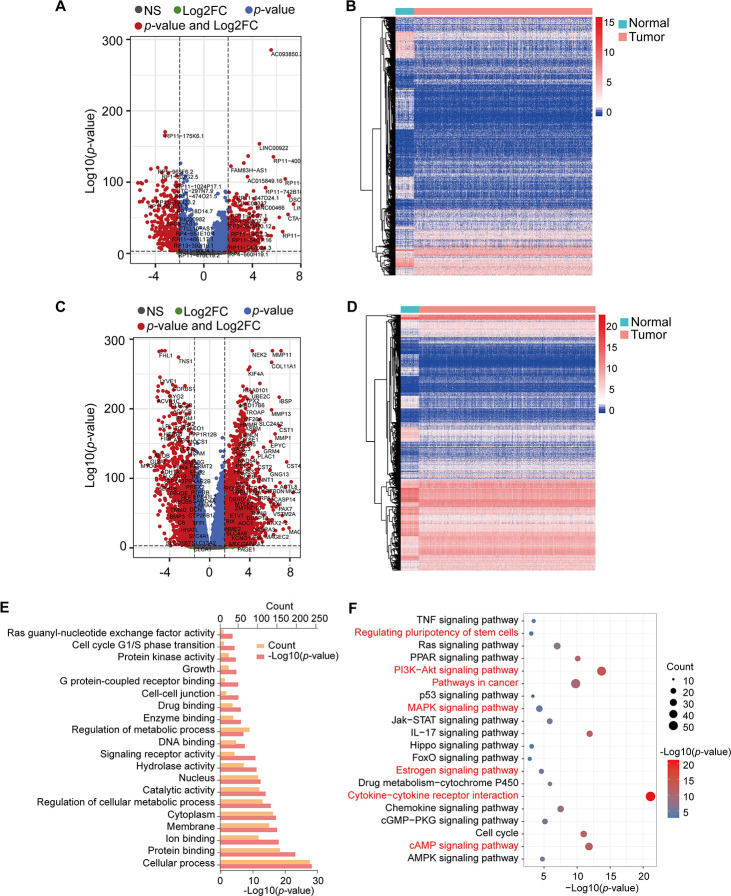
Volcano plots, heatmap, and gene enrichment analysis of DElncRNAs and DEmRNAs. (A) Volcano plot of DElncRNAs. (B) Heatmap of DElncRNAs. (C) Volcano plot of DEmRNAs. (D) Heatmap of DEmRNAs. NS: no significant, Log2FC: |Log2FC|>2, p-value: p-value<1e-3, p-value and Log2FC: p-value<1e-3 and |Log2FC|>2. (E) GO enrichment of DEmRNAs. (F) KEGG pathway enrichment of DEmRNAs. Red pathways are common with DEmRNAs of the Brown module.
Figure 2
Figure 2
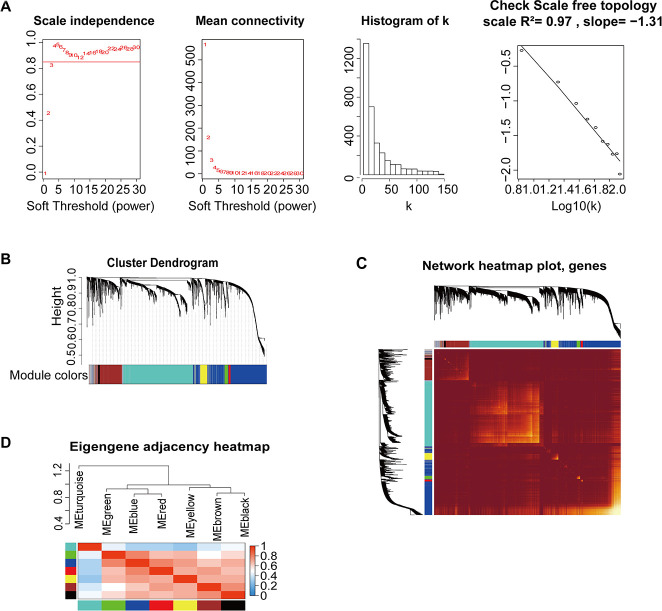
Construction of co-expression modules based on BRCA RNA-seq data from TCGA database by WGCNA. (A) Analysis of network topology for various soft-threshold powers. Check scale-free topology; the adjacency matrix was defined using soft-thresholds with β=4. (B) Clustering dendrograms of genes, with dissimilarity based on topological overlap, together with assigned module colors. (C) Heatmap depicting the topological overlap matrix (TOM) among genes based on co-expression modules. A redder background indicates a higher module correlation. (D) Visualization of the gene network using a heatmap plot.
Figure 3
Figure 3
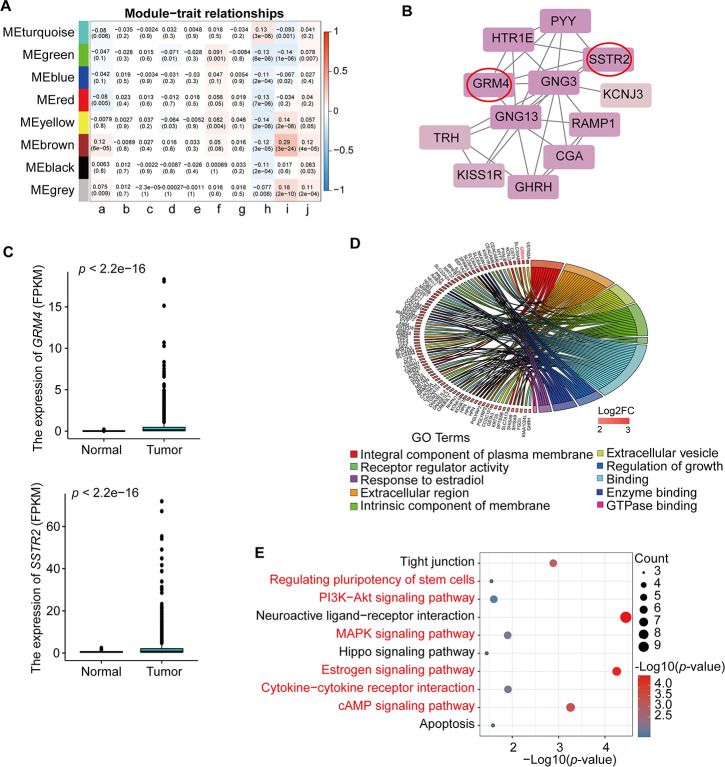
Identification and analysis of key module and hub genes. (A) Analysis of module-trait relationships of BRCA based on TCGA data; a. age at initial pathologic diagnosis, b. pathologic_M, c. pathologic_N, d. pathologic_T, e. tumor stage I, f. additional pharmaceutical therapy, g. radiation therapy, h. vital status, i. days to new tumor event after initial treatment, j. days to death. TNM = tumor, node, metastasis (classification). (B) PPI analysis and identification of hub genes involved in the co-expression Brown module using STRING database and MCODE plug-in in Cytoscape. The genes in the red circle are the hub genes. (C) Expression of GRM4 and SSTR2 in BRCA from TCGA database. (D) GO enrichment in the co-expression Brown module. The red gene is the hub gene of PPI. (E) KEGG pathway enrichment in the co-expression Brown module. Red pathways are common with total DEmRNAs.
Figure 4
Figure 4
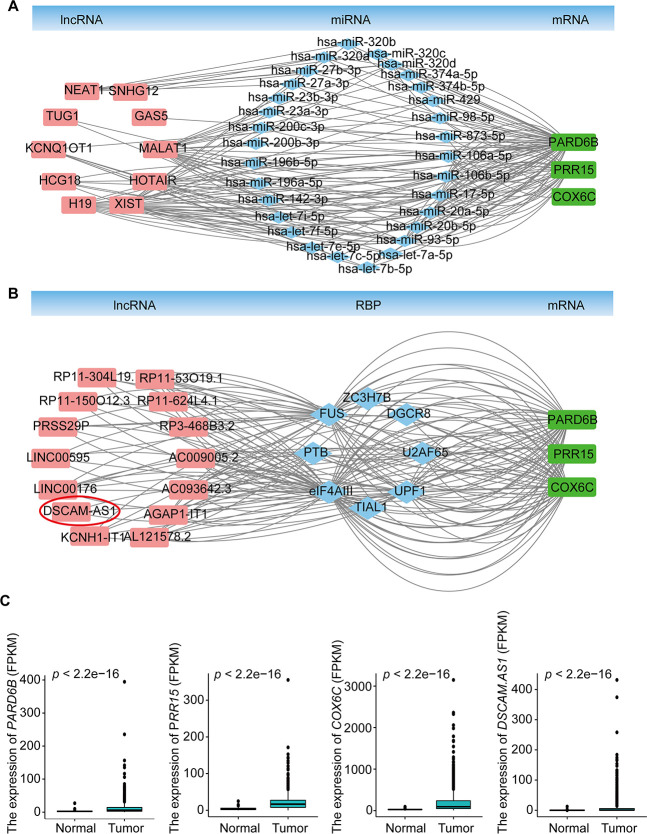
lncRNA-miRNA-mRNA ceRNA and lncRNA-RBP-mRNA networks. (A) lncRNA-miRNA-mRNA ceRNA network based on the co-expression Brown module. (B) lncRNA-RBP-mRNA network based on the co-expression Brown module. (C) Expression of PARD6B, PRR15, COX6C, and DSCAM-AS1.
Figure 5
Figure 5
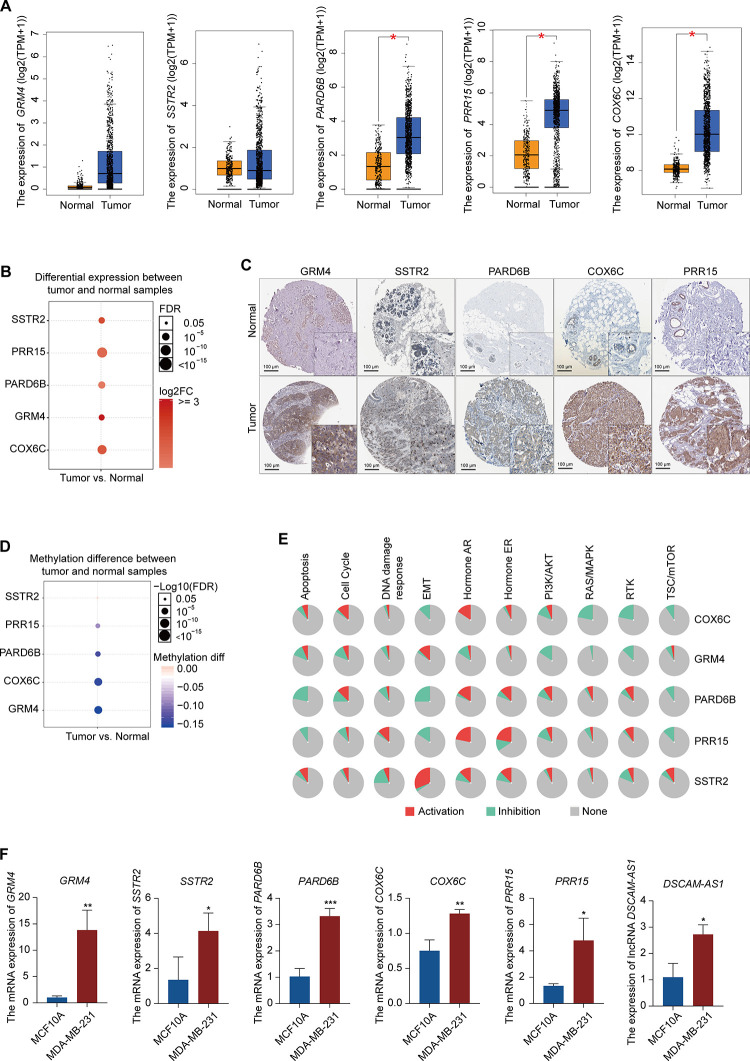
Expression pattern validation of hub genes and signaling pathways in BRCA. (A) Expression pattern of GRM4, SSTR2, PARD6B, COX6C, and PRR15 in BRCA and normal samples from the GEPIA database. (B) Expression of GRM4, SSTR2, PARD6B, COX6C, and PRR15 in BRCA and normal samples from the GSCALite database. (C) IHC of the GRM4 (GRM4 normal sample from 2104; GRM4 BRCA sample from 2160), SSTR2 (SSTR2 normal sample from 3286; SSTR2 BRCA sample from 2091), PARD6B (PARD6B normal sample from 2042; PARD6B BRCA sample from 1874), COX6C (COX6C normal sample from 2773; COX6C BRCA sample from 1775), and PRR15 (PRR15 normal sample from 2773; PRR15 BRCA sample from 2428) in BRCA and normal samples from the HPA database. (D) Difference in the methylation of GRM4, SSTR2, PARD6B, COX6C, and PRR15 between BRCA and normal samples from the GSCALite database. (E) Difference in the signaling of pathways associated with GRM4, SSTR2, PARD6B, COX6C, and PRR15 between BRCA and normal samples from the GSCALite database. (F) Expression of GRM4, SSTR2, PARD6B, COX6C, PRR15, and lncRNA DSCAM-AS1 in MCF10A (normal breast epithelial cell line) and MDA-MB-231 (breast cancer cell line) using qRT-PCR.
Figure 6
Figure 6
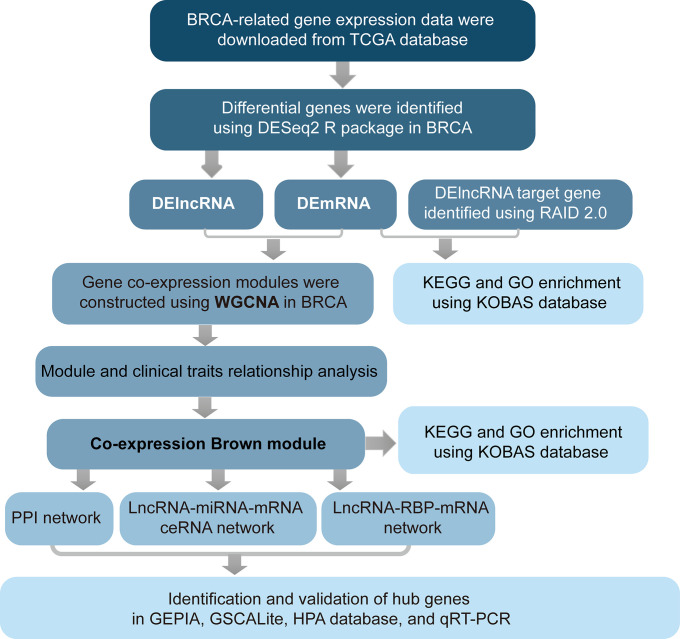
Flow chart of analysis.

References

    1. Siegel RL, Miller KD, Jemal A. Cancer statistics, 2020. CA Cancer J Clin. 2020; 70:7–30. 10.3322/caac.21590 - DOI - PubMed
    1. Kimbung S, Loman N, Hedenfalk I. Clinical and molecular complexity of breast cancer metastases. Semin Cancer Biol. 2015; 35:85–95. 10.1016/j.semcancer.2015.08.009 - DOI - PubMed
    1. Zhou Q, Ren J, Hou J, Wang G, Ju L, Xiao Y, Gong Y. Co-expression network analysis identified candidate biomarkers in association with progression and prognosis of breast cancer. J Cancer Res Clin Oncol. 2019; 145:2383–96. 10.1007/s00432-019-02974-4 - DOI - PMC - PubMed
    1. Lorusso G, Rüegg C. New insights into the mechanisms of organ-specific breast cancer metastasis. Semin Cancer Biol. 2012; 22:226–33. 10.1016/j.semcancer.2012.03.007 - DOI - PubMed
    1. Ciriello G, Gatza ML, Beck AH, Wilkerson MD, Rhie SK, Pastore A, Zhang H, McLellan M, Yau C, Kandoth C, Bowlby R, Shen H, Hayat S, et al. , and TCGA Research Network. Comprehensive molecular portraits of invasive lobular breast cancer. Cell. 2015; 163:506–19. 10.1016/j.cell.2015.09.033 - DOI - PMC - PubMed

Publication types

MeSH terms