


Missing lateral relationships in top-level concepts of an ontology
- PMID: 33319709
- PMCID: PMC7737264
- DOI: 10.1186/s12911-020-01319-3
Missing lateral relationships in top-level concepts of an ontology
Abstract
Background: Ontologies house various kinds of domain knowledge in formal structures, primarily in the form of concepts and the associative relationships between them. Ontologies have become integral components of many health information processing environments. Hence, quality assurance of the conceptual content of any ontology is critical. Relationships are foundational to the definition of concepts. Missing relationship errors (i.e., unintended omissions of important definitional relationships) can have a deleterious effect on the quality of an ontology. An abstraction network is a structure that overlays an ontology and provides an alternate, summarization view of its contents. One kind of abstraction network is called an area taxonomy, and a variation of it is called a subtaxonomy. A methodology based on these taxonomies for more readily finding missing relationship errors is explored.
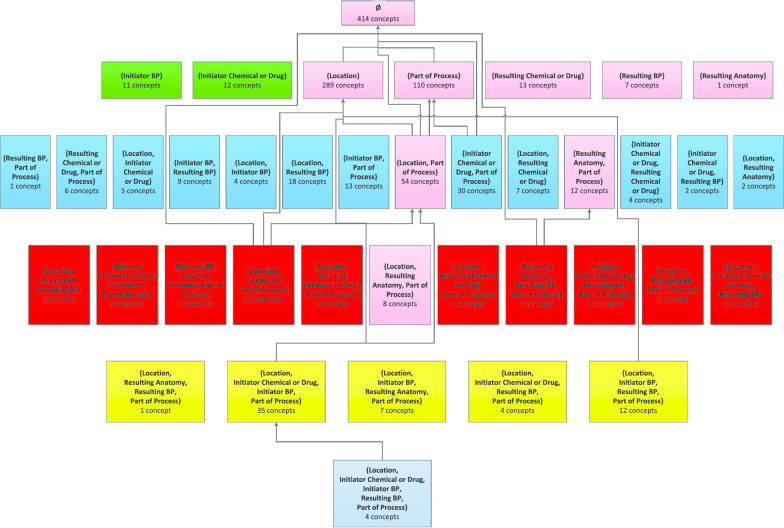
Methods: The area taxonomy and the subtaxonomy are deployed to help reveal concepts that have a high likelihood of exhibiting missing relationship errors. A specific top-level grouping unit found within the area taxonomy and subtaxonomy, when deemed to be anomalous, is used as an indicator that missing relationship errors are likely to be found among certain concepts. Two hypotheses pertaining to the effectiveness of our Quality Assurance approach are studied.
Results: Our Quality Assurance methodology was applied to the Biological Process hierarchy of the National Cancer Institute thesaurus (NCIt) and SNOMED CT's Eye/vision finding subhierarchy within its Clinical finding hierarchy. Many missing relationship errors were discovered and confirmed in our analysis. For both test-bed hierarchies, our Quality Assurance methodology yielded a statistically significantly higher number of concepts with missing relationship errors in comparison to a control sample of concepts. Two hypotheses are confirmed by these findings.
Conclusions: Quality assurance is a critical part of an ontology's lifecycle, and automated or semi-automated tools for supporting this process are invaluable. We introduced a Quality Assurance methodology targeted at missing relationship errors. Its successful application to the NCIt's Biological Process hierarchy and SNOMED CT's Eye/vision finding subhierarchy indicates that it can be a useful addition to the arsenal of tools available to ontology maintenance personnel.
Keywords: Abstraction network; Error concentration; Missing relationship error; National Cancer Institute thesaurus (NCIt); Omission error; Ontology modeling; Ontology quality assurance; SNOMED CT; Taxonomy.
Conflict of interest statement
The authors declare that they have no competing interests.
Figures

References
Publication types
MeSH terms
Grants and funding
LinkOut - more resources
Full Text Sources
Research Materials
