


doi: 10.1021/acs.joc.0c02486.
Epub 2020 Dec 15.
Stereoselective α-Chlorination of β-Keto Esters in the Presence of Hybrid Amide-Based Cinchona Alkaloids as Catalysts
Affiliations
- PMID: 33320665
- PMCID: PMC7872425
- DOI: 10.1021/acs.joc.0c02486
Item in Clipboard
Stereoselective α-Chlorination of β-Keto Esters in the Presence of Hybrid Amide-Based Cinchona Alkaloids as Catalysts
J Org Chem.
.
Abstract
We report an enantioselective phase transfer α-chlorination of β-keto esters catalyzed by hybrid amide-based Cinchona derivatives. The chlorination process proceeds with proper quantitative yields (up to <99%) and high asymmetric induction (up to 97% ee). We show that the use of only 0.5 mol % hybrid catalyst based on a Cinchona core allows the chlorination reaction to be conducted in a highly enantioselective manner with various indanone and tetralone carboxylate esters.
Conflict of interest statement
The authors declare no competing financial interest.
Figures
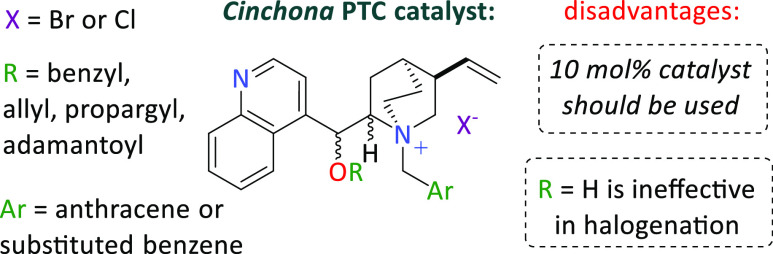
Previously reported Cinchona PTC
catalysts in asymmetric chlorination.


For example, compound 14a was obtained using 13a (1.0 mmol), NCS (1.05
mmol),
KF (2 mmol), and catalyst 5 (0.5 mol%) in toluene (5
mL) for 30 min at −50 °C.

Proposed transition state model for catalyst 5 and
substrate 13a.

(a)Molar ratio: NCS
(1.05 equiv), catalyst 5 (0.005 equiv), and KF (2 equiv). (b) Isolated yields. (c) The ee values were determined
by HPLC analysis using a chiral column Chiralcel OD-H.
References
-
-
See:
- Thomas G.Medicine Chemistry: An Introduction; Wiley: New York, 2000.
- Purser S.; Moore P. R.; Swallow S.; Gouverneur V. Fluorine in medicinal chemistry. Chem. Soc. Rev. 2008, 37, 320–330. 10.1039/b610213c. - DOI - PubMed
- Liu Y.; Leng H. J.; Li Q. Z.; Li J. L. Catalytic Strategies for the Asymmetric Construction of Cyclic Frameworks with a Halogenated Tetrasubstituted Stereocenter. Adv. Synth. Catal. 2020, 362, 3926–3947. 10.1002/adsc.202000540. - DOI
-
-
-
For reviews, see:
- Muñiz K. Improving Enantioselective Fluorination Reactions: ChiralN-Fluoroammonium Salts and Transition Metal Catalysts. Angew. Chem., Int. Ed. 2001, 40, 1653–1656. 10.1002/1521-3773(20010504)40:9<1653::aid-anie16530>3.0.co;2-w. - DOI - PubMed
- Ma J.-A.; Cahard D. Asymmetric Fluorination, Trifluoromethylation, and Perfluoroalkylation Reactions. Chem. Rev. 2004, 104, 6119–6146. 10.1021/cr030143e. - DOI - PubMed
- Yang X.; Wu T.; Phipps R. J.; Toste F. D. Advances in Catalytic Enantioselective Fluorination, Mono-, Di-, and Trifluoromethylation, and Trifluoromethylthiolation Reactions. Chem. Rev. 2015, 115, 826–870. 10.1021/cr500277b. - DOI - PMC - PubMed
-
-
-
For selected examples, see:
- Oestreich M. Strategies for Catalytic Asymmetric Electrophilic ? Halogenation of Carbonyl Compounds. Angew. Chem., Int. Ed. 2005, 44, 2324–2327. 10.1002/anie.200500478. - DOI - PubMed
- Shibatomi K.; Narayama A. Catalytic Enantioselective α-Chlorination of Carbonyl Compounds. Asian J. Org. Chem. 2013, 2, 812–823. 10.1002/ajoc.201300058. - DOI
- Gómez-Martínez M.; Alonso D. A.; Pastor I. M.; Guillena G.; Baeza A. Organocatalyzed Assembly of Chlorinated Quaternary Stereogenic Centers. Asian J. Org. Chem. 2016, 5, 1428–1437. 10.1002/ajoc.201600404. - DOI
-
-
-
For reviews, see:
- Isanbor C.; O’Hagan D. Fluorine in medicinal chemistry: A review of anti-cancer agents. J. Fluorine Chem. 2006, 127, 303–319. 10.1016/j.jfluchem.2006.01.011. - DOI
- Muller K.; Faeh C.; Diederich F. Fluorine in Pharmaceuticals: Looking Beyond Intuition. Science 2007, 317, 1881–1886. 10.1126/science.1131943. - DOI - PubMed
- O’Hagan D. Understanding organofluorine chemistry. An introduction to the C–F bond. Chem. Soc. Rev. 2008, 37, 308–319. 10.1039/b711844a. - DOI - PubMed
-
Publication types
LinkOut - more resources
Full Text Sources
