. 2020 Dec 15;16(12):e1009133.
doi: 10.1371/journal.ppat.1009133. eCollection 2020 Dec.

Emergence of artemisinin-resistant Plasmodium falciparum with kelch13 C580Y mutations on the island of New Guinea

Affiliations

Emergence of artemisinin-resistant Plasmodium falciparum with kelch13 C580Y mutations on the island of New Guinea

Olivo Miotto et al. PLoS Pathog. .

Abstract

The rapid and aggressive spread of artemisinin-resistant Plasmodium falciparum carrying the C580Y mutation in the kelch13 gene is a growing threat to malaria elimination in Southeast Asia, but there is no evidence of their spread to other regions. We conducted cross-sectional surveys in 2016 and 2017 at two clinics in Wewak, Papua New Guinea (PNG) where we identified three infections caused by C580Y mutants among 239 genotyped clinical samples. One of these mutants exhibited the highest survival rate (6.8%) among all parasites surveyed in ring-stage survival assays (RSA) for artemisinin. Analyses of kelch13 flanking regions, and comparisons of deep sequencing data from 389 clinical samples from PNG, Indonesian Papua and Western Cambodia, suggested an independent origin of the Wewak C580Y mutation, showing that the mutants possess several distinctive genetic features. Identity by descent (IBD) showed that multiple portions of the mutants' genomes share a common origin with parasites found in Indonesian Papua, comprising several mutations within genes previously associated with drug resistance, such as mdr1, ferredoxin, atg18 and pnp. These findings suggest that a P. falciparum lineage circulating on the island of New Guinea has gradually acquired a complex ensemble of variants, including kelch13 C580Y, which have affected the parasites' drug sensitivity. This worrying development reinforces the need for increased surveillance of the evolving parasite populations on the island, to contain the spread of resistance.


Conflict of interest statement

The authors have declared that no competing interests exist.

Figures
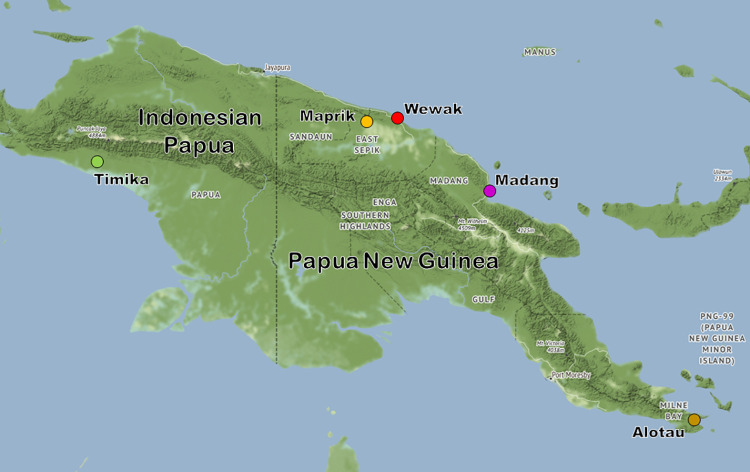
Fig 1
Fig 1. Geographical location of New Guinea sites.
Sites that contributed samples in both countries that form part of the island of New Guinea (Indonesia to the west and PNG to the east) are shown by coloured circular markers. Map tiles by Stamen Design (stamen.com), under CC-BY 3.0. Data ©OpenStreetMap contributors (openstreetmap.org).
Fig 2
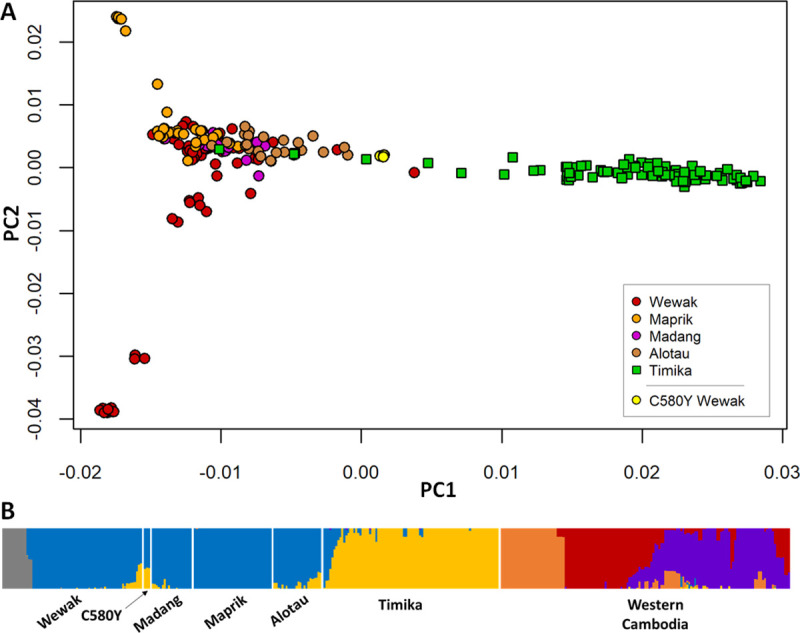
Fig 2. Population Structure in the New Guinea.
(A) Plot of the first two components (PC2 vs PC1) of principal coordinates analysis (PCoA) using genetic distances computed from whole-genome sequence data from all samples in New Guinea. We note a marked separation between parasites from Papua Indonesia (green squares) and PNG (circles), with a minority of samples from both regions at an intermediate position, suggesting admixture. (B) Population structure at all sites, estimated by fastSTRUCTURE, based on the hypothesis of K = 6 ancestral populations; each ancestral populations is indicated by a different colour, and each vertical bar represents a single sample, coloured according to the estimated ancestry proportions. The plot suggests no recent common ancestry between New Guinea parasites and those in Cambodia. Furthermore, it shows strong differentiations between parasites in Papua Indonesia and PNG (consistent with PCoA results above), with a minority of samples from both sides (including the Wewak C580Y mutants) exhibiting significant levels of admixture. This analysis also identified a subpopulation of Wewak parasites (gray) which correspond to the cluster of samples in the lower left-hand corner of the PCoA plot.
Fig 3
Fig 3. IBD between parasites from Wewak and those from other New Guinea sites.
This plot shows the distributions of the level of IBD (i.e. the percentage of the genome that is predicted to be in IBD) between parasites samples in Wewak and those sampled at other sites on the island of New Guinea. For each of the five sites, two boxplots show the distribution of pairwise IBD levels for parasites from that site: either against the Wewak C580Y mutants (blue, labelled “C580Y”), or against the Wewak kelch13 wild-type parasites (pink, “WT”). For the Wewak site (first two boxplots) we compare the two groups against Wewak WT samples only; hence, the blue boxplot shows IBD levels between Wewak C580Y mutants and Wewak WT parasites, while the pink boxplot shows IBD levels among Wewak WT parasites only.
Fig 4
Fig 4. IDB-based clustering.
These isoRelate network plots show IBD relationships between all samples analyzed for different genomic regions. Wewak C580Y mutants are shown by a magenta circle, pointed to by an arrow; note that only two mutants were included in this analysis, due to high degree of genotype missingness in the third mutant. (A) Whole-genome IBD shows that, although most parasites cluster strongly by geography, the C580Y mutants form a separate group, probably reflecting their admixed structure. (B) IBD in chromosome 13 regions flanking the kelch13 gene shows that Wewak parasites do not cluster in a single group, and the C580Y mutants form a group on their own; no New Guinea parasites cluster with the Cambodian group, confirming that kelch13 haplotypes on the island have independent origin. (C) IBD in chromosome 10 regions flanking the atg18 gene shows that C580Y mutants cluster with the Timika samples, as is also the case in the chromosome 5 regions flanking the pnp gene (D). In B-D, flanking regions are 75 kbp regions on either flank.
Fig 5
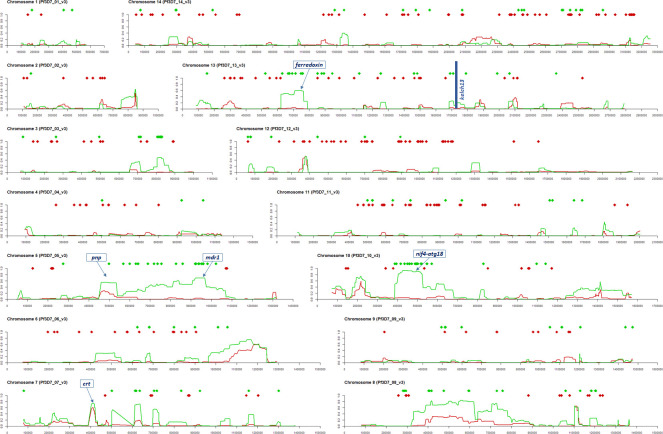
Fig 5. Structure of genetic admixture in Wewak C580Y mutants.
Fourteen plots are shown, one per chromosome in the P. falciparum nuclear genome; the x-axis of each plot represents nucleotide positions along the chromosome. At the top of each plot, two rows of diamond markers indicate the position of SNPs that are highly differentiated between the Wewak and Timika populations (FST ≥ 0.3); the marker colour indicates whether the allele present in the Wewak C580Y mutants matches the most common one in Timika (green diamonds) or Wewak (red diamonds). The line charts below the markers show the proportion of sample pairs in the Timika (green lines) and Wewak (red) population that are IDB with the Wewak C580Y parasites at each chromosome position.

References

    1. World Health Organization. World Malaria Report 2017. 2017.
    1. Dondorp AM, Nosten F, Yi P, Das D, Phyo AP, Tarning J, et al. Artemisinin resistance in Plasmodium falciparum malaria. N Engl J Med. 2009;361(5):455–67. 10.1056/NEJMoa0808859 . - DOI - PMC - PubMed
    1. Ashley EA, Dhorda M, Fairhurst RM, Amaratunga C, Lim P, Suon S, et al. Spread of artemisinin resistance in Plasmodium falciparum malaria. The New England Journal of Medicine. 2014;371(5):411–23. Epub 2014/07/31. 10.1056/NEJMoa1314981 ; PubMed Central PMCID: 4143591. - DOI - PMC - PubMed
    1. Amaratunga C, Lim P, Suon S, Sreng S, Mao S, Sopha C, et al. Dihydroartemisinin-piperaquine resistance in Plasmodium falciparum malaria in Cambodia: a multisite prospective cohort study. The Lancet Infectious diseases. 2016;16(3):357–65. Epub 2016/01/18. 10.1016/S1473-3099(15)00487-9 - DOI - PMC - PubMed
    1. Anderson TJ, Nair S, McDew-White M, Cheeseman IH, Nkhoma S, Bilgic F, et al. Population Parameters Underlying an Ongoing Soft Sweep in Southeast Asian Malaria Parasites. Mol Biol Evol. 2017;34(1):131–44. 10.1093/molbev/msw228 - DOI - PMC - PubMed

Publication types