. 2020 Dec;13(6):e002769.
doi: 10.1161/CIRCGEN.119.002769. Epub 2020 Aug 13.

Genetic Predisposition to Coronary Artery Disease in Type 2 Diabetes Mellitus

Natalie R van Zuydam  1   2   3 Claes Ladenvall  4 Benjamin F Voight  5   6   7 Rona J Strawbridge  8 Juan Fernandez-Tajes  3 N William Rayner  2   3   9 Neil R Robertson  2   3 Anubha Mahajan  2   3 Efthymia Vlachopoulou  10 Anuj Goel  3   11 Marcus E KleberChristopher P Nelson  12   13 Lydia Coulter Kwee  14 Tõnu Esko  15 Evelin Mihailov  15 Reedik Mägi  15 Lili Milani  15 Krista Fischer  15 Stavroula Kanoni  16   17   18   19   20 Jitender Kumar  21   22 Ci Song  21   23   24   25 Jaana A Hartiala  26 Nancy L Pedersen  27 Markus Perola  28   15   29 Christian Gieger  30   31   32 Annette Peters  30   32   33 Liming Qu  34   35   36 Sara M Willems  37 Alex S F Doney  38 Andrew D Morris  39   40 Yan Zheng  35   41 Giorgio Sesti  42 Frank B Hu  35   43   44 Lu Qi  34   35   36 Markku Laakso  45   46 Unnur Thorsteinsdottir  47 Harald Grallert  30   31   48   49 Cornelia van Duijn  37 Muredach P Reilly  34 Erik Ingelsson  21   50   51   52 Panos Deloukas  17   53 Sek Kathiresan  16   17   18   19   20 Andres Metspalu  15   54 Svati H Shah  55   14 Juha Sinisalo  56 Veikko Salomaa  29 Anders Hamsten  8 Nilesh J Samani  12   13 Winfried März  57   58 Stanley L Hazen  59 Hugh Watkins  3   11 Danish Saleheen  60   61 Andrew P Morris  3   62   63 Helen M Colhoun  64   65 Leif Groop  4 Mark I McCarthy  2   3   66 Colin N A Palmer  1 SUMMIT Steering Committee; CARDIOGRAMplusC4D Steering Committee*
Collaborators, Affiliations

Genetic Predisposition to Coronary Artery Disease in Type 2 Diabetes Mellitus

Natalie R van Zuydam et al. Circ Genom Precis Med. 2020 Dec.

Abstract

Background: Coronary artery disease (CAD) is accelerated in subjects with type 2 diabetes mellitus (T2D).

Methods: To test whether this reflects differential genetic influences on CAD risk in subjects with T2D, we performed a systematic assessment of genetic overlap between CAD and T2D in 66 643 subjects (27 708 with CAD and 24 259 with T2D). Variants showing apparent association with CAD in stratified analyses or evidence of interaction were evaluated in a further 117 787 subjects (16 694 with CAD and 11 537 with T2D).

Results: None of the previously characterized CAD loci was found to have specific effects on CAD in T2D individuals, and a genome-wide interaction analysis found no new variants for CAD that could be considered T2D specific. When we considered the overall genetic correlations between CAD and its risk factors, we found no substantial differences in these relationships by T2D background.

Conclusions: This study found no evidence that the genetic architecture of CAD differs in those with T2D compared with those without T2D.

Keywords: blood pressure; coronary artery disease; diabetes mellitus; genome-wide association study; risk factors.


Conflict of interest statement

Authors have disclosed possible conflicts of interest and have confirmed that these are unrelated to the work described in this article. Dr Ingelsson is a scientific advisor for Precision Wellness. Dr Salomaa has consulted for Novo Nordisk and Sanofi and has ongoing research collaboration with Bayer (all unrelated to the present study). Dr März reports employment with Synlab Holding Deutschland GmbH and has received grants or personal fees from Abbott Diagnostics; Aegerion Pharmaceuticals; AMGEN; AstraZeneca; BASF Pharma Solutions; Danone Research; MSD; Sanofi; Siemens Diagnostics; and Synageva. Dr Colhoun receives research support and honoraria from and is also a member of the advisory panels and speaker’s bureaus for Sanofi Aventis, Regeneron, and Eli Lilly. Dr Colhoun has been a member of Data and Safety Monitoring Board of the Advisory Panel for the CANTOS Trial (Canakinumab. Anti-Inflammatory Thrombosis Outcome Study; Novartis Pharmaceuticals). Dr Colhoun also receives or has recently received nonbinding research support from Roche Pharmaceuticals, Pfizer, Inc, Boehringer Ingelheim, and AstraZeneca. Dr Colhoun is a shareholder of Roche Pharmaceuticals and Bayer. Dr McCarthy has served on advisory panels for Pfizer, NovoNordisk, and Zoe Global, has received honoraria from Merck, Pfizer, Novo Nordisk, and Eli Lilly, and research funding from Abbvie, AstraZeneca, Boehringer Ingelheim, Eli Lilly, Janssen, Merck, NovoNordisk, Pfizer, Roche, Sanofi Aventis, Servier, and Takeda. As of June 2019, Dr McCarthy is an employee of Genentech and a holder of Roche stock. As of September 2019, Dr van Zuydam is an employee of AstraZeneca. As of 2016, Dr Vlachopoulou is an employee of Medpace. The other authors report no conflicts.

Figures
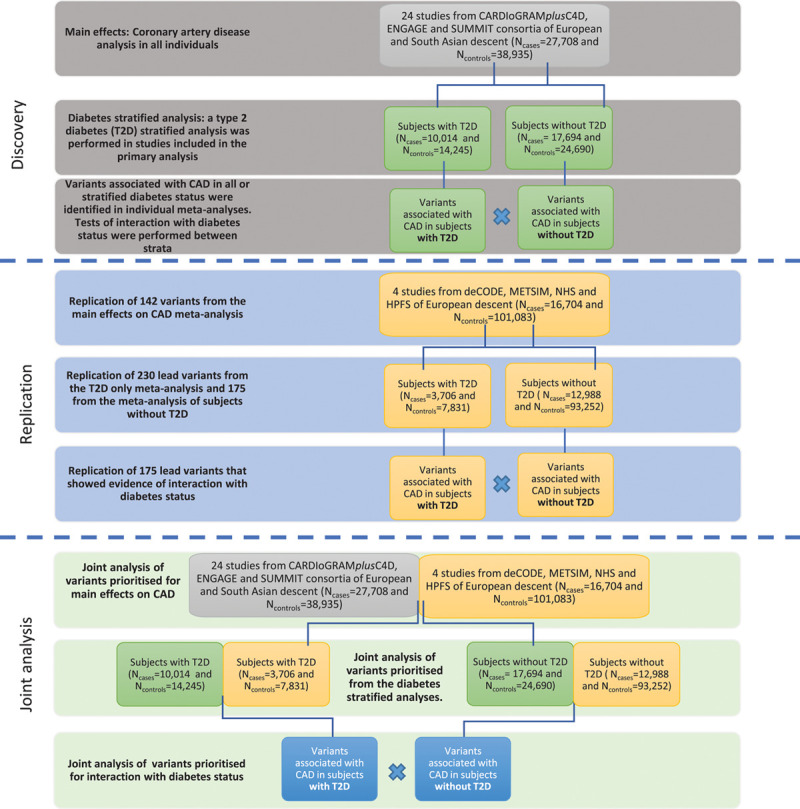
Figure 1.
Figure 1.
Study design. In the discovery meta-analyses, we performed 4 different meta-analyses of coronary artery disease (CAD): in all individuals irrespective of Type 2 diabetes mellitus (T2D) status; in all individuals corrected for T2D stats; and stratified by T2D status. We examined allelic effects within strata to identify stratum-specific CAD associated variants, and between strata to identify variants that may interact with T2D status to modify the risk of CAD. We selected variants that achieved P<1×10⁻⁴ for association with CAD in at least one of the following analyses: all individuals combined regardless of T2D status; subjects with T2D only; subjects without diabetes mellitus; or the interaction analysis. The replication analysis was performed in independent samples using the same study design as the discovery analysis. CARDIoGRAMplusC4D indicates Coronary Artery Disease Genome Wide Replication and Meta-Analysis (CARDIoGRAM) Plus the Coronary Artery Disease (C4D) Genetics; ENGAGE, European Network for Genetic and Genomic Epidemiology; HPFS, Health Professionals Follow-Up Study; METSIM, The Metabolic Syndrome in Men Study; NHS, Nurses’ Health Study; and SUMMIT, Surrogate Markers for Micro- and Macro-Vascular Hard End Points for Innovative Diabetes Tools.
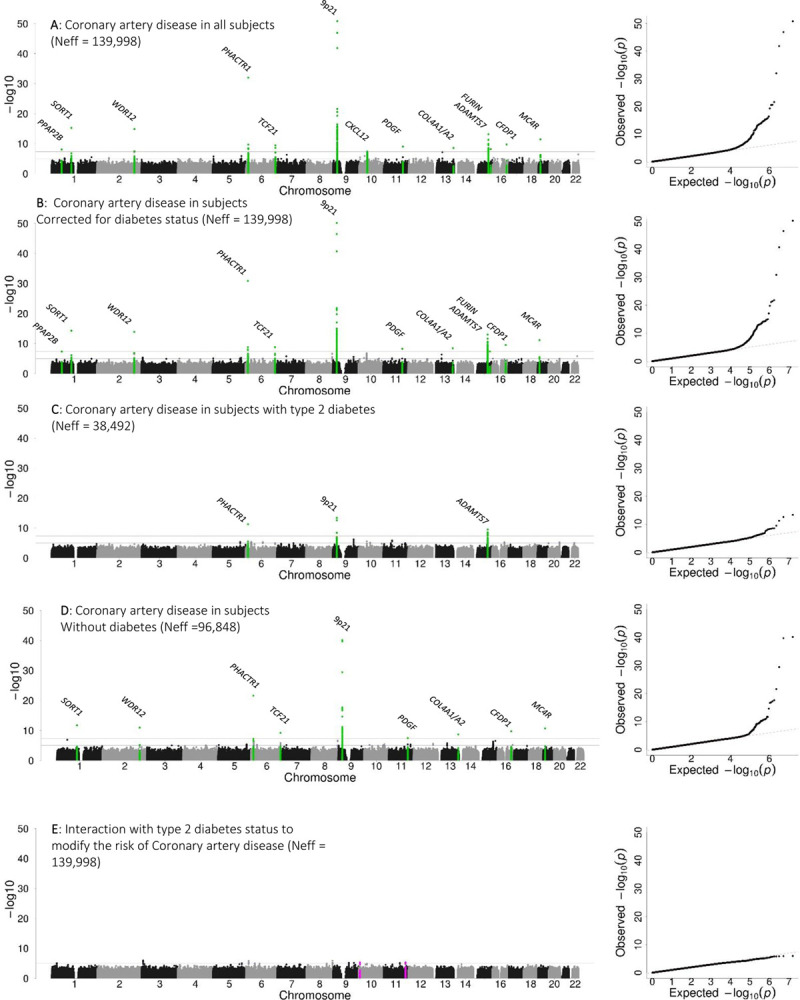
Figure 2.
Figure 2.
Five genetic association study meta-analyses were performed to investigate the genetic architecture of coronary artery disease (CAD) in the context of Type 2 diabetes mellitus (T2D). Manhattan and QQ plots from (A) a meta-analysis that combined allelic effects on CAD from subjects with T2D status and without diabetes mellitus and (B) corrected for T2D status to identify variants associated with CAD irrespective of T2D status; (C) a meta-analysis of allelic effects on CAD in subjects with T2D to identify loci that may influence the development of CAD in the context of T2D; (D) a meta-analysis of allelic effects on CAD in the absence of diabetes mellitus to identify loci that may influence the development of CAD in the absence of diabetes mellitus; and (E) an interaction analysis to identify loci that may interact with T2D to modify the risk of CAD. The effective sample size was based on the combined discovery and replication sample of 184 250 subjects.

References

    1. Waller BF, Palumbo PJ, Lie JT, Roberts WC. Status of the coronary arteries at necropsy in diabetes mellitus with onset after age 30 years. Analysis of 229 diabetic patients with and without clinical evidence of coronary heart disease and comparison to 183 control subjects. Am J Med. 1980;69:498–506. doi: 10.1016/s0149-2918(05)80002-5 - PubMed
    1. Koistinen MJ. Prevalence of asymptomatic myocardial ischaemia in diabetic subjects. BMJ. 1990;301:92–95. doi: 10.1136/bmj.301.6743.92 - PMC - PubMed
    1. Carr ME. Diabetes mellitus: a hypercoagulable state. J Diabetes Complications. 2001;15:44–54. doi: 10.1016/s1056-8727(00)00132-x - PubMed
    1. El-Osta A, Brasacchio D, Yao D, Pocai A, Jones PL, Roeder RG, Cooper ME, Brownlee M. Transient high glucose causes persistent epigenetic changes and altered gene expression during subsequent normoglycemia. J Exp Med. 2008;205:2409–2417. doi: 10.1084/jem.20081188 - PMC - PubMed
    1. Erdmann J, Kessler T, Munoz Venegas L, Schunkert H. A decade of genome-wide association studies for coronary artery disease: the challenges ahead. Cardiovasc Res. 2018;114:1241–1257. doi: 10.1093/cvr/cvy084 - PubMed

Publication types

MeSH terms