


Parents' Experiences of the First Year at Home with an Infant Born Extremely Preterm with and without Post-Discharge Intervention: Ambivalence, Loneliness, and Relationship Impact
- PMID: 33322234
- PMCID: PMC7764273
- DOI: 10.3390/ijerph17249326
Parents' Experiences of the First Year at Home with an Infant Born Extremely Preterm with and without Post-Discharge Intervention: Ambivalence, Loneliness, and Relationship Impact
Abstract
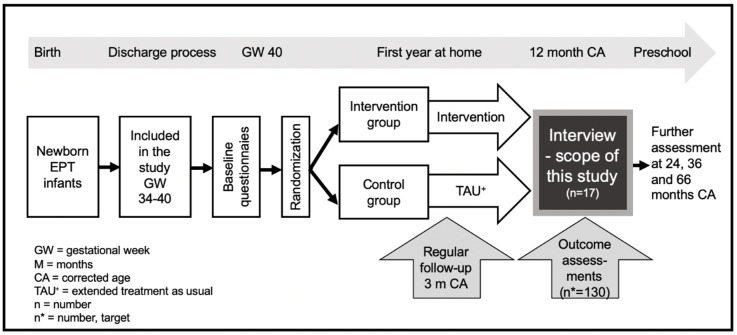
With increasing survival rates of children born extremely preterm (EPT), before gestational week 28, the post-discharge life of these families has gained significant research interest. Quantitative studies of parental experiences post-discharge have previously reported elevated levels depressive symptoms, posttraumatic stress-disorder and anxiety among the parents. The current investigation aims to qualitatively explore the situation for parents of children born EPT in Sweden during the first year at home. Semi-structured interviews were performed with 17 parents of 14 children born EPT; eight parents were from an early intervention group and nine parents from a group that received treatment as usual, with extended follow-up procedures. Three main themes were identified using a thematic analytic approach: child-related concerns, the inner state of the parent, and changed family dynamics. Parents in the intervention group also expressed themes related to the intervention, as a sense of security and knowledgeable interventionists. The results are discussed in relation to different concepts of health, parent-child interaction and attachment, and models of the recovery processes. In conclusion, parents describe the first year at home as a time of prolonged parental worries for the child as well as concerns regarding the parent's own emotional state.
Keywords: early intervention; follow-up; home visit program; infancy; parent-child interaction; parenthood; preterm infant; qualitative research; strengths-based approach.
Conflict of interest statement
The authors declare no conflict of interest.
Figures
References
-
- March of Dimes. PMNCH. Save the Children. WHO . In: Born Too Soon: The Global Action Report on Preterm Birth. Howson C.P., Kinney M.V., Lawn J.E., editors. World Health Organization; Geneva, Switzerland: 2012.
-
- Davis D., Stein M.T. Intensive Parenting: Surviving the Emotional Journey through the NICU. Fulcrum Publishing; Wheat Ridge, CO, USA: 2016.
Publication types
MeSH terms
LinkOut - more resources
Full Text Sources
Medical
