


Considerations for the Design of a Physical Fitness Battery to Assess Adults with Intellectual Disabilities: Preliminary Reference Values for the SAMU DIS-FIT Study
- PMID: 33322511
- PMCID: PMC7763473
- DOI: 10.3390/ijerph17249280
Considerations for the Design of a Physical Fitness Battery to Assess Adults with Intellectual Disabilities: Preliminary Reference Values for the SAMU DIS-FIT Study
Abstract
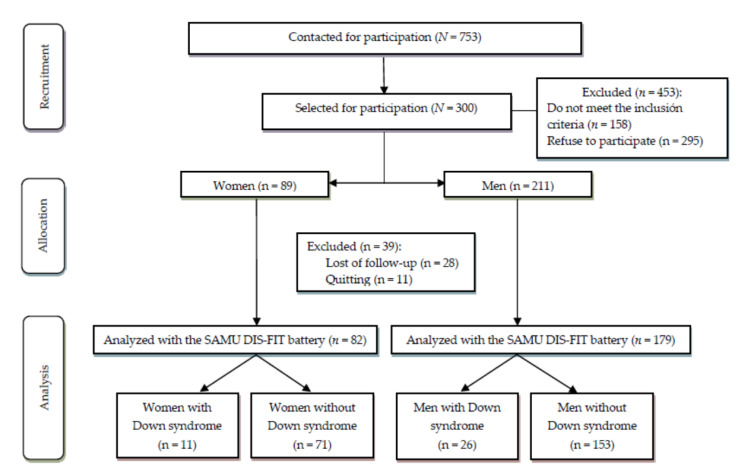
For the assessment of the health-related physical fitness (PF) of individuals with intellectual disabilities (ID), tools designed for people without disabilities have generally been used. Also, the results of these assessments have routinely been compared with the scores obtained by people without ID. The objectives of the present study are to present the rationale for the design of an assessment battery for PF, the so-called SAMU DIS-FIT battery, and to present the results obtained by the participants classified according to age, sex, and level of PF (physical fitness). The selection criteria for the tests that would make up the battery were: (i) utility, (ii) psychometric properties, (iii) easiness and diversity, (iv) simplicity of execution, (v) familiarity and motivation, and (vi) economy of resources. A cross-sectional study was designed to assess the PF of 261 individuals with ID. To interpret the results obtained by the participants, each of the quantitative variables of PF was categorized into three levels: lower-fit, mid-fit, and higher-fit. The findings of this study serve as a first step in establishing PF baseline values for individuals with ID.
Keywords: disability; health; life span; physical fitness; reference values; tool.
Conflict of interest statement
The author declares no conflict of interest. The funders had no role in the design of the study; in the collection, analyses, or interpretation of data; in the writing of the manuscript, or in the decision to publish the results.
References
-
- Rintala P., Asunta P., Lahti J., Loovis E.M. Physical fitness of individuals with intellectual disability who have special olympics experience. EUJAPA. 2016;9:13–19. doi: 10.5507/euj.2016.006. - DOI
Publication types
MeSH terms
LinkOut - more resources
Full Text Sources
Medical
