Review
. 2020 Dec 11;10(12):346.
doi: 10.3390/life10120346.

De Novo Nucleic Acids: A Review of Synthetic Alternatives to DNA and RNA That Could Act as Bio-Information Storage Molecules

Affiliations
Review

De Novo Nucleic Acids: A Review of Synthetic Alternatives to DNA and RNA That Could Act as Bio-Information Storage Molecules

Kevin G Devine et al. Life (Basel). .

Abstract

Modern terran life uses several essential biopolymers like nucleic acids, proteins and polysaccharides. The nucleic acids, DNA and RNA are arguably life's most important, acting as the stores and translators of genetic information contained in their base sequences, which ultimately manifest themselves in the amino acid sequences of proteins. But just what is it about their structures; an aromatic heterocyclic base appended to a (five-atom ring) sugar-phosphate backbone that enables them to carry out these functions with such high fidelity? In the past three decades, leading chemists have created in their laboratories synthetic analogues of nucleic acids which differ from their natural counterparts in three key areas as follows: (a) replacement of the phosphate moiety with an uncharged analogue, (b) replacement of the pentose sugars ribose and deoxyribose with alternative acyclic, pentose and hexose derivatives and, finally, (c) replacement of the two heterocyclic base pairs adenine/thymine and guanine/cytosine with non-standard analogues that obey the Watson-Crick pairing rules. This manuscript will examine in detail the physical and chemical properties of these synthetic nucleic acid analogues, in particular on their abilities to serve as conveyors of genetic information. If life exists elsewhere in the universe, will it also use DNA and RNA?

Keywords: alien life forms; hexose derivatives; non-standard nucleic acids; pentose sugars; phosphate group replacement; sugar-phosphate backbone.


Conflict of interest statement

The authors declare that there is no conflict of interests.

Figures
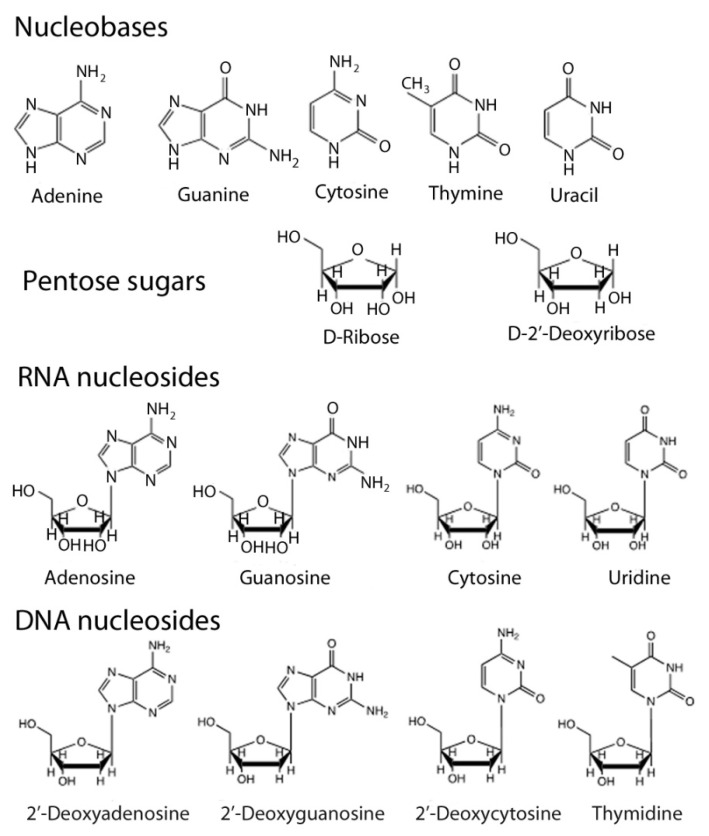
Figure 1
Figure 1
The molecular structures of the nucleobases, sugars and nucleosides found in DNA and RNA.
Figure 2
Figure 2
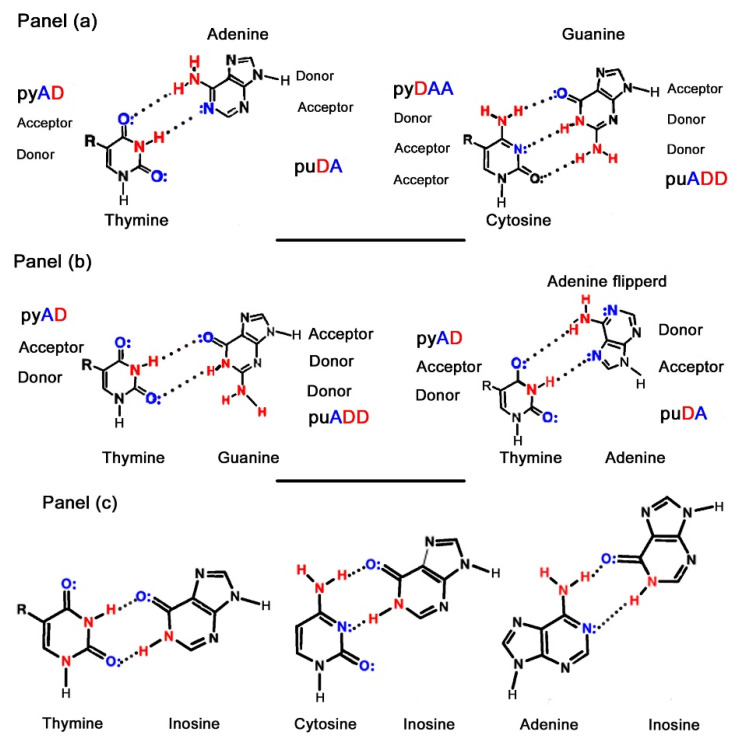
Panel (a): the base-pairs between T–A and C–G revealing both the size and hydrogen-bonding complementarities displayed by these pairs. Panel (b): The wobble base-pairing of T and G (left), and the Hoogsteen base-pairing of T and A (right). Panel (c): wobble base-pairings between thymine and inosine (left), cytosine and inosine (centre), and adenine and inosine (right).
Figure 3
Figure 3
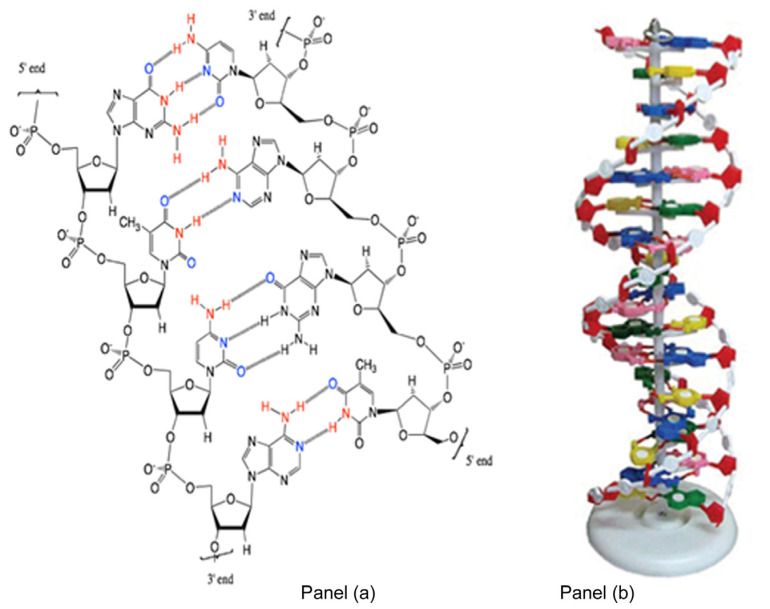
The duplex between two Watson–Crick base-paired complementary DNA strands panel (a), is arranged as a double-helix in which the base-pairs are the steps and the sugar-phosphate backbone the handles panel (b).
Figure 4
Figure 4
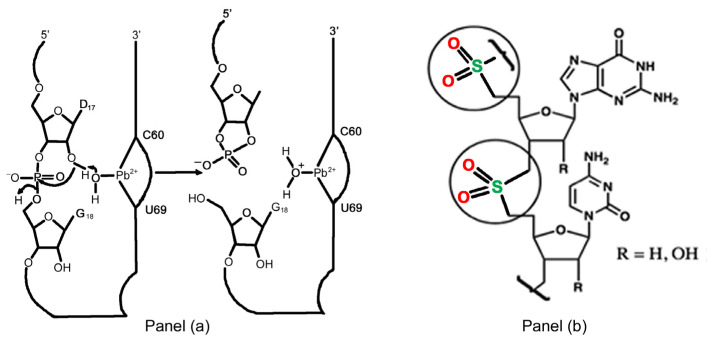
Panel (a): a proposed mechanism for the cleavage of a phosphodiester bond in yeast phenylalanine tRNA. The Pb2+ is bound to a specific site on the RNA around the bases U59 and C60. The active species is probably (PbOH)+ which has a pKa of about 7.0. Panel (b): oligosulfones, which contain a dimethylene sulfone group in place of phosphate, no longer form duplexes with Watson–Crick base-pairings but bend and fold more like proteins.
Figure 5
Figure 5
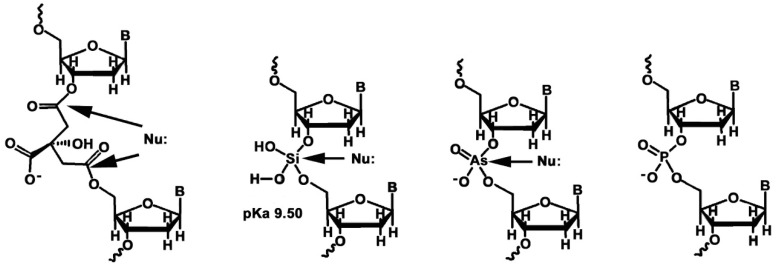
The phosphodiester linkage in nucleic acids is much more resistant to attack by nucleophiles (Nu:) than the alternative arsenate diesters, silicate diesters and citrate diesters.
Figure 6
Figure 6
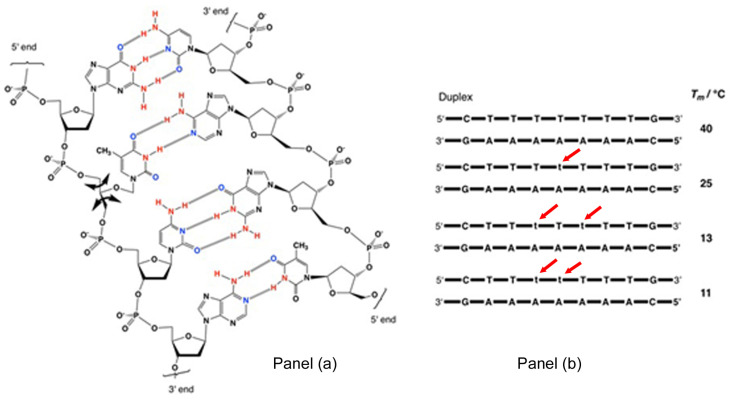
The more flexible 3′-1′-glycerol linker disrupts base-pairing and duplex formation in comparison to the more rigid 2′-deoxyribose panel (a), as revealed by the much lower melting temperatures of the duplexes containing one or two of these linkers panel (b).
Figure 7
Figure 7
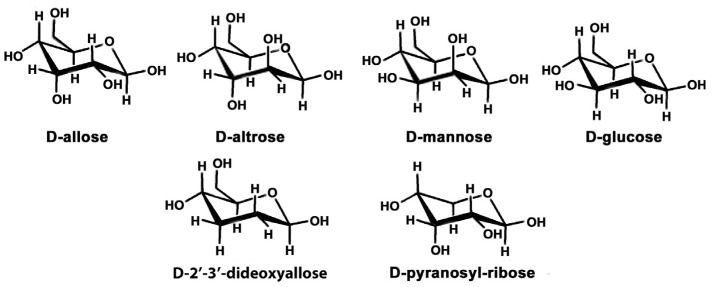
The six hexose sugars used by Eschenmoser’s group to make hexose-nucleic acids.
Figure 8
Figure 8
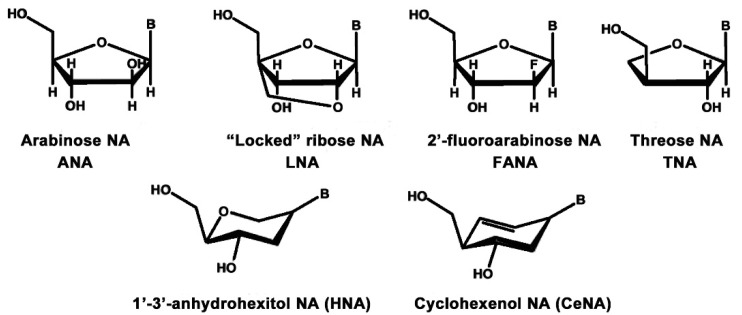
The six xeno-nucleosides, built from 4 pentoses and 2 hexoses used to construct xeno-nucleic acids, XNAs.
Figure 9
Figure 9
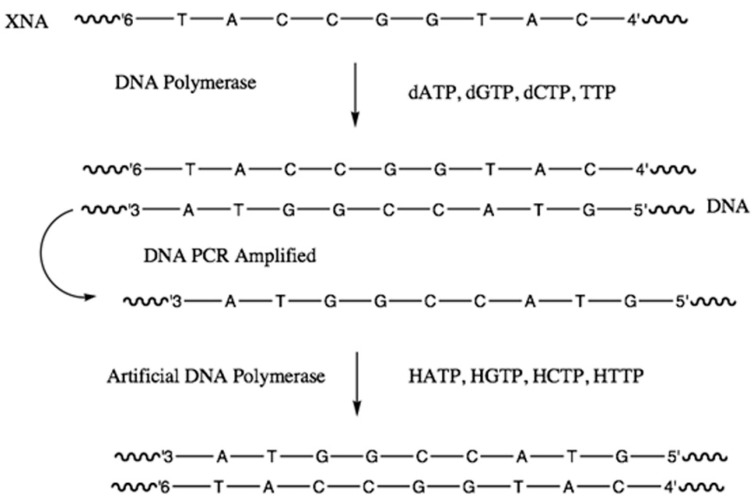
Specially evolved “Artificial” DNA polymerases enable XNA and DNA to act as templates for each other in PCR.
Figure 10
Figure 10
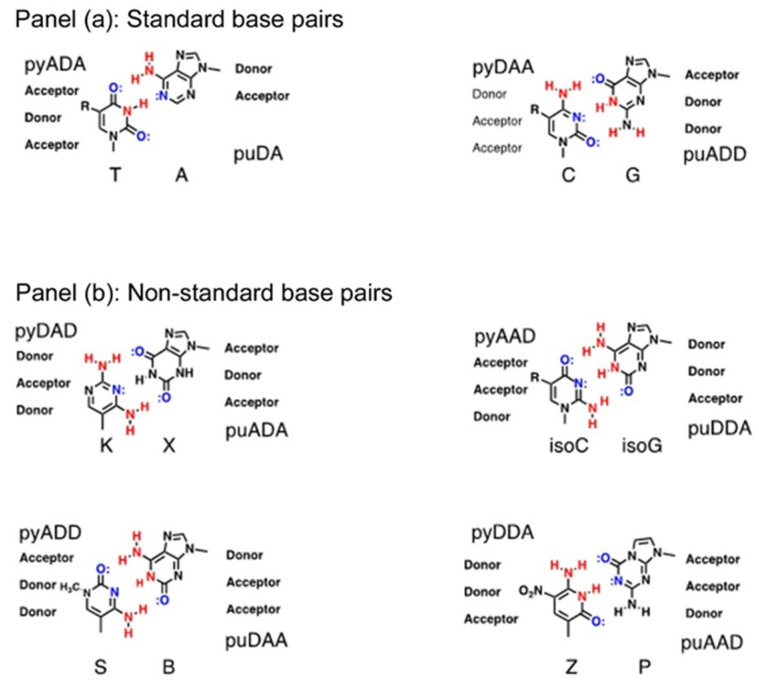
Panel (a) shows standard base pairs in contemporary biology. Panel (b) shows an Expanded Genetic Information System containing 8 non-standard bases arranged as 4 non-standard pairs; K–X, isoC–isoG, S–B and Z–P.

References

    1. Watson J.D., Crick F.H.C. Molecular structure of Nucleic Acids. Nature. 1953;171:737–738. doi: 10.1038/171737a0. - DOI - PubMed
    1. Hoogsteen K. The crystal and molecular structure of a hydrogen-bonded complex between 1-methylthymine and 9-methyladenine. Acta Crystallogr. 1963;16:907–916. doi: 10.1107/S0365110X63002437. - DOI
    1. Zagryadskaya E.I., Doyon F.R., Steinberg S.V. Importance of the reverse Hoogsteen base pair 54-58 for tRNA function. Nucleic Acids Res. 2003;31:3946–3953. doi: 10.1093/nar/gkg448. - DOI - PMC - PubMed
    1. Herbert A. Z-DNA and Z-RNA in human disease. Nat. Commun. Biol. 2019;2:1–10. doi: 10.1038/s42003-018-0237-x. - DOI - PMC - PubMed
    1. Benner S.A. Size Limits of Very Small Microorganisms: Proceedings of a Workshop. National Research Council; Washington, DC, USA: 1999. pp. 126–135. Steering Group on Astrobiology of the Space Studies Board. - PubMed

LinkOut - more resources