


Trends and Determinants of EBF among Adolescent Children Born to Adolescent Mothers in Rural Bangladesh
- PMID: 33322838
- PMCID: PMC7768375
- DOI: 10.3390/ijerph17249315
Trends and Determinants of EBF among Adolescent Children Born to Adolescent Mothers in Rural Bangladesh
Abstract
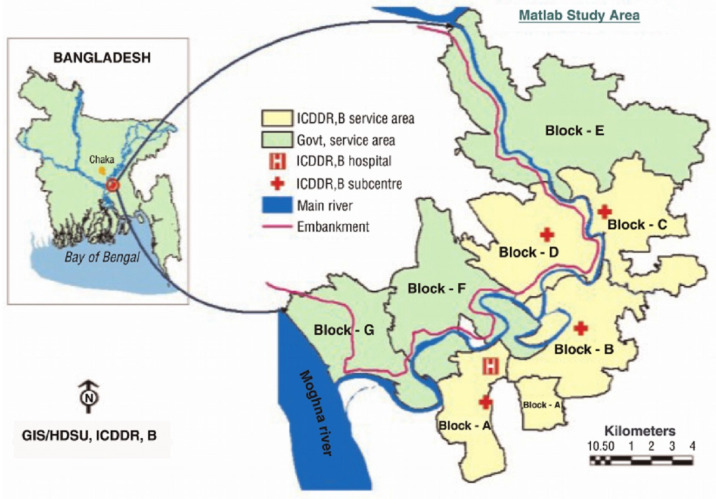
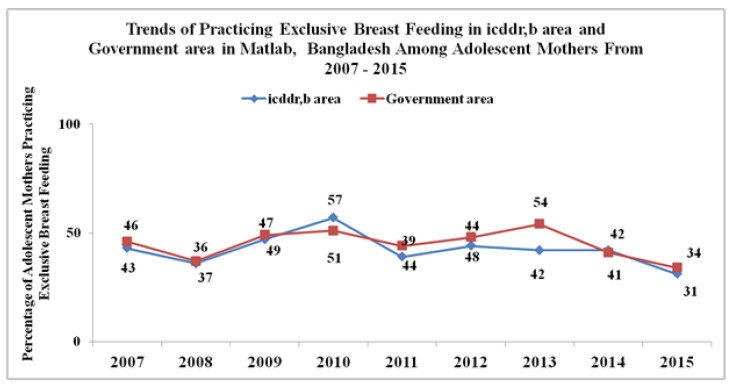
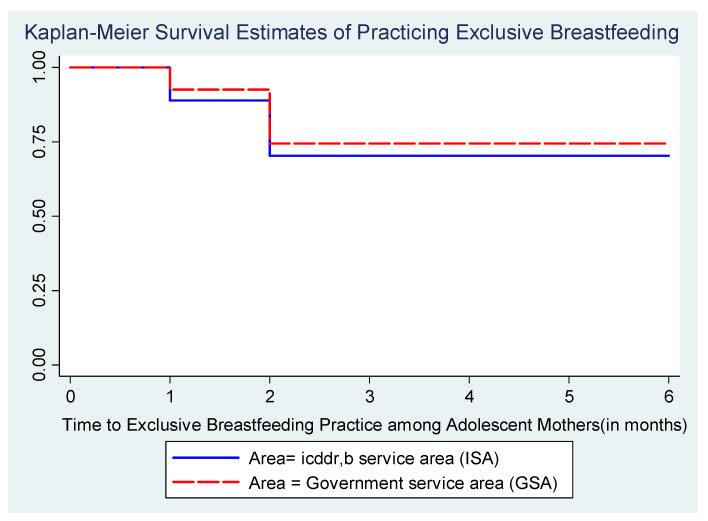
Exclusive breastfeeding (EBF) has proven benefits for both mothers and infants; however, adolescent mothers have poor EBF practices globally. In Bangladesh, the practice of EBF among adolescent mothers remains unexplored. The aim of our study was to understand the EBF practices among adolescent mothers and their determinants in both the Health and Demographic Surveillance (HDSS) system areas of the International Centre for Diarrheal Disease Research, Bangladesh (icddr,b) service area (ISA) and government service area (GSA) in rural Matlab, Bangladesh. For the purpose of our study, we collected relevant information from the database of the Health and Demographic Surveillance System (HDSS) of icddr,b and performed analysis to understand the trends and identify the determinants of EBF and identify the determinants of EBF among adolescent mothers living in two areas between 2007 and 2015. In total, 2947 children born to adolescent mothers were included in our final analysis. We used the Kaplan-Meier and the Cox-proportional hazards models to determine the differences in EBF practices in the two areas. We noted a lower trends of EBF in the ISA compared to the GSA in bivariate analysis. However, after adjusting for confounding variables, EBF status was 15% lower in the GSA than the ISA (HR: 0.85, 95% CI: 0.72-0.99). The father's education was significantly different among the two populations. In both study areas, the coverage of EBF among adolescent mothers was lower than the national average (42% vs. 65%). Ensuring that adolescent mothers receive optimal care may improve EBF behavior.
Keywords: Bangladesh; adolescent; exclusive breastfeeding.
Conflict of interest statement
The authors declare no conflict of interest. The funders had role in the design of the study; in the collection, analyses, or interpretation of data; in the writing of the manuscript; or in the decision to publish the results.
Figures
References
-
- Wrottesley S., Lamper C., Pisa P. Review of the importance of nutrition during the first 1000 days: Maternal nutritional status and its associations with fetal growth and birth, neonatal and infant outcomes among African women. J. Dev. Orig. Health Dis. 2016;7:144–162. doi: 10.1017/S2040174415001439. - DOI - PubMed
-
- Centers for Disease Control and Prevention, National Center for Chronic Disease Prevention and Health Promotion Breastfeeding among US children born 2002–2012. CDC National Immunization Surveys. [(accessed on 15 September 2020)]; Available online: www.cdc.gov/breastfeeding/data/nis_data/index.htm.
-
- WHO. UNICEF. AED. USAID. IFPRI. UCDAVIS . Indicators for Assessing Infant and Young Child Feeding Practices: Conclusions of a Consensus Meeting Held 6–8 November 2007 in Washington DC, USA. World Health Organization; Geneva, Switzerland: 2008.
-
- Ngamnil N., Kaewkiattikun K. Prevalence of EBF among adolescent mothers in Bangkok. Thai J. Obstet. Gynaecol. 2019;27:79–87.
Publication types
MeSH terms
LinkOut - more resources
Full Text Sources
Medical
