. 2020 Nov 20;5(48):30989-30999.
doi: 10.1021/acsomega.0c03907. eCollection 2020 Dec 8.

Para-Substituted α-Phenyl- N- tert-butyl Nitrones: Spin-Trapping, Redox and Neuroprotective Properties

Affiliations

Para-Substituted α-Phenyl- N- tert-butyl Nitrones: Spin-Trapping, Redox and Neuroprotective Properties

Anaïs Deletraz et al. ACS Omega. .

Abstract

In this work, a series of para-substituted α-phenyl-N-tert-butyl nitrones (PBN) were studied. Their radical-trapping properties were evaluated by electron paramagnetic resonance, with 4-CF3-PBN being the fastest derivative to trap the hydroxymethyl radical (CH2OH). The redox properties of the nitrones were further investigated by cyclic voltammetry, and 4-CF3-PBN was the easiest to reduce and the hardest to oxidize. This is due to the presence of the electron-withdrawing CF3 group. Very good correlations between the Hammett constants (σp) of the substituents and both spin-trapping rates and redox potentials were observed. These correlations were further supported by computationally determined ionization potentials and atom charge densities. Finally, the neuroprotective effect of these derivatives was studied using two different in vitro models of cell death on primary cortical neurons injured by glutamate exposure or on glial cells exposed to t BuOOH. Trends between the protection afforded by the nitrones and their lipophilicity were observed. 4-CF3-PBN was the most potent agent against t BuOOH-induced oxidative stress on glial cells, while 4-Me2N-PBN showed potency in both models.


Conflict of interest statement

The authors declare no competing financial interest.

Figures

Figure 1
Figure 1
Chemical structures of DMPO, PBN, NXY-059, and X-PBNs studied in this work. Molecular weight, SMILES string, and PubChem IDs of all of the compounds are given in the Supporting Information (Table S1).
Scheme 1
Scheme 1. Methods Used for the Synthesis of 4-X-PBN Nitrones
Scheme 2
Scheme 2. General Spin-Trapping Mechanism by Nitrones
Figure 2
Figure 2
EPR signals of TN and N hydroxymethyl radical adducts, respectively. (A) N = PBN and (B) N = 4-CF3-PBN. The hydroxymethyl radical was generated by a Fenton system and the concentration ratio [N]/[TN] = 4. The peaks topped by a cross (×) correspond to the hydroxymethyl radical adduct of N. (C) Determination of the relative rate constants kN/kTN of CH2OH trapping by PBN, 4-CF3-PBN, and 4-iPr-PBN.
Figure 3
Figure 3
Correlation of relative rate constants (kN/kPBN) of CH2OH addition to nitrones with (A) Hammett constants (σp) (R2 = 0.86) and with (B) atomic total charge of the nitronyl moiety (R2 = 0.83, excluding the outlier 4-Ph-PBN marked as ○).
Figure 4
Figure 4
Cyclic voltammograms of PBN, 4-iPr-PBN, 4-MeCONH-PBN, and 4-CF3-PBN in acetonitrile containing 0.1 M TBAP at a GC electrode and potential scan rate ν = 0.1 V/s: (A) reduction and (B) oxidation. Inset: correlation of ionization potential with the oxidation potential of nitrones (R2 = 0.71), excluding the outlier 4-MeS-PBN for which a more complex oxidation process was observed. The correlation includes the values for 4-AcNHCH2-PBN, 4-MeNHCO-PBN, 4-HOOC-PBN, and 4-NC-PBN from Rosselin et al and for 4-MeO-PBN from Deletraz et al.
Figure 5
Figure 5
Antioxidant effect of 4-X-PBN derivatives at 10 μM on glial cells challenged by tBuOOH (300 μM, 24 h), after 24 h of incubation with nitrones. Cell survival evaluation: MTT assay. Significance was accepted with *p < 0.05 versus tBuOOH condition by the one-way analysis of variance (ANOVA) test.
Figure 6
Figure 6
Neuroprotective effect of PBN derivatives at 0.1, 1, and 10 μM on primary cortical neurons injured by glutamate (20 μM, 20 min, evaluation performed 48 h after the glutamate washout) after 1 h of incubation with nitrones. Cell survival evaluation: MTT assay. Significance was accepted with *p < 0.05 versus glutamate condition by one-way ANOVA, followed by PLSD Fisher’s test.
Figure 7
Figure 7
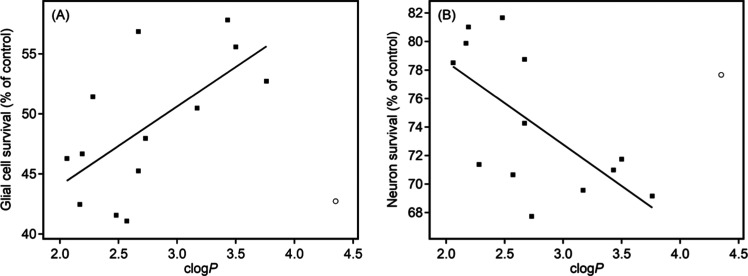
Correlation of octanol–water partition coefficient (c log P) of the nitrones with their protective effect at 10 μM on (A) glial cells challenged by tBuOOH (R2 = 0.41) and (B) primary cortical neurons injured by glutamate (R2 = 0.42), excluding the outlier 4-Ph-PBN marked as ○.

References

    1. Halliwell B.; Gutteridge J. M. C.. Free Radicals in Biology and Medicine; Oxford University Press, 2015.
    1. Finkel T.; Holbrook N. J. Oxidants, Oxidative Stress and the Biology of Ageing. Nature 2000, 408, 239–247. 10.1038/35041687. - DOI - PubMed
    1. Villamena F. A.Reactive Species Detection in Biology: From Fluorescence to Electron Paramagnetic Resonance Spectroscopy; Elsevier, 2017.
    1. Floyd R. A.; Kopke R. D.; Choi C.-H.; Foster S. B.; Doblas S.; Towner R. A. Nitrones as Therapeutics. Free Radical Biol. Med. 2008, 45, 1361–1374. 10.1016/j.freeradbiomed.2008.08.017. - DOI - PMC - PubMed
    1. Villamena F. A.; Das A.; Nash K. M. Potential Implication of the Chemical Properties and Bioactivity of Nitrone Spin Traps for Therapeutics. Future Med. Chem. 2012, 4, 1171–1207. 10.4155/fmc.12.74. - DOI - PMC - PubMed