Review
. 2020 Jun 16:2:17.
doi: 10.1186/s42466-020-00060-6. eCollection 2020.

Recovery from stroke: current concepts and future perspectives

Affiliations
Review

Recovery from stroke: current concepts and future perspectives

Christian Grefkes et al. Neurol Res Pract. .

Abstract

Stroke is a leading cause of acquired, permanent disability worldwide. Although the treatment of acute stroke has been improved considerably, the majority of patients to date are left disabled with a considerable impact on functional independence and quality of life. As the absolute number of stroke survivors is likely to further increase due to the demographic changes in our aging societies, new strategies are needed in order to improve neurorehabilitation. The most critical driver of functional recovery post-stroke is neural reorganization. For developing novel, neurobiologically informed strategies to promote recovery of function, an improved understanding of the mechanisms enabling plasticity and recovery is mandatory. This review provides a comprehensive survey of recent developments in the field of stroke recovery using neuroimaging and non-invasive brain stimulation. We discuss current concepts of how the brain reorganizes its functional architecture to overcome stroke-induced deficits, and also present evidence for maladaptive effects interfering with recovery. We demonstrate that the combination of neuroimaging and neurostimulation techniques allows a better understanding of how brain plasticity can be modulated to promote the reorganization of neural networks. Finally, neurotechnology-based treatment strategies allowing patient-tailored interventions to achieve enhanced treatment responses are discussed. The review also highlights important limitations of current models, and finally closes with possible solutions and future directions.

Keywords: Brain stimulation; Motor; Neuroimaging; Neurorehabilitation; TMS.


Conflict of interest statement

Competing interestsThe authors declare no competing interests.

Figures
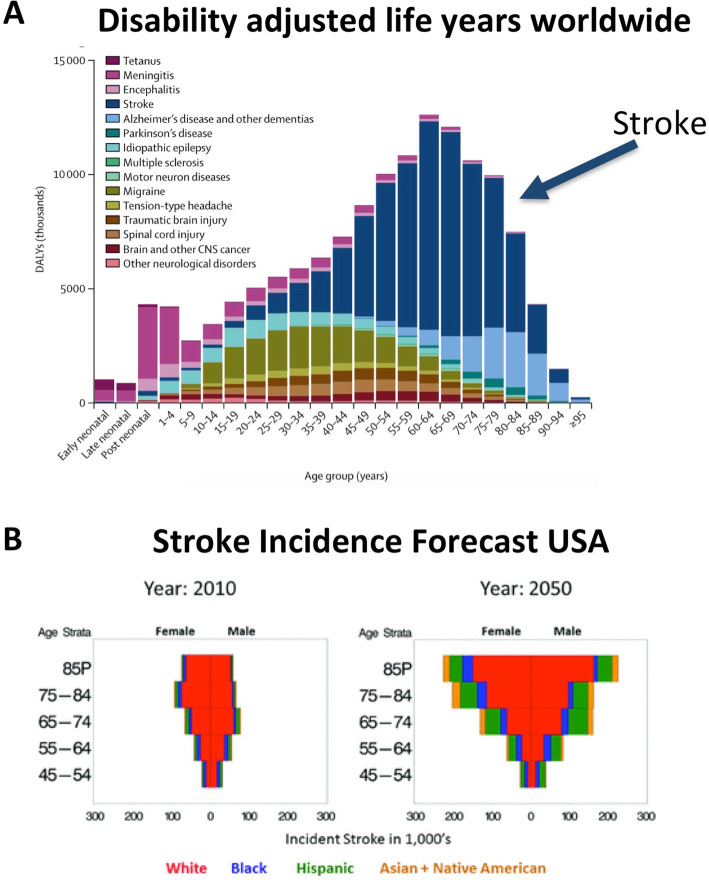
Fig. 1
Fig. 1
Stroke impact on society. a Disability-adjusted life years for 15 neurological disorder categories worldwide. With increasing age, stroke contributes the most to life years lost by death or disability. Shown are estimates for male persons; the graphs for females show similar percentages. Modified from the Global Burden of Disease Study group (2019,  [20]). b Projection of the distribution of incident stroke events in the US for the years 2010 and 2050, separated by ethnicity and age. Especially the proportion of very old patients (> 85 years) is expected to strongly increase over the next three decades. From [35] (with permission)
Fig. 2
Fig. 2
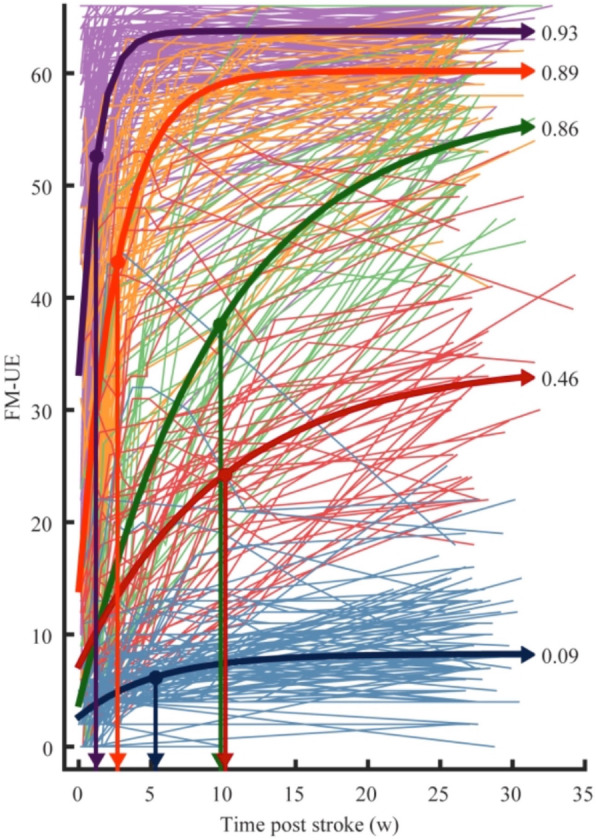
Motor recovery after stroke in a sample of n = 412 ischemic stroke patients based on the Fugl-Meyer upper extremity (FM-UE) score. Patients with mild initial deficits make on average better recovery than patients with severe deficits. Different colors represent different recovery subgroups based on a longitudinal mixture model. The numbers next to the recovery graphs represent the proportional recovery coefficient rK, which denotes how much of the potential recovery has been achieved based on the FM-UE score. The downward arrows indicate the time constants τk in weeks, i.e., how fast patients recovered (here: reaching 1-e− 1 = 63.2% of total recovery). Of note, also initially severely affected patients (green curve) can achieve a good outcome with a relatively high recovery coefficient (rk = 0.86) but a longer time constant (τk = 9.8 weeks) compared to the other subgroups. From Van der Vliet et al. [71]
Fig. 3
Fig. 3
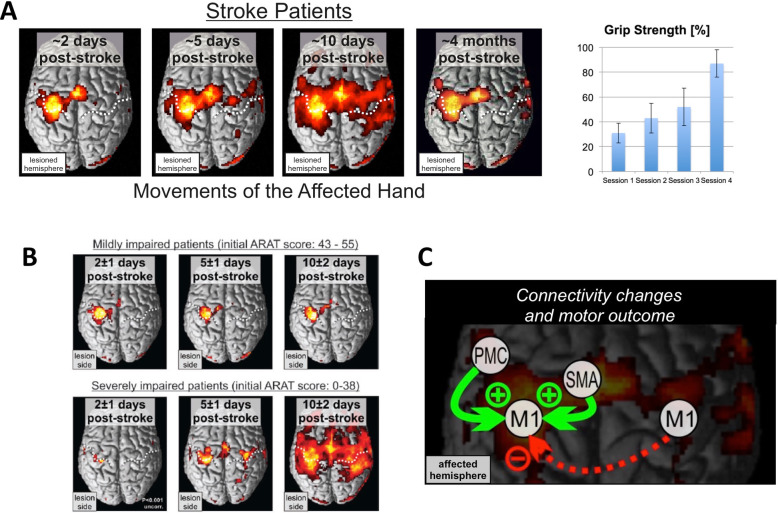
Neuroimaging of motor network reorganization after a first-ever stroke. a fMRI activity maps associated with movements of the paretic hand at different time points post-stroke. Recovery of hand motor function (here: maximum grip strength) is associated with fMRI signal increases early after stroke, the latter returning to levels observed in healthy controls with good functional recovery. From Rehme et al. [52, 53], with permission. b Impact of motor impairment and activity changes post-stroke. From Rehme et al. [52, 53], with permission. c Connectivity changes correlated with motor outcome. Green arrows: Increases indicate good functional motor outcome. Red arrow: Patients developing inhibitory influence from contralesional upon ipsilesional M1 activity feature poor functional motor outcome
Fig. 4
Fig. 4
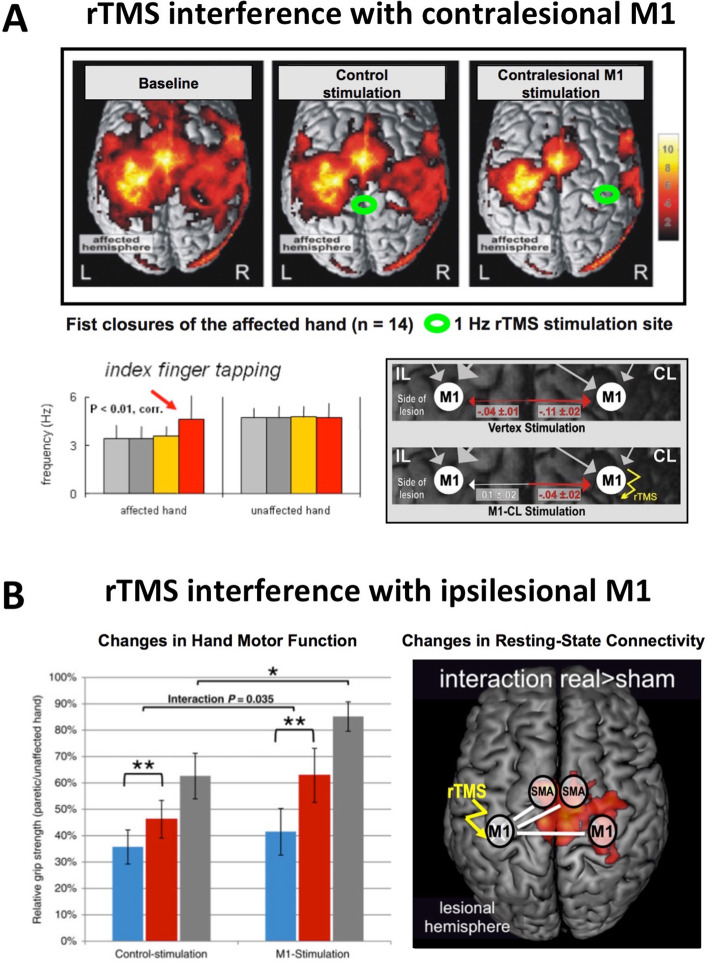
Shaping brain networks post-stroke using non-invasive brain stimulation. a Application of 1 Hz rTMS to suppress contralesional M1 activity leads to normalization of brain activity associated with movements of the stroke-affected hand. Connectivity analyses reveal that inhibitory influences originating from M1 of the unaffected hemisphere disappear after 1 Hz treatment compared to baseline measurement or sham stimulation. From Grefkes et al. [27], with permissions. b Application of iTBS rTMS to enhance ipsilesional M1 activity in the first weeks after stroke improves recovery of grip strengths (blue: baseline measurement; red: post-intervention measurement; grey: follow-up measurements 3 months later). At the neural level, patients having received iTBS over M1 feature more robust resting-state functional connectivity of the stimulated motor cortex with ipsi- and contralesional sensorimotor areas. From Volz et al. [72], with permission

References

    1. Ameli M, Grefkes C, Kemper F, Riegg FP, Rehme AK, Karbe H, et al. Differential effects of high-frequency repetitive transcranial magnetic stimulation over ipsilesional primary motor cortex in cortical and subcortical middle cerebral artery stroke. Annals of Neurology. 2009;66:298–309. doi: 10.1002/ana.21725. - DOI - PubMed
    1. Bendszus M, Bonekamp S, Berge E, Boutitie F, Brouwer P, Gizewski E, et al. A randomized controlled trial to test efficacy and safety of thrombectomy in stroke with extended lesion and extended time window. International Journal of Stroke. 2019;14:87–93. doi: 10.1177/1747493018798558. - DOI - PMC - PubMed
    1. Bernhardt J, Hayward KS, Kwakkel G, Ward NS, Wolf SL, Borschmann K, et al. Agreed definitions and a shared vision for new standards in stroke recovery research: The stroke recovery and rehabilitation roundtable taskforce. Neurorehabilitation and Neural Repair. 2017;31:793–799. doi: 10.1177/1545968317732668. - DOI - PubMed
    1. Bestmann S, Swayne O, Blankenburg F, Ruff CC, Teo J, Weiskopf N, et al. The role of contralesional dorsal premotor cortex after stroke as studied with concurrent TMS-fMRI. The Journal of Neuroscience. 2010;30:11926–11937. doi: 10.1523/JNEUROSCI.5642-09.2010. - DOI - PMC - PubMed
    1. Bonkhoff, A. K., Hope, T., Bzdok, D., Guggisberg, A. G., Hawe, R. L., Dukelow, S. P., Rehme, A. K., Fink, G. R., Grefkes, C., & Bowman, H. (2020a). Bringing proportional recovery into proportion: Bayesian modelling of post-stroke motor performance. Brain. 10.1093/brain/awaa146. - PubMed