


Study Designs for Extending Causal Inferences From a Randomized Trial to a Target Population
- PMID: 33324969
- PMCID: PMC8536837
- DOI: 10.1093/aje/kwaa270
Study Designs for Extending Causal Inferences From a Randomized Trial to a Target Population
Abstract
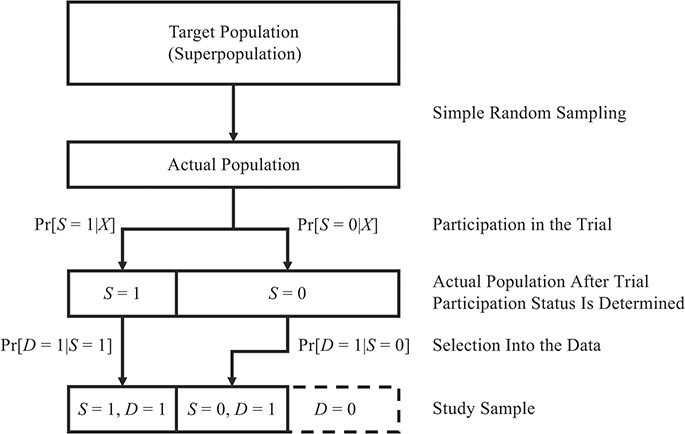
In this article, we examine study designs for extending (generalizing or transporting) causal inferences from a randomized trial to a target population. Specifically, we consider nested trial designs, where randomized individuals are nested within a sample from the target population, and nonnested trial designs, including composite data-set designs, where observations from a randomized trial are combined with those from a separately obtained sample of nonrandomized individuals from the target population. We show that the counterfactual quantities that can be identified in each study design depend on what is known about the probability of sampling nonrandomized individuals. For each study design, we examine identification of counterfactual outcome means via the g-formula and inverse probability weighting. Last, we explore the implications of the sampling properties underlying the designs for the identification and estimation of the probability of trial participation.
Keywords: causal inference; generalizability; randomized trials; transportability.
© The Author(s) 2021. Published by Oxford University Press on behalf of the Johns Hopkins Bloomberg School of Public Health. All rights reserved. For permissions, please e-mail: journals.permissions@oup.com.
Figures
References
-
- Keiding N, Louis TA. Perils and potentials of self-selected entry to epidemiological studies and surveys. J R Stat Soc Ser A Stat Soc. 2016;179(2):319–376.
-
- Hernán MA. Discussion of “perils and potentials of self-selected entry to epidemiological studies and surveys”. J R Stat Soc Ser A Stat Soc. 2016;179(2):346–347.
-
- Dahabreh IJ, Hernán MA. Extending inferences from a randomized trial to a target population. Eur J Epidemiol. 2019;34(8):719–722. - PubMed
