


Citizens Versus the Internet: Confronting Digital Challenges With Cognitive Tools
- PMID: 33325331
- PMCID: PMC7745618
- DOI: 10.1177/1529100620946707
Citizens Versus the Internet: Confronting Digital Challenges With Cognitive Tools
Abstract
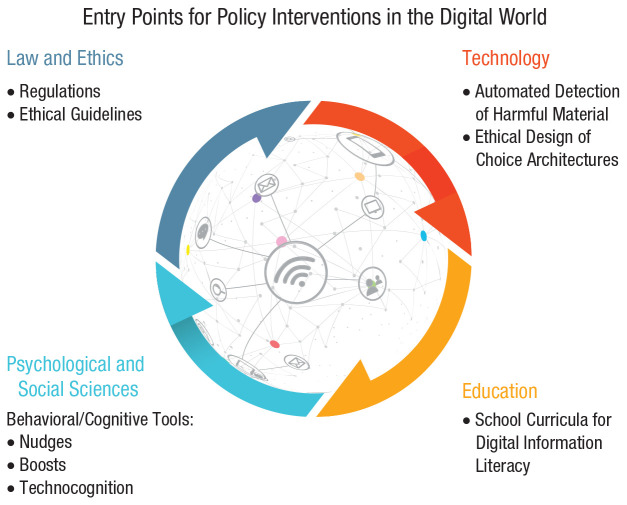
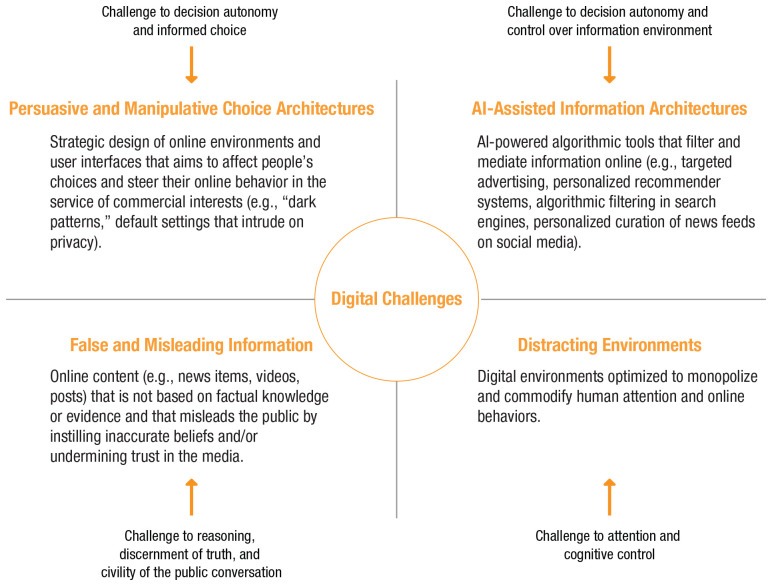
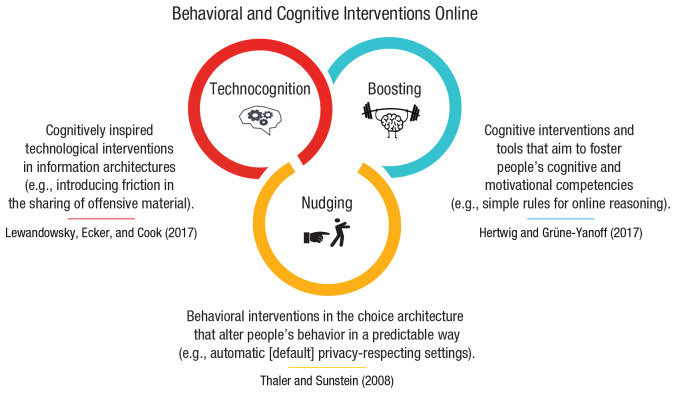
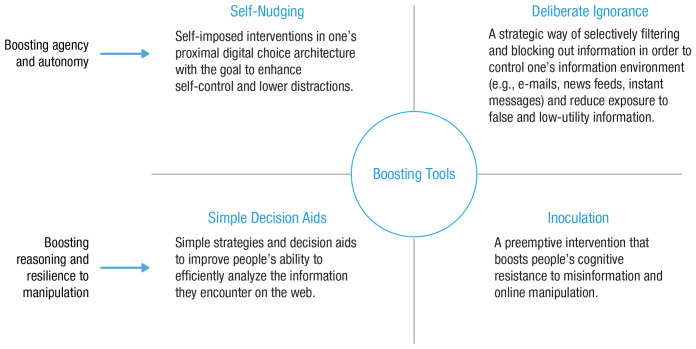
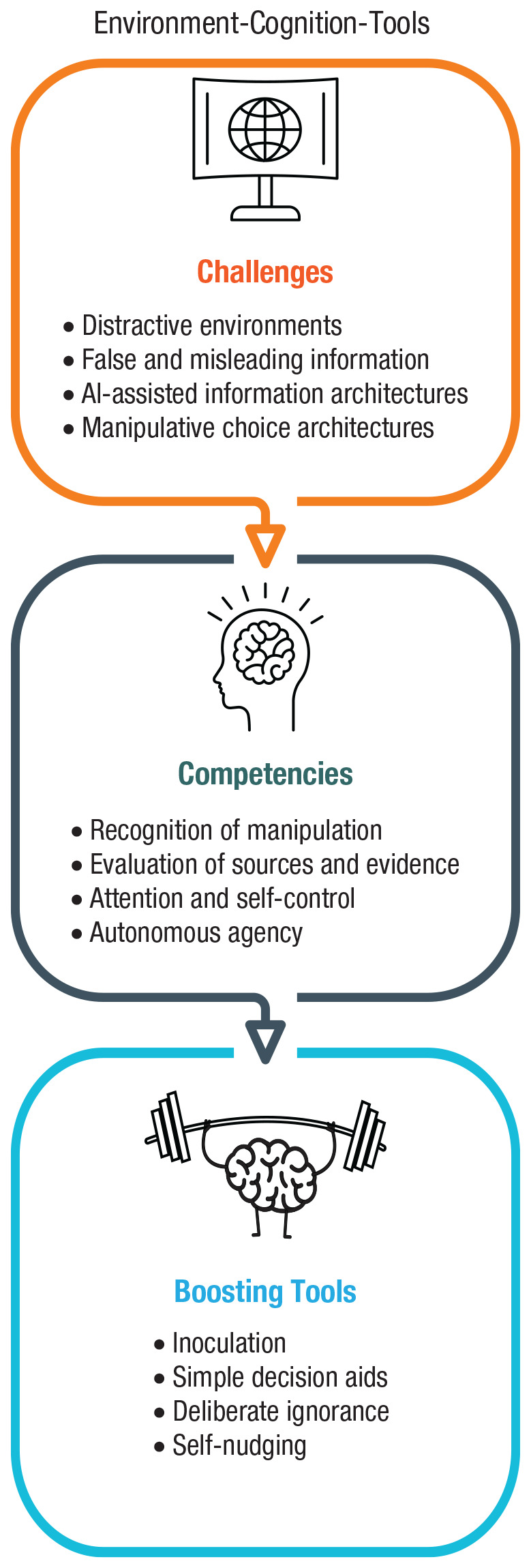
The Internet has evolved into a ubiquitous and indispensable digital environment in which people communicate, seek information, and make decisions. Despite offering various benefits, online environments are also replete with smart, highly adaptive choice architectures designed primarily to maximize commercial interests, capture and sustain users' attention, monetize user data, and predict and influence future behavior. This online landscape holds multiple negative consequences for society, such as a decline in human autonomy, rising incivility in online conversation, the facilitation of political extremism, and the spread of disinformation. Benevolent choice architects working with regulators may curb the worst excesses of manipulative choice architectures, yet the strategic advantages, resources, and data remain with commercial players. One way to address some of this imbalance is with interventions that empower Internet users to gain some control over their digital environments, in part by boosting their information literacy and their cognitive resistance to manipulation. Our goal is to present a conceptual map of interventions that are based on insights from psychological science. We begin by systematically outlining how online and offline environments differ despite being increasingly inextricable. We then identify four major types of challenges that users encounter in online environments: persuasive and manipulative choice architectures, AI-assisted information architectures, false and misleading information, and distracting environments. Next, we turn to how psychological science can inform interventions to counteract these challenges of the digital world. After distinguishing among three types of behavioral and cognitive interventions-nudges, technocognition, and boosts-we focus on boosts, of which we identify two main groups: (a) those aimed at enhancing people's agency in their digital environments (e.g., self-nudging, deliberate ignorance) and (b) those aimed at boosting competencies of reasoning and resilience to manipulation (e.g., simple decision aids, inoculation). These cognitive tools are designed to foster the civility of online discourse and protect reason and human autonomy against manipulative choice architectures, attention-grabbing techniques, and the spread of false information.
Keywords: attention economy; behavioral policy; boosting; choice architecture; cognitive tools; decision aids; disinformation; false news; media literacy; nudging.
Conflict of interest statement
Figures
References
-
- Adams T. (2020, April 26). 5G, coronavirus and contagious superstition. The Guardian. https://www.theguardian.com/world/2020/apr/26/5g-coronavirus-and-contagi...
-
- Aghaei S., Nematbakhsh M. A., Farsani H. K. (2012). Evolution of the world wide web: From WEB 1.0 TO WEB 4.0. International Journal of Web & Semantic Technology, 3(1), 1–10. 10.5121/ijwest.2012.3101 - DOI
-
- Aisch G., Huang J., Kang C. (2016, December 10). Dissecting the #PizzaGate conspiracy theories. The New York Times. https://www.nytimes.com/interactive/2016/12/10/business/media/pizzagate....
-
- Alexa. (2020). youtube.com competitive analysis, marketing mix and traffic. https://www.alexa.com/siteinfo/youtube.com
Publication types
MeSH terms
LinkOut - more resources
Full Text Sources
