. 2020 Dec 28;60(12):5832-5852.
doi: 10.1021/acs.jcim.0c01010. Epub 2020 Dec 16.

Supercomputer-Based Ensemble Docking Drug Discovery Pipeline with Application to Covid-19

Affiliations

Supercomputer-Based Ensemble Docking Drug Discovery Pipeline with Application to Covid-19

A Acharya et al. J Chem Inf Model. .

Abstract

We present a supercomputer-driven pipeline for in silico drug discovery using enhanced sampling molecular dynamics (MD) and ensemble docking. Ensemble docking makes use of MD results by docking compound databases into representative protein binding-site conformations, thus taking into account the dynamic properties of the binding sites. We also describe preliminary results obtained for 24 systems involving eight proteins of the proteome of SARS-CoV-2. The MD involves temperature replica exchange enhanced sampling, making use of massively parallel supercomputing to quickly sample the configurational space of protein drug targets. Using the Summit supercomputer at the Oak Ridge National Laboratory, more than 1 ms of enhanced sampling MD can be generated per day. We have ensemble docked repurposing databases to 10 configurations of each of the 24 SARS-CoV-2 systems using AutoDock Vina. Comparison to experiment demonstrates remarkably high hit rates for the top scoring tranches of compounds identified by our ensemble approach. We also demonstrate that, using Autodock-GPU on Summit, it is possible to perform exhaustive docking of one billion compounds in under 24 h. Finally, we discuss preliminary results and planned improvements to the pipeline, including the use of quantum mechanical (QM), machine learning, and artificial intelligence (AI) methods to cluster MD trajectories and rescore docking poses.


Figures
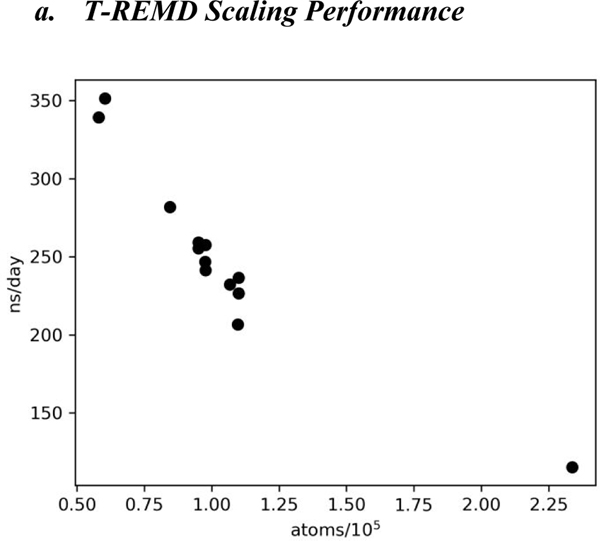
Figure 1.
Figure 1.
Simulation throughput per replica. Each point represents the performance achieved by replica-exchange MD simulations on a single protein/water system. Run parameters were one replica per node (each node has 6 GPUs), using between 24 and 40 replicas in a given system.
Figure 2.
Figure 2.
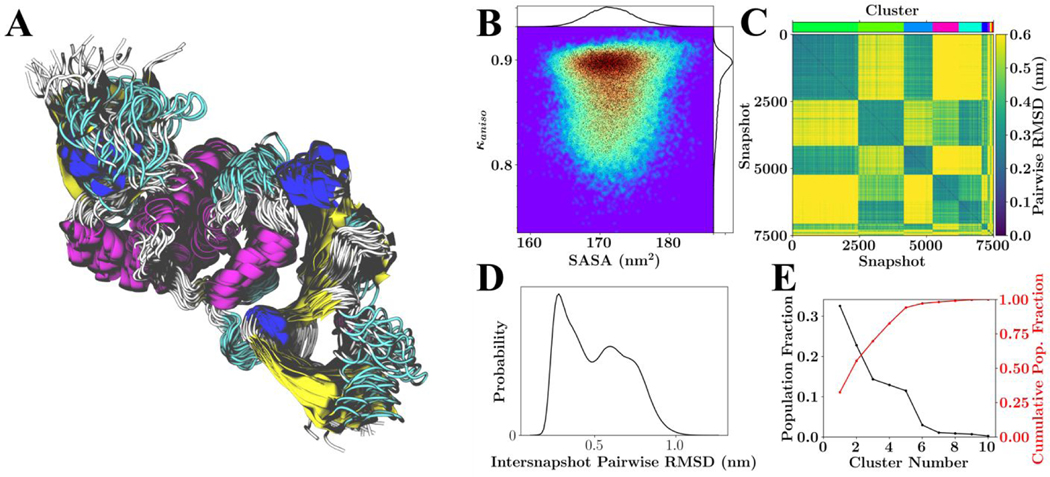
Configurational variability of PLPro (PDB: 6WRH) with neutral HIS protonation states. (A) Overlay of 26 RMSD aligned structures from the lowest temperature replicate spanning the 750 ns of sampling. (B) Population distribution for shape anisotropy (κ) and solvent accessible surface area (SASA), with redder colors indicating greater occupancy of these kappa-SASA combinations. The distributions are also reflected by one-dimensional histograms above and to the right of the plot, and black dots within the population distribution, which represent position information for 10% of the total snapshots considered. (C) Pairwise RMSD clustering for the lowest temperature replica, with the snapshots ordered according to their cluster. The clusters in this instance were defined using a cutoff of half the maximum RMSD observed within the simulation and are labeled according to color with a color-bar for reference located above the plot. (D) Pairwise RMSD distribution across all snapshots. (E) Population statistics for the clusters introduced in (C).
Figure 3.
Figure 3.
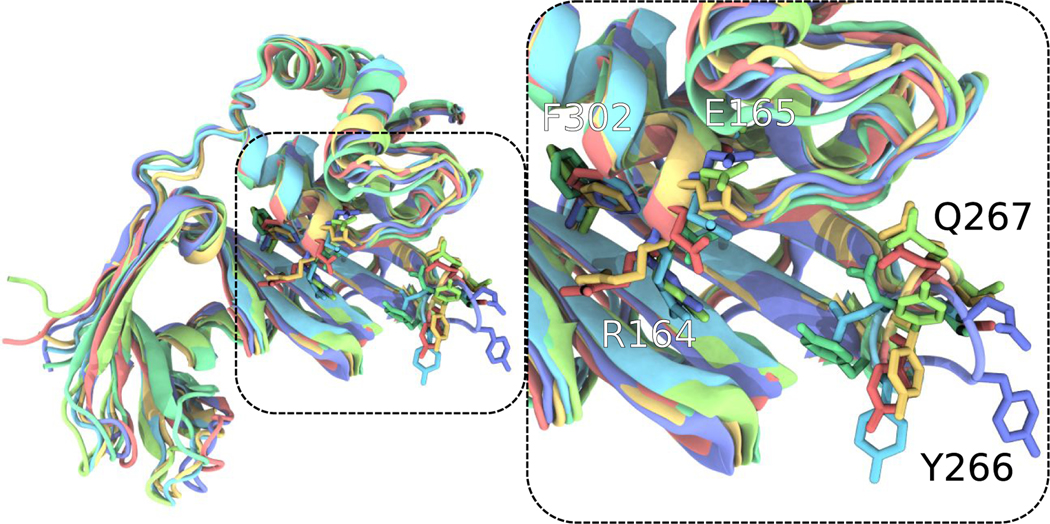
Configurational variability of the PLPro (PDB: 6WRH) active site region generally bounded by the black dashed lines and the next step in analysis after Figure 3. Each of the differently colored aligned protein models represents the center of a populous cluster, as defined by active site conformation RMSD. Residues such as R164, E165, Y266, Q267, and F302 vary in conformation substantially and highlight the conformational variation within the ensemble created through T-REMD. For clearer visualization, only residues 91 and onward for PLPro are shown, as this selection was used for active site alignment. Within the VMD rendering, sidechains are displayed without their hydrogens.
Figure 4.
Figure 4.
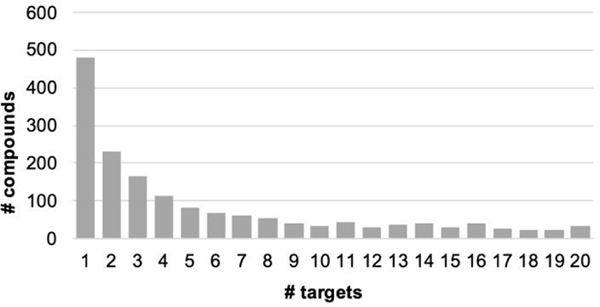
Distribution of the number of identical compounds being found in n-number of target top 500-compounds selection out of 9,014 compounds.
Figure 5.
Figure 5.
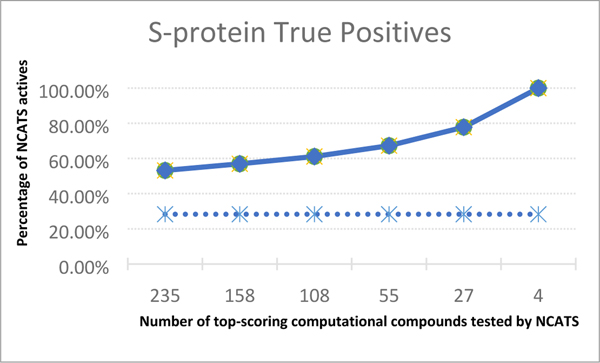
Comparison of S-protein (Spike) true-positive rates for strong-actives. Plot shows percentage of experimental NCATS positives in top computational-predicted chemicals as solid line. Dashed-line represents constant NCATS positive rate for comparision.
Figure 6.
Figure 6.
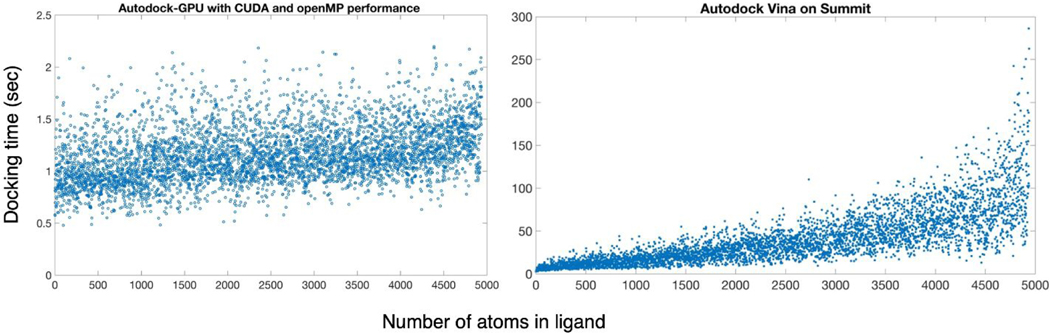
General benchmarking of Autodock-GPU and Autodock Vina performance against subset of Enamine database.
Figure 7.
Figure 7.
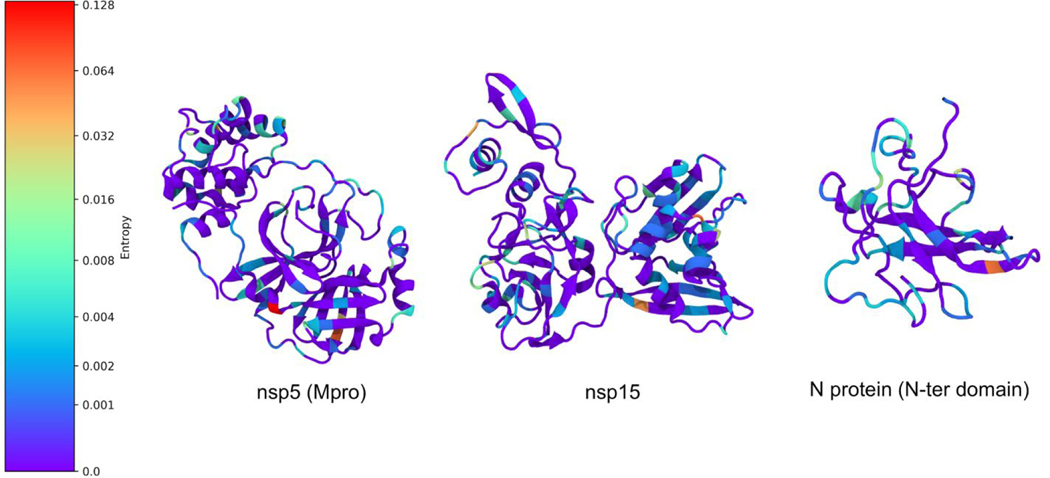
Example mutational entropy analysis. Residues are colored by entropy, with redder colors corresponding to greater entropy.
Figure 8.
Figure 8.
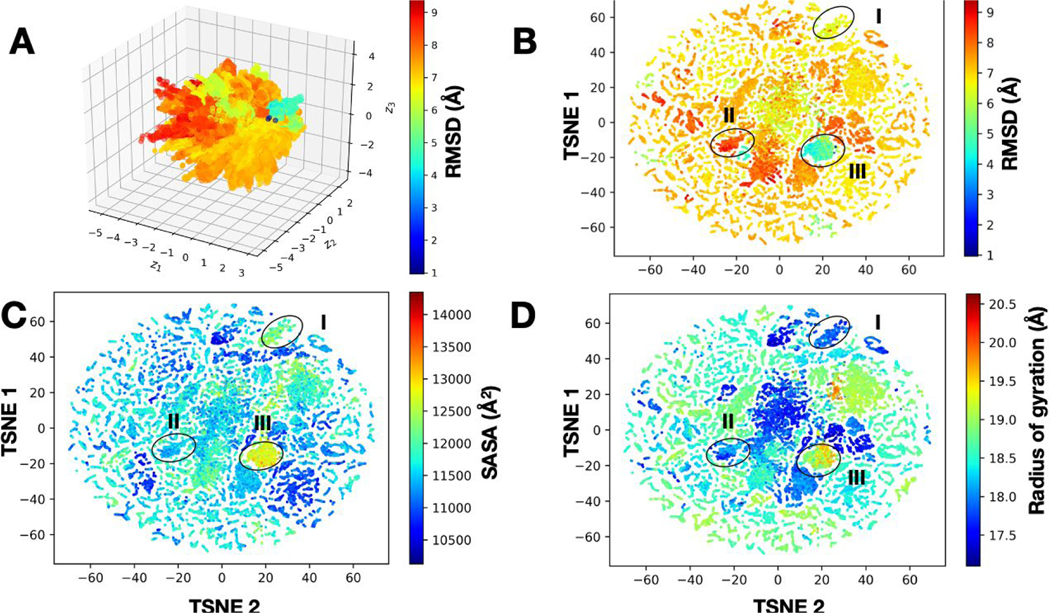
Deep learning clusters T-REMD simulations of the NSP15 hexameric complex into conformational states that are potentially relevant for docking studies. (A) A 3D-representation of the CVAE learned from the T-REMD simulations shows the presence of multiple conformational states. Each conformation from the simulation is painted using the RMSD to the starting structure and shows the presence of distinct directions in the conformational landscape where low- and high-RMSD structures are distributed. To understand this representation better, we use an at-stochastic neighbor embedding (t-SNE) algorithm to embed the data into a low-dimensional space, where we can clearly visualize how the conformational landscape is organized. In this two-dimensional space, we visualize various observables from the simulations, including (B) RMSD to the native structure, (C) SASA, and (D) radius of gyration. In each of these cases, we can observe the presence of at least three dominant sub-states with distinct structural characteristics, which can be further used for docking simulations.
Figure 9.
Figure 9.
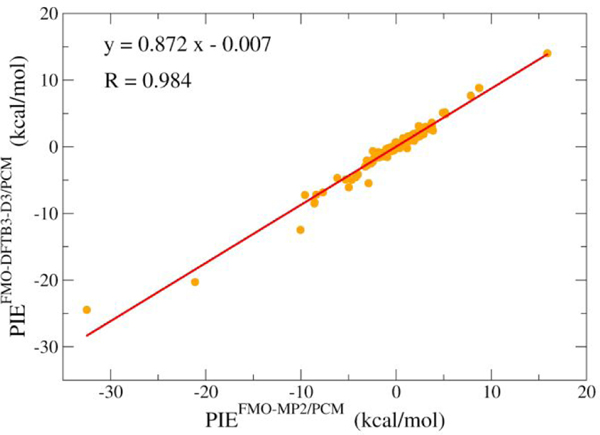
Pair interaction energy (PIE) decomposition analysis for FMO-DFTB/PCM plotted against FMO-MP2/3–21G/PCM data.

Update of

  • Supercomputer-Based Ensemble Docking Drug Discovery Pipeline with Application to Covid-19.
    Acharya A, Agarwal R, Baker M, Baudry J, Bhowmik D, Boehm S, Byler KG, Coates L, Chen SY, Cooper CJ, Demerdash O, Daidone I, Eblen JD, Ellingson S, Forli S, Glaser J, Gumbart JC, Gunnels J, Hernandez O, Irle S, Larkin J, Lawrence TJ, LeGrand S, Liu SH, Mitchell JC, Park G, Parks JM, Pavlova A, Petridis L, Poole D, Pouchard L, Ramanathan A, Rogers D, Santos-Martins D, Scheinberg A, Sedova A, Shen S, Smith JC, Smith MD, Soto C, Tsaris A, Thavappiragasam M, Tillack AF, Vermaas JV, Vuong VQ, Yin J, Yoo S, Zahran M, Zanetti-Polzi L. Acharya A, et al. ChemRxiv [Preprint]. 2020 Jul 29. doi: 10.26434/chemrxiv.12725465. ChemRxiv. 2020. Update in: J Chem Inf Model. 2020 Dec 28;60(12):5832-5852. doi: 10.1021/acs.jcim.0c01010. PMID: 33200117 Free PMC article. Updated. Preprint.

References

    1. Agostini ML; Andres EL; Sims AC; Graham RL; Sheahan TP; Lu X; Smith EC; Case JB; Feng JY; Jordan R, Coronavirus susceptibility to the antiviral remdesivir (GS-5734) is mediated by the viral polymerase and the proofreading exoribonuclease. MBio 2018, 9, e00221–18. - PMC - PubMed
    1. Brown AJ; Won JJ; Graham RL; Dinnon KH 3rd; Sims AC; Feng JY; Cihlar T; Denison MR; Baric RS; Sheahan TP, Broad spectrum antiviral remdesivir inhibits human endemic and zoonotic deltacoronaviruses with a highly divergent RNA dependent RNA polymerase. Antiviral Res 2019, 169, 104541. - PMC - PubMed
    1. Sheahan TP; Sims AC; Leist SR; Schafer A; Won J; Brown AJ; Montgomery SA; Hogg A; Babusis D; Clarke MO; Spahn JE; Bauer L; Sellers S; Porter D; Feng JY; Cihlar T; Jordan R; Denison MR; Baric RS, Comparative therapeutic efficacy of remdesivir and combination lopinavir, ritonavir, and interferon beta against MERS-CoV. Nat Commun 2020, 11, 222. - PMC - PubMed
    1. Amanat F; Krammer F, SARS-CoV-2 Vaccines: Status Report. Immunity 2020, 52, 583–589. - PMC - PubMed
    1. de Wit E; Feldmann F; Cronin J; Jordan R; Okumura A; Thomas T; Scott D; Cihlar T; Feldmann H, Prophylactic and therapeutic remdesivir (GS-5734) treatment in the rhesus macaque model of MERS-CoV infection. Proc Natl Acad Sci U S A 2020, 117, 6771–6776. - PMC - PubMed

Publication types

Substances