. 2021 Jun 1;203(11):1410-1418.
doi: 10.1164/rccm.202006-2576OC.

CC16 Binding to α4β1 Integrin Protects against Mycoplasma pneumoniae Infection

Affiliations

CC16 Binding to α4β1 Integrin Protects against Mycoplasma pneumoniae Infection

Michael D L Johnson et al. Am J Respir Crit Care Med. .

Abstract

Rationale CC16 (club cell secretory protein) is a pneumoprotein produced predominantly by pulmonary club cells. Circulating CC16 is associated with protection from the inception and progression of the two most common obstructive lung diseases (asthma and chronic obstructive pulmonary disease). Objectives Although exact mechanisms remain elusive, studies consistently suggest a causal role of CC16 in mediating antiinflammatory and antioxidant functions in the lung. We sought to determine any novel receptor systems that could participate in CC16's role in obstructive lung diseases. Methods Protein alignment of CC16 across species led to the discovery of a highly conserved sequence of amino acids, leucine-valine-aspartic acid (LVD), a known integrin-binding motif. Recombinant CC16 was generated with and without the putative integrin-binding site. A Mycoplasma pneumoniae mouse model and a fluorescent cellular adhesion assay were used to determine the impact of the LVD site regarding CC16 function during live infection and on cellular adhesion during inflammatory conditions. Measurements and Main Results CC16 bound to integrin α4β1), also known as the adhesion molecule VLA-4 (very late antigen 4), dependent on the presence of the LVD integrin-binding motif. During infection, recombinant CC16 rescued lung function parameters both when administered to the lung and intravenously but only when the LVD integrin-binding site was intact; likewise, neutrophil recruitment during infection and leukocyte adhesion were both impacted by the loss of the LVD site. Conclusions We discovered a novel receptor for CC16, VLA-4, which has important mechanistic implications for the role of CC16 in circulation as well as in the lung compartment.

Keywords: CC16; CCSP; VLA-4; integrins; leukocyte adhesion.


Figures

Figure 1.
Figure 1.
Conservation of leucine–valine–aspartic acid (LVD) sequence across mammalian species. Alignment was performed using the constraint-based multiple alignment tool on CC16 in different mammalian species. Protein residues that are identical in all species are shown in red and notated with an asterisk (*); the remaining residues are in blue. Residues that do not align (Rattus norvegicus and Mus musculus) are in gray. Furthermore, “:” represents highly conserved residues (by charge, size, and hydropreference [e.g., valine and alanine]). The conserved LVD site is bolded and highlighted in yellow. In order, Latin names correspond with human, chimpanzee, orangutan, cat, horse, rat, dog, mouse, pig, crab-eating macaque, and cow.
Figure 2.
Figure 2.
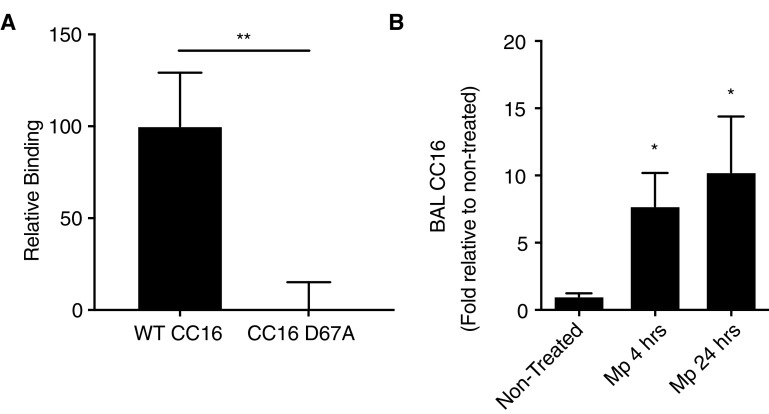
Binding of recombinant CC16 (club cell secretory protein) (rCC16) to α4β1 integrin complex and relative abundance of CC16 during Mycoplasma pneumoniae (Mp) infection. (A) Plate-binding assays were conducted with human recombinant CC16 with (WT CC16) and without the leucine–valine–aspartic acid sequence (CC16 D67A) that were generated with a histidine tag. The His-tagged rCC16 protein was used to saturate nickel-coated plates and recombinant human integrin subunit α4 was combined with β1 to make the α4β1 integrin complex. Combined integrins were added to the plate-bound rCC16 for 1 hour, after which the plate was washed, and a fluorescent anti-α4 antibody was used to detect the CC16-bound integrin by relative fluorescent intensity. The CC16 to the anti-α4 antibody control was subtracted from each sample to give a final relative binding. Binding assays were conducted (n = 3 replicates) and averaged; **P < 0.01. (B) BAL fluid was examined for CC16 concentrations in nontreated and Mp-infected mice after 4 and 24 hours by Western blot and densitometry analysis. n = 3–5 mice/group; *P < 0.05 compared with nontreated control mice by one-way ANOVA for multiple comparisons. WT = wild-type.
Figure 3.
Figure 3.
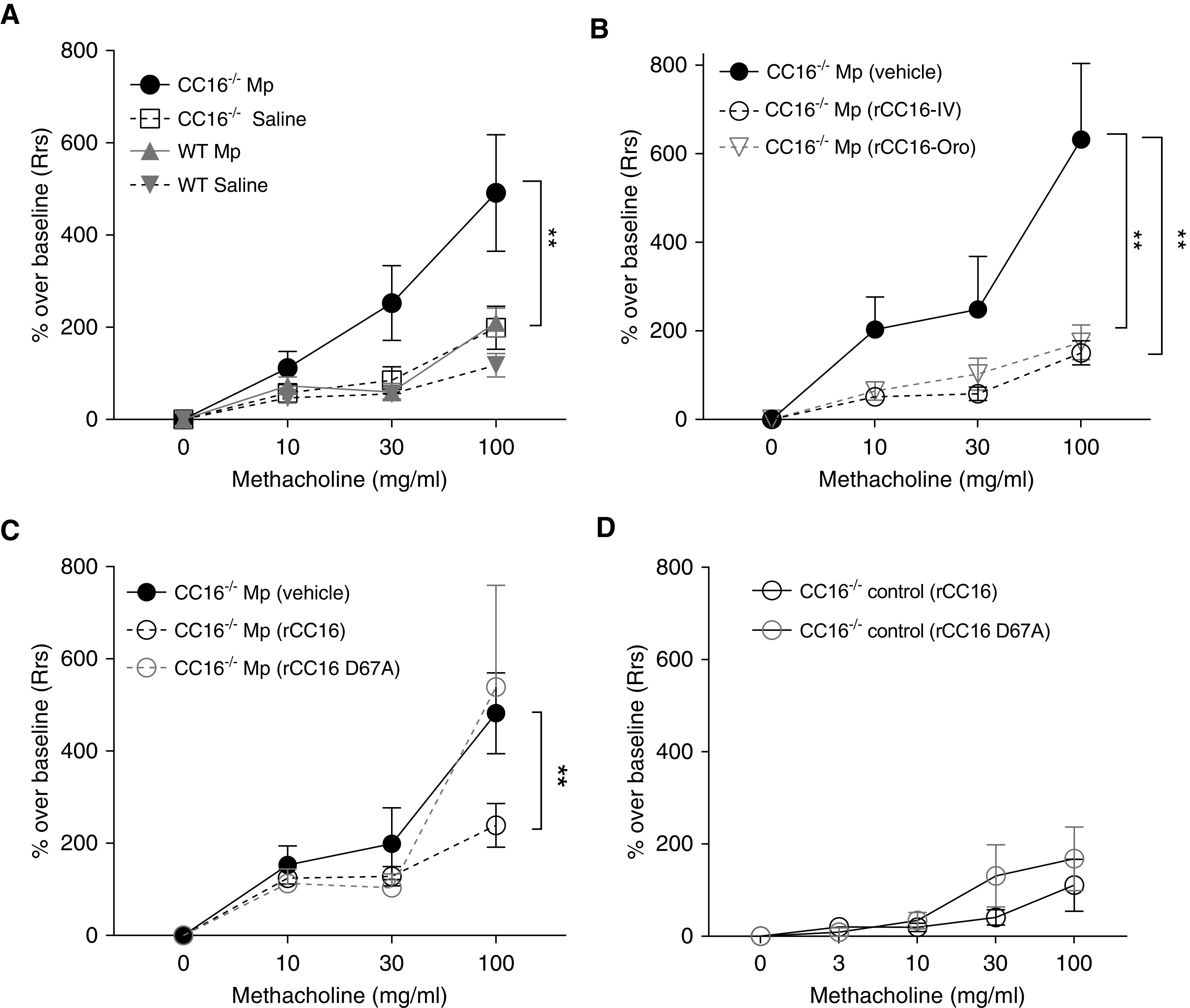
The impact of CC16 (club cell secretory protein) on airway hyperresponsiveness to methacholine challenge. (A) Wild-type (WT) and Cc16−/− mice were infected with Mycoplasma pneumoniae (Mp) for 3 days, after which their airway resistance during methacholine challenge was determined on the Flexivent machine. n = 10 WT mice/group; n = 15 Cc16−/− mice/group. (B) Recombinant CC16 (rCC16) given 2 hours before infection attenuated Mp-infected airway hyperresponsiveness in Cc16−/− mice whether given via oropharyngeal (Oro) or i.v. routes; n = 9 Mp only; n = 6 Oro; n = 6 i.v. (C) The D67A mutation alters the activity of i.v. rCC16 to reduce airway hyperresponsiveness in Mp-infected CC16−/− mice during Mp infection. n = 10–15 mice/group. (D) No differences in airway hyperresponsiveness were observed in Cc16−/− vehicle control mice given either rCC16 or rCC16 D67A; n = 4 mice/group; **P < 0.01 at the respective dose indicated. Rrs = respiratory system resistance.
Figure 4.
Figure 4.
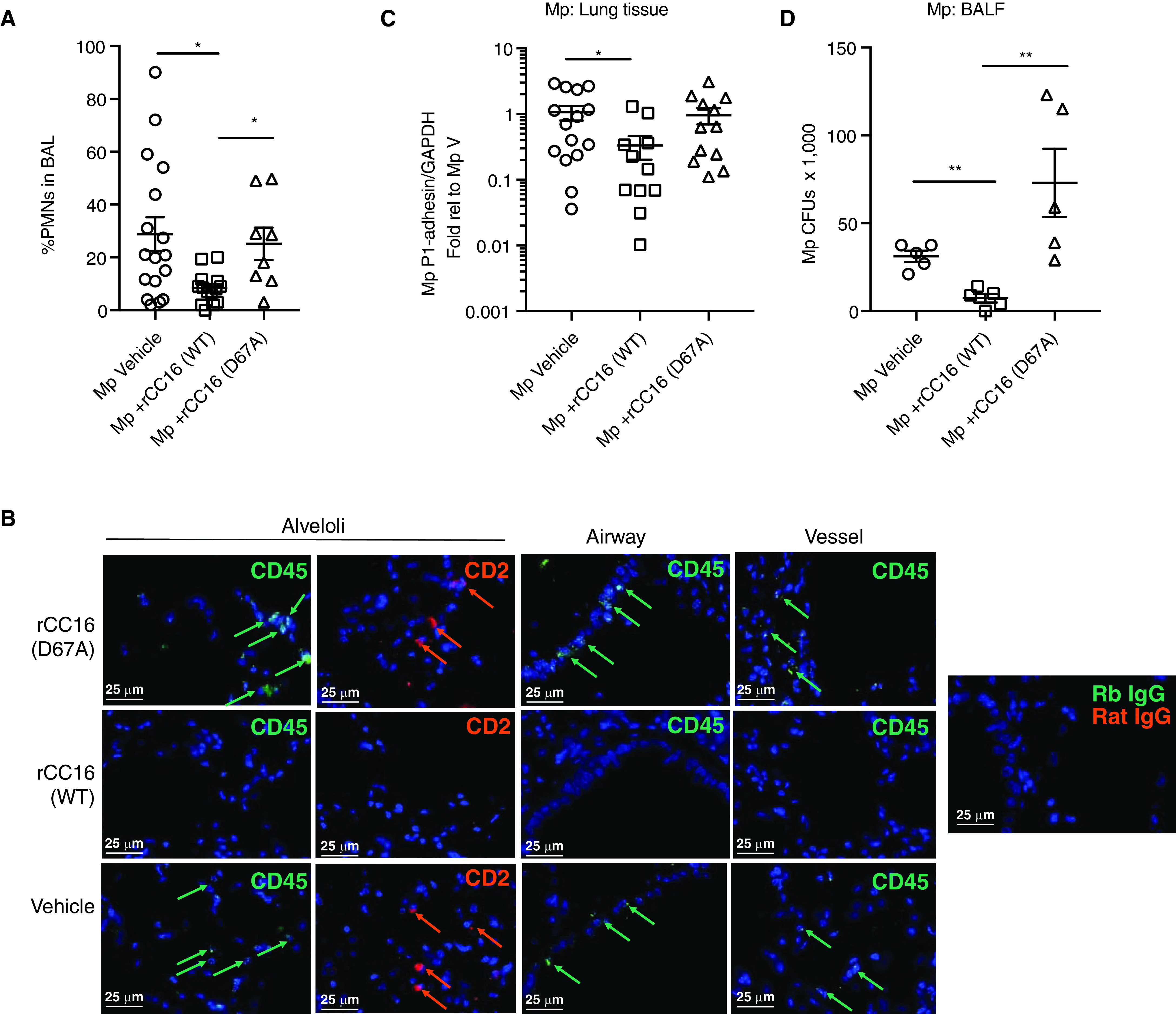
Inflammatory cell assessment and pathogen burden based on CC16 (club cell secretory protein) treatment. (A) A subset of Cc16−/− mice that were assessed for pulmonary function tests were also assessed for the presence of neutrophils in the lavage fluid by differential staining. CC16-deficient mice that received recombinant CC16 (rCC16) (WT) had a significantly lower percentage of neutrophils (PMNS) versus those that received no CC16 or rCC16 (D67A). (B) Representative (n = 4/treatment group) immunofluorescence staining for CD45 and CD2 in alveoli, airways, and vessels in the specific treatment groups. Arrows indicate positively stained cells relative to negative antibody controls (Rb IgG and rat IgG). Scale bars, 25 μm. (C) Assessment of Mycoplasma pneumoniae (Mp) burden in lung tissue by RT-PCR for Mp-specific P1-adhesin gene relative to GAPDH. Data shown as fold relative to Mp vehicle. (D) Assessment of Mp CFUs present in cell-free BAL at time of harvest. *P < 0.05 and **P < 0.01 by one-way ANOVA with Kruskal-Wallis test for multiple comparisons. BALF = BAL fluid; CFU = colony-forming unit; PMNS = polymorphonuclear leukocytes; V = vehicle; WT = wild-type.
Figure 5.
Figure 5.
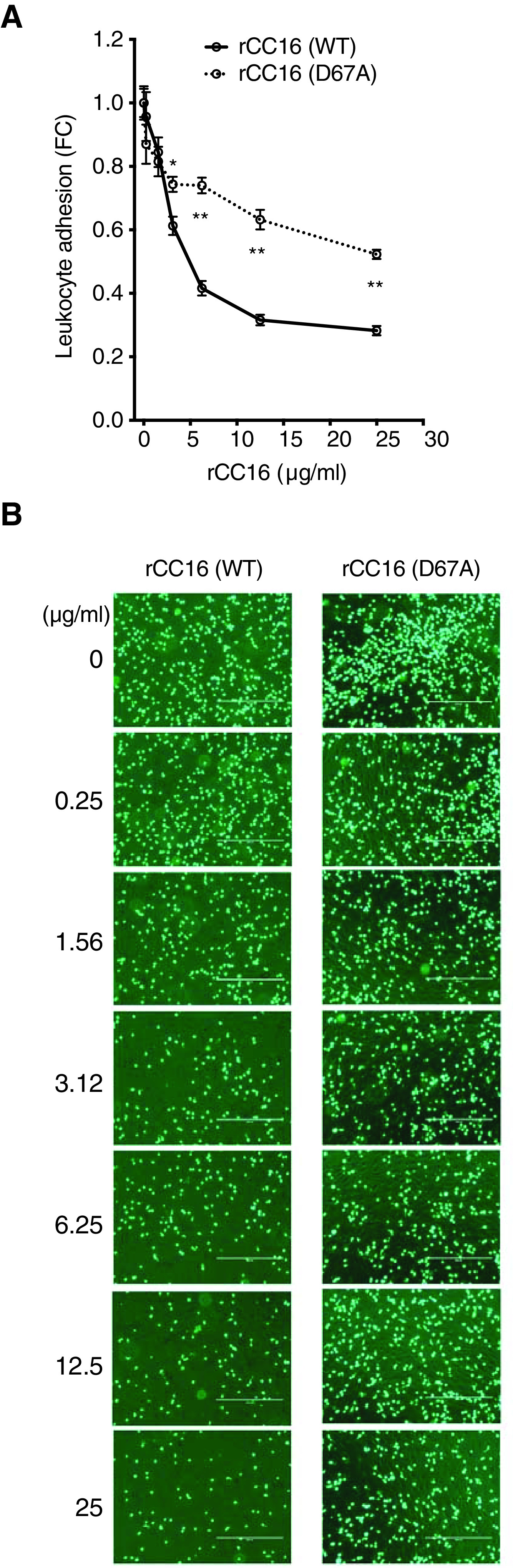
The VLA-4 (very late antigen 4) binding sequence impacts leukocyte adhesion. (A) recombinant CC16 (club cell secretory protein) (rCC16) (WT) dose-dependently inhibited fluorescent THP-1 adhesion to human endothelial cells after TNF-α activation, whereas D67A was significantly less active. Fluorescence was determined at 480 nm/520 nm wavelength, and data were plotted as the FC reduction from the non–CC16-treated values. N = minimum of 4 replicates/2 repeat experiments. By linear regression, *P < 0.05 and **P < 0.001. (B) Representative pictures of the various rCC16 doses of adhered fluorescent THP-1 cells to human endothelial cells. Scale bars, 400 μm. FC = fold change; WT = wild-type.

Comment in

References

    1. Broeckaert F, Clippe A, Knoops B, Hermans C, Bernard A. Clara cell secretory protein (CC16): features as a peripheral lung biomarker. Ann N Y Acad Sci . 2000;923:68–77. - PubMed
    1. Lakind JS, Holgate ST, Ownby DR, Mansur AH, Helms PJ, Pyatt D, et al. A critical review of the use of Clara cell secretory protein (CC16) as a biomarker of acute or chronic pulmonary effects. Biomarkers . 2007;12:445–467. - PubMed
    1. Shijubo N, Itoh Y, Yamaguchi T, Sugaya F, Hirasawa M, Yamada T, et al. Serum levels of Clara cell 10-kDa protein are decreased in patients with asthma. Lung . 1999;177:45–52. - PubMed
    1. Guerra S, Halonen M, Vasquez MM, Spangenberg A, Stern DA, Morgan WJ, et al. Relation between circulating CC16 concentrations, lung function, and development of chronic obstructive pulmonary disease across the lifespan: a prospective study. Lancet Respir Med . 2015;3:613–620. - PMC - PubMed
    1. Rava M, Tares L, Lavi I, Barreiro E, Zock JP, Ferrer A, et al. Serum levels of Clara cell secretory protein, asthma, and lung function in the adult general population. J Allergy Clin Immunol . 2013;132:230–232. - PubMed

Publication types

LinkOut - more resources