


Clinical outcomes and inflammatory marker levels in patients with Covid-19 and obesity at an inner-city safety net hospital
- PMID: 33326480
- PMCID: PMC7744045
- DOI: 10.1371/journal.pone.0243888
Clinical outcomes and inflammatory marker levels in patients with Covid-19 and obesity at an inner-city safety net hospital
Abstract
Objectives: Patients with Covid-19 and obesity have worse clinical outcomes which may be driven by increased inflammation. This study aimed to characterize the association between clinical outcomes in patients with obesity and inflammatory markers.
Methods: We analyzed data for patients aged ≥18 years admitted with a positive SARS-CoV-2 PCR test. We used multivariate logistic regression to determine the association between BMI and intensive care unit (ICU) transfer and all-cause mortality. Inflammatory markers (C-reactive protein [CRP], lactate dehydrogenase [LDH], ferritin, and D-dimer) were compared between patients with and without obesity (body mass index [BMI] ≥30 kg/m2).
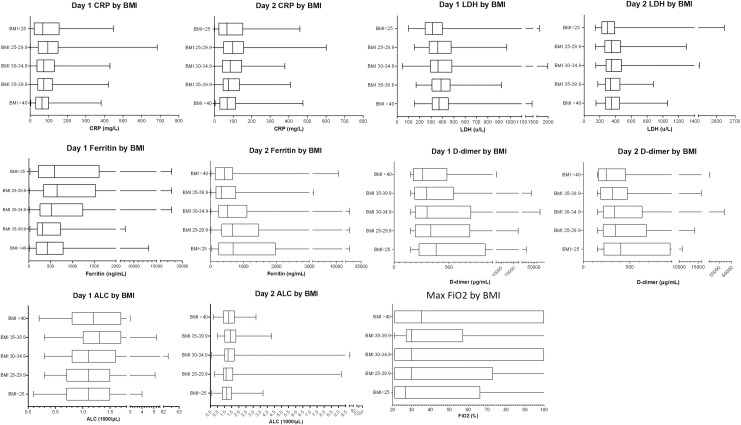
Results: Of 791 patients with Covid-19, 361 (45.6%) had obesity. In multivariate analyses, BMI ≥35 was associated with a higher odds of ICU transfer (adjusted odds ratio [aOR] 2.388 (95% confidence interval [CI]: 1.074-5.310) and hospital mortality (aOR = 4.3, 95% CI: 1.69-10.82). Compared to those with BMI<30, patients with obesity had lower ferritin (444 vs 637 ng/mL; p<0.001) and lower D-dimer (293 vs 350 mcg/mL; p = 0.009), non-significant differences in CRP (72.8 vs 84.1 mg/L, p = 0.099), and higher LDH (375 vs 340, p = 0.009) on the first hospital day.
Conclusions: Patients with obesity were more likely to have poor outcomes even without increased inflammation.
Conflict of interest statement
The authors have declared that no competing interests exist.
Figures
References
-
- Johns Hopkins University of Medicine. Mortality Analyses, Coronavirus Resource Center. 2020; https://coronavirus.jhu.edu/data/mortality. Accessed July 28, 2020.
-
- Coronavirus Pneumonia Emergency Response Epidemiology Team. The epidemiological characteristics of an outbreak of 2019 novel coronavirus diseases (COVID-19) in China. Zhonghua liu xing bing xue za zhi = Zhonghua liuxingbingxue zazhi. 2020;41(2):145 10.3760/cma.j.issn.0254-6450.2020.02.003 - DOI - PubMed
-
- Audit ICN, Centre R. ICNARC report on COVID-19 in critical care Intensive Care National Audit & Research Centre; London; 2020.
-
- Petrilli CM, Jones SA, Yang J, Rajagopalan Hm, O’Donnell L, Chernyak Y, et al. Factors associated with hospital admission and critical illness among 5279 people with coronavirus disease 2019 in New York City: prospective cohort study. British Medical Journal. 2020; 369:m1966 10.1136/bmj.m1966 - DOI - PMC - PubMed
Publication types
MeSH terms
Substances
Grants and funding
LinkOut - more resources
Full Text Sources
Medical
Research Materials
Miscellaneous
