


Individual preferences for COVID-19 vaccination in China
- PMID: 33328140
- PMCID: PMC7719001
- DOI: 10.1016/j.vaccine.2020.12.009
Individual preferences for COVID-19 vaccination in China
Abstract
Background: Vaccinations are an effective choice to stop disease outbreaks, including COVID-19. There is little research on individuals' COVID-19 vaccination decision-making.
Objective: We aimed to determine individual preferences for COVID-19 vaccinations in China, and to assess the factors influencing vaccination decision-making to facilitate vaccination coverage.
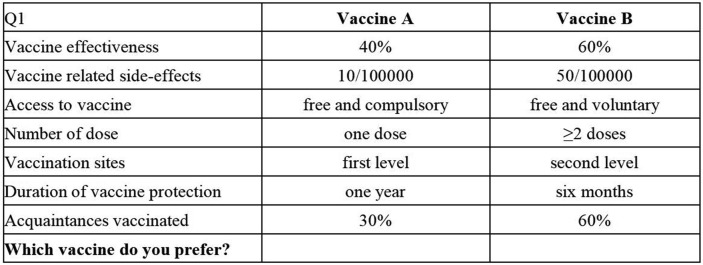
Methods: A D-efficient discrete choice experiment was conducted across six Chinese provinces selected by the stratified random sampling method. Vaccine choice sets were constructed using seven attributes: vaccine effectiveness, side-effects, accessibility, number of doses, vaccination sites, duration of vaccine protection, and proportion of acquaintances vaccinated. Conditional logit and latent class models were used to identify preferences.
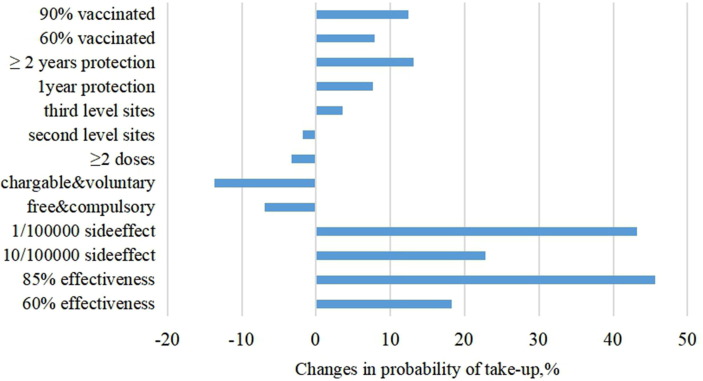
Results: Although all seven attributes were proved to significantly influence respondents' vaccination decision, vaccine effectiveness, side-effects and proportion of acquaintances vaccinated were the most important. We also found a higher probability of vaccinating when the vaccine was more effective; risks of serious side effects were small; vaccinations were free and voluntary; the fewer the number of doses; the longer the protection duration; and the higher the proportion of acquaintances vaccinated. Higher local vaccine coverage created altruistic herd incentives to vaccinate rather than free-rider problems. The predicted vaccination uptake of the optimal vaccination scenario in our study was 84.77%. Preference heterogeneity was substantial. Individuals who were older, had a lower education level, lower income, higher trust in the vaccine and higher perceived risk of infection, displayed a higher probability to vaccinate.
Conclusions: Preference heterogeneity among individuals should lead health authorities to address the diversity of expectations about COVID-19 vaccinations. To maximize COVID-19 vaccine uptake, health authorities should promote vaccine effectiveness; pro-actively communicate the absence or presence of vaccine side effects; and ensure rapid and wide media communication about local vaccine coverage.
Keywords: COVID-19; Health policy; Preference; Vaccine.
Copyright © 2020 The Author(s). Published by Elsevier Ltd.. All rights reserved.
Conflict of interest statement
Declaration of Competing Interest The authors declare that they have no known competing financial interests or personal relationships that could have appeared to influence the work reported in this paper.
Figures
References
-
- WHO. Coronavirus disease (COVID-19) pandemic-27 July 2020. https://www.who.int/emergencies/diseases/novel-coronavirus-2019 [accessed July 27, 2020].
-
- WHO. DRAFT landscape of COVID-19 candidate vaccines–30 April 2020. https://www.who.int/whodocuments-detail/draft-landscape-of-COVID-19-cand... [accessed May 5, 2020].
-
- Chou W.Y.S., Budenz A. Considering Emotion in COVID-19 vaccine communication: addressing vaccine hesitancy and fostering vaccine confidence. Health Commun. 2020;35(14):1718–1722. - PubMed
Publication types
MeSH terms
Substances
LinkOut - more resources
Full Text Sources
Other Literature Sources
Medical
