Does medicine run in the family-evidence from three generations of physicians in Sweden: retrospective observational study
- PMID: 33328192
- PMCID: PMC7737652
- DOI: 10.1136/bmj.m4453
Does medicine run in the family-evidence from three generations of physicians in Sweden: retrospective observational study
Abstract
Objective: To examine occupational heritability in medicine and changes in heritability over time, with Swedish population wide administrative data that allowed mapping family trees of physicians spanning up to three generations.
Design: Retrospective observational study.
Setting: Individual level administrative registry data from Sweden.
Participants: Physicians born in 1950-90 and living in Sweden at some time during 2001-16 (n=47 400).
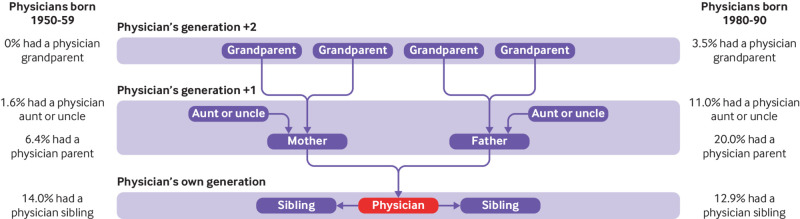
Main outcome measures: The proportion of individuals with a completed medical degree with at least one parent who also trained in medicine, and the change in this proportion across birth cohorts. Additional analyses were conducted among other relatives (grandparents, aunts and uncles, and siblings) and for individuals with a law degree.
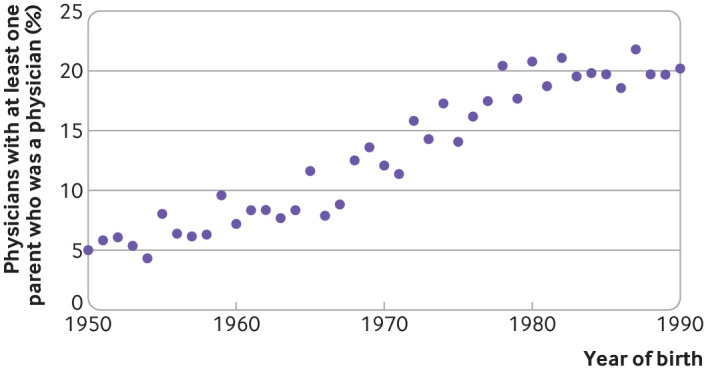
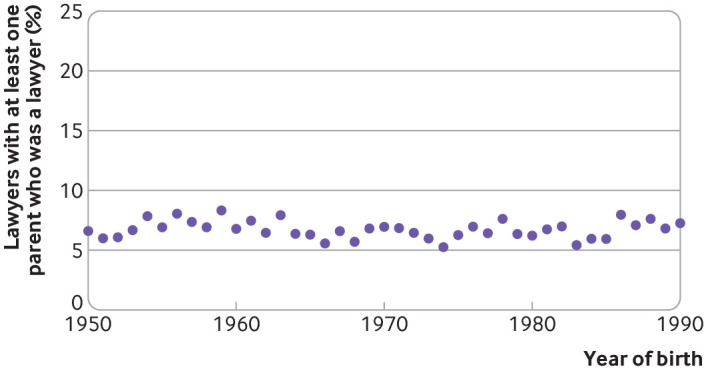
Results: For 27 788 physicians, where the educational background for both parents was known, 14% had a parent who was also a physician and 2% had two parents who were physicians. The proportion of physicians with at least one physician parent increased significantly over time, from 6% for physicians born in 1950-59 to 20% for physicians born in 1980-90 (P<0.001). The same pattern of increasing occupational heritability was not seen for individuals with law degrees.
Conclusions: In recent cohorts of physicians in Sweden, one in five had a parent who was also a physician, more than triple the proportion seen for physicians born three decades earlier. A similar pattern was not seen in lawyers, suggesting that increasing occupational heritability in medicine does not reflect intergenerational persistence of high paying degrees alone. Rather, for physicians in Sweden, medicine might increasingly run in families.
© Author(s) (or their employer(s)) 2019. Re-use permitted under CC BY-NC. No commercial re-use. See rights and permissions. Published by BMJ.
Conflict of interest statement
Funding: Support was provided by the Office of the Director, National Institutes of Health (1DP5OD017897, ABJ) and the National Institute on Aging (R21AG0528, PP and MP). The research conducted was independent of any involvement from the sponsor of the study. The funding sources had no role in the design and conduct of the study; collection, management, analysis, and interpretation of the data; preparation, review, or approval of the manuscript; or decision to submit the manuscript for publication. Competing interests: All authors have completed the ICMJE uniform disclosure form at www.icmje.org/coi_disclosure.pdf and declare: support from the National Institutes of Health and National Institute on Aging for the submitted work; ABJ reports receiving consulting fees unrelated to this work from Pfizer, Hill Rom Services, Bristol Myers Squibb, Novartis, Amgen, Eli Lilly, Vertex Pharmaceuticals, AstraZeneca, Celgene, Tesaro, Sanofi Aventis, Biogen, Precision Health Economics, and Analysis Group; no other relationships or activities that could appear to have influenced the submitted work.
Figures
Comment in
-
Auf den Spuren des ärztlichen Gens.MMW Fortschr Med. 2021 Feb;163(3):32-33. doi: 10.1007/s15006-021-9648-6. MMW Fortschr Med. 2021. PMID: 33591509 German. No abstract available.
References
-
- Alsan M, Garrick O, Graziani G. Does diversity matter for health? Experimental evidence from Oakland. Am Econ Rev 2019;109:4071-111 10.1257/aer.20181446. - DOI
Publication types
MeSH terms
Grants and funding
LinkOut - more resources
Full Text Sources