. 2020 Dec 16;10(1):22093.
doi: 10.1038/s41598-020-78897-9.

Glutamatergic projections from homeostatic to hedonic brain nuclei regulate intake of highly palatable food

Affiliations

Glutamatergic projections from homeostatic to hedonic brain nuclei regulate intake of highly palatable food

Ashley E Smith et al. Sci Rep. .

Abstract

Food intake is a complex behavior regulated by discrete brain nuclei that integrate homeostatic nutritional requirements with the hedonic properties of food. Homeostatic feeding (i.e. titration of caloric intake), is typically associated with hypothalamic brain nuclei, including the paraventricular nucleus of the hypothalamus (PVN). Hedonic feeding is driven, in part, by the reinforcing properties of highly palatable food (HPF), which is mediated by the nucleus accumbens (NAc). Dysregulation of homeostatic and hedonic brain nuclei can lead to pathological feeding behaviors, namely overconsumption of highly palatable food (HPF), that may drive obesity. Both homeostatic and hedonic mechanisms of food intake have been attributed to several brain regions, but the integration of homeostatic and hedonic signaling to drive food intake is less clear, therefore we aimed to identify the neuroanatomical, functional, and behavioral features of a novel PVN → NAc circuit. Using viral tracing techniques, we determined that PVN → NAc has origins in the parvocellular PVN, and that PVN → NAc neurons express VGLUT1, a marker of glutamatergic signaling. Next, we pharmacogenetically stimulated PVN → NAc neurons and quantified both gamma-aminobutyric acid (GABA) and glutamate release and phospho-cFos expression in the NAc and observed a robust and significant increase in extracellular glutamate and phospho-cFos expression. Finally, we pharmacogenetically stimulated PVN → NAc which decreased intake of highly palatable food, demonstrating that this glutamatergic circuitry regulates aspects of feeding.


Conflict of interest statement

The authors declare no competing interests.

Figures
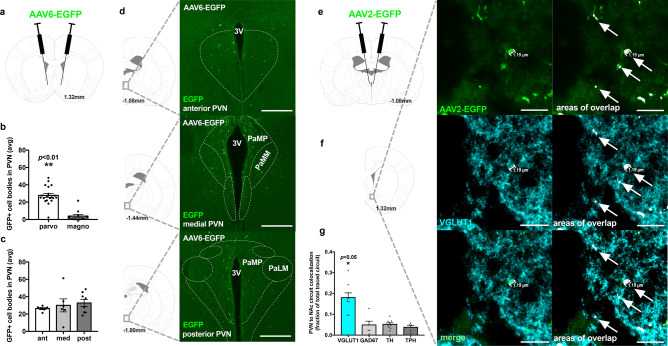
Figure 1
Figure 1
PVN → NAc projection neurons originate from parvocellular PVN and co-localize with VGLUT1. (A) viral targeting approach to label PVN → NAc cell bodies. (B) PVN cell bodies that project to the NAc are localized to parvocellular regions of the PVN. n = 3, **p < 0.01 by unpaired T-test. (C) PVN cell bodies that project to the NAc are uniformly localized in anterior, medial, and posterior PVN (n = 3, p > 0.05 by one-way ANOVA). (D) representative PVN images from n = 3 brains of anterior, medial, and posterior PVN with outlined structures used in quantification. (E) viral targeting approach to label PVN → NAc terminals. (F) PVN → NAc terminals strongly localize with VGLUT1 compared to GAD67, TH and TPH (n = 4, *p < 0.05 by one-way ANOVA). (G) representative NAc images from n = 4 brains illustrating PVN → NAc terminals overlap with VGLUT1. 3 V third ventricle, PaMP paraventricular hypothalamic nucleus, medial parvicellular part, PaMM paraventricular hypothalamic nucleus, medial magnocellular part, PaLM paraventricular hypothalamic nucleus, lateral magnocellular part.
Figure 2
Figure 2
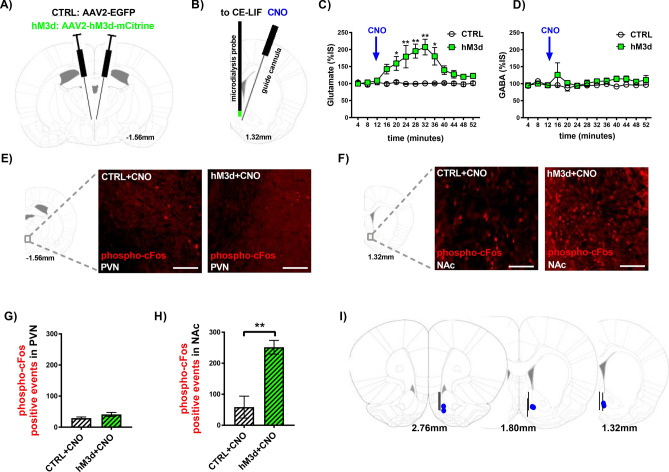
hM3d-induced stimulation of PVN → NAc increases extracellular glutamate and phospho-cFos expression in the NAc. (A) PVN CTRL and hM3d viral targeting approach. (B) NAc microdialysis probe placement to collect and quantify dialysate via CE-LIF methodology (left) and NAc guide cannula placement to administer CNO directly to NAc (right). (C) Pharmacogenetic stimulation of PVN → NAc neurons induced a robust, sustained increase in extracellular glutamate (CTRL n = 3, hM3d n = 3, *p < 0.05 and **p < 0.01 by 2-way ANOVA). (D) Pharmacogenetic stimulation of PVN → NAc neurons did not increase extracellular GABA (CTRL n = 3, hM3d n = 3, p > 0.05 by 2-way ANOVA). (E) Representative IHC images of phospho-cFos expression in the PVN of CTRL + CNO (left) and hM3d + CNO (right) rats show minimal staining. (F) Representative IHC images of phospho-cFos expression in the NAc of CTRL + CNO (left) show minimal staining. Representative IHC images of phospho-cFos expression in the NAc of hM3d + CNO (right) rats show increased staining. (G) Stimulation of PVN → NAc did not alter phospho-cFos expression in the PVN of CTRL + CNO vs. hM3d + CNO rats (CTRL n = 3, hM3d n = 3, p > 0.05 by unpaired T-test). (H) Stimulation of PVN → NAc did not alter phospho-cFos expression in the NAc of CTRL + CNO rats, but significantly increases phospho-cFos expression in the NAc of hM3d + CNO rats (CTRL n = 3, hM3d n = 3, **p < 0.01 by unpaired T-test). (I) Post-mortem placement of NAc guide cannula (blue dots) and NAc microdialysis probe (black lines). CE-LIF capillary electrophoresis with laser induced fluorescence, CNO clozapine-N-oxide, IHC immunohistochemistry.
Figure 3
Figure 3
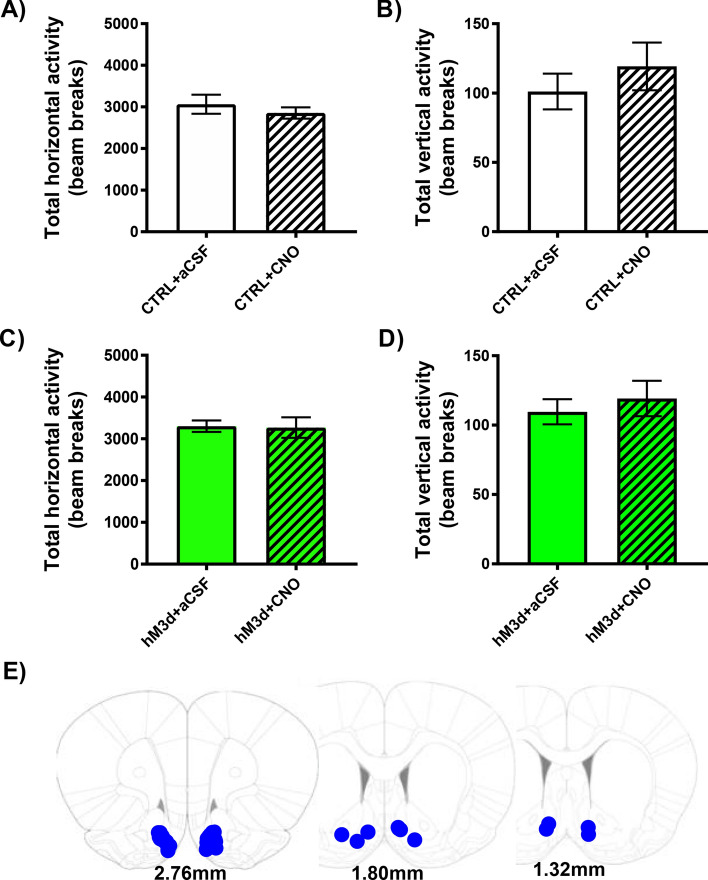
hM3d-induced stimulation of PVN → NAc did not alter locomotor activity. (A) Intra-NAc aCSF or CNO administration did not alter total horizontal activity in CTRL + aCSF or CTRL + CNO rats (n = 11, p > 0.05 by paired T-test). (B) Intra-NAc aCSF or CNO administration did not alter total vertical activity in CTRL + aCSF or CTRL + CNO rats (n = 11, p > 0.05 by paired T-test). (C) Intra-NAc aCSF or CNO administration did not alter total horizontal activity in hM3d + aCSF or hM3d + CNO rats (n = 15, p > 0.05 by paired T-test. (D) Intra-NAc aCSF or CNO administration did not alter total vertical activity in hM3d + aCSF or hM3d + CNO rats (n = 15, p > 0.05 by paired T-test). (E) Post-mortem placement of NAc guide cannula (blue dots).
Figure 4
Figure 4
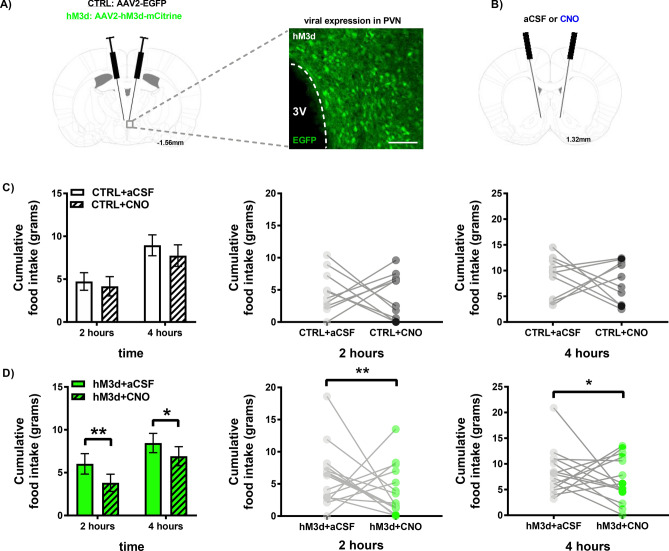
hM3d-induced stimulation of PVN → NAc decreases intake of HPF. (A) PVN hM3d viral targeting approach (left) and representative IHC image of hM3d viral expression in the PVN (right). (B) NAc guide cannula placement for aCSF or CNO administration. (C) Stimulation of PVN → NAc did not alter intake of HPF in CTRL + aCSF or CTRL + CNO rats at 2 h or 4 h post-administration (n = 11, p > 0.05 by 2-way RM-ANOVA). Cumulative food intake is also shown for each rat at 2 h (middle) and 4 h (right) post-aCSF or CNO administration. (D) Stimulation of PVN → NAc significantly decreased intake of HPF in hM3d + CNO rats compared to aCSF at 2 h post-administration (n = 15, **p < 0.01 by 2-way RM-ANOVA). Stimulation of PVN → NAc significantly decreased intake of HPF in hM3d + CNO rats compared to aCSF at 4 h post-administration, (n = 15, *p < 0.05 by 2-way RM-ANOVA). Cumulative intake of HPF is also shown for each rat at 2 h (middle) and 4 h (right) post-aCSF or CNO administration.

References

    1. Hales, C. M., M.D., Carroll, M. D., M.S.P.H., Fryar, C. D., M.S.P.H. & Ogden, C. L., Ph.D. Prevalence of Obesity Among Adults And Youth: United States, 2015–2016. NCHS data brief, no. 288. Hyattsville, MD: National Center for Health Statistics. 2017. (2017). - PubMed
    1. Managing Overweight and Obesity in Adults, Systematic Evidence Review from the Obesity Expert Panel. 1–501 (National Institutes of Health, National Heart, Lung, and Blood Institute, 2013).
    1. Freeman LR, Haley-Zitlin V, Rosenberger DS, Granholm AC. Damaging effects of a high-fat diet to the brain and cognition: a review of proposed mechanisms. Nutr. Neurosci. 2014;17:241–251. doi: 10.1179/1476830513y.0000000092. - DOI - PMC - PubMed
    1. Kasper JM, et al. Cognitive deficits associated with a high-fat diet and insulin resistance are potentiated by overexpression of ecto-nucleotide pyrophosphatase phosphodiesterase-1. Int. J. Dev. Neurosci. 2017 doi: 10.1016/j.ijdevneu.2017.03.011. - DOI - PMC - PubMed
    1. Drewnowski A, Grinker JA, Hirsch J. Obesity and flavor perception: multidimensional scaling of soft drinks. Appetite. 1982;3:361–368. doi: 10.1016/S0195-6663(82)80054-8. - DOI - PubMed

Publication types

MeSH terms