. 2020 Dec 16;10(1):22019.
doi: 10.1038/s41598-020-79042-2.

Identification of a new cannabidiol n-hexyl homolog in a medicinal cannabis variety with an antinociceptive activity in mice: cannabidihexol

Affiliations

Identification of a new cannabidiol n-hexyl homolog in a medicinal cannabis variety with an antinociceptive activity in mice: cannabidihexol

Pasquale Linciano et al. Sci Rep. .

Abstract

The two most important and studied phytocannabinoids present in Cannabis sativa L. are undoubtedly cannabidiol (CBD), a non-psychotropic compound, but with other pharmacological properties, and Δ9-tetrahydrocannabinol (Δ9-THC), which instead possesses psychotropic activity and is responsible for the recreative use of hemp. Recently, the homolog series of both CBDs and THCs has been expanded by the isolation in a medicinal cannabis variety of four new phytocannabinoids possessing on the resorcinyl moiety a butyl-(in CBDB and Δ9-THCB) and a heptyl-(in CBDP and Δ9-THCP) aliphatic chain. In this work we report a new series of phytocannabinoids that fills the gap between the pentyl and heptyl homologs of CBD and Δ9-THC, bearing a n-hexyl side chain on the resorcinyl moiety that we named cannabidihexol (CBDH) and Δ9-tetrahydrocannabihexol (Δ9-THCH), respectively. However, some cannabinoids with the same molecular formula and molecular weight of CBDH and Δ9-THCH have been already identified and reported as monomethyl ether derivatives of the canonical phytocannabinoids, namely cannabigerol monomethyl ether (CBGM), cannabidiol monomethyl ether (CBDM) and Δ9-tetrahydrocannabinol monomethyl ether (Δ9-THCM). The unambiguously identification in cannabis extract of the n-hexyl homologues of CBD and Δ9-THC different from the corresponding methylated isomers (CBDM, CBGM and Δ9-THCM) was achieved by comparison of the retention time, molecular ion, and fragmentation spectra with those of the authentic standards obtained via stereoselective synthesis, and a semi-quantification of these cannabinoids in the FM2 medical cannabis variety was provided. Conversely, no trace of Δ9-THCM was detected. Moreover, CBDH was isolated by semipreparative HPLC and its identity was confirmed by comparison with the spectroscopic data of the corresponding synthetic standard. Thus, the proper recognition of CBDH, CBDM and Δ9-THCH closes the loop and might serve in the future for researchers to distinguish between these phytocannabinoids isomers that show a very similar analytical behaviour. Lastly, CBDH was assessed for biological tests in vivo showing interesting analgesic activity at low doses in mice.


Conflict of interest statement

The authors declare no competing interests.

Figures
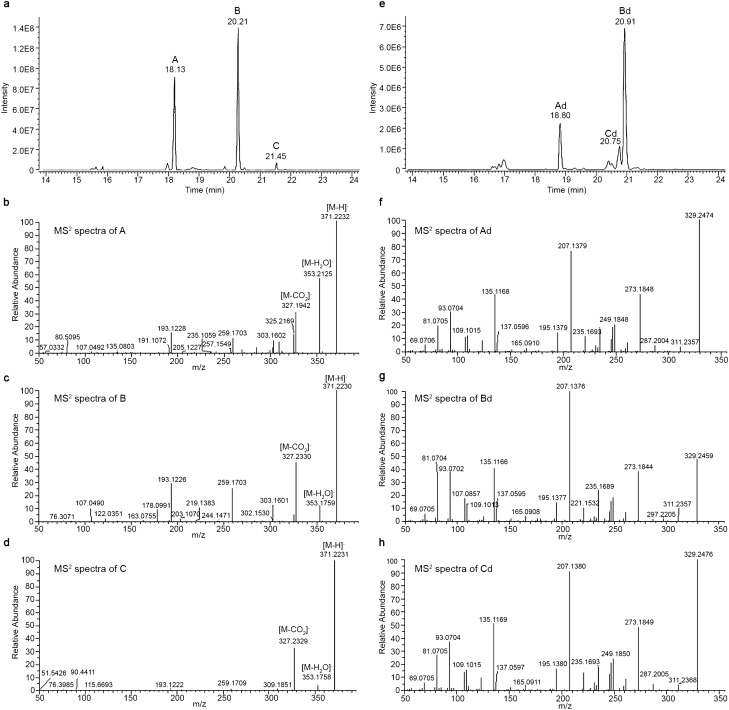
Figure 1
Figure 1
Identification of compounds corresponding to the molecular formula C23H32O4 in C. sativa FM2. (A) UHPLC-HRMS extracted ion chromatogram (EIC) for molecular formula C23H32O4 in native FM2 and the relative fragmentation spectra, in negative ionization mode, for the identified peaks A (panel B), B (panel C) and C (panel D). (E) UHPLC-HRMS extracted ion chromatogram (EIC) for molecular formula C22H31O2 in decarboxylated FM2 and the relative fragmentation spectra, in negative ionization mode, for the identified peaks Ad (panel F), Bd (panel G) and Cd (panel H).
Figure 2
Figure 2
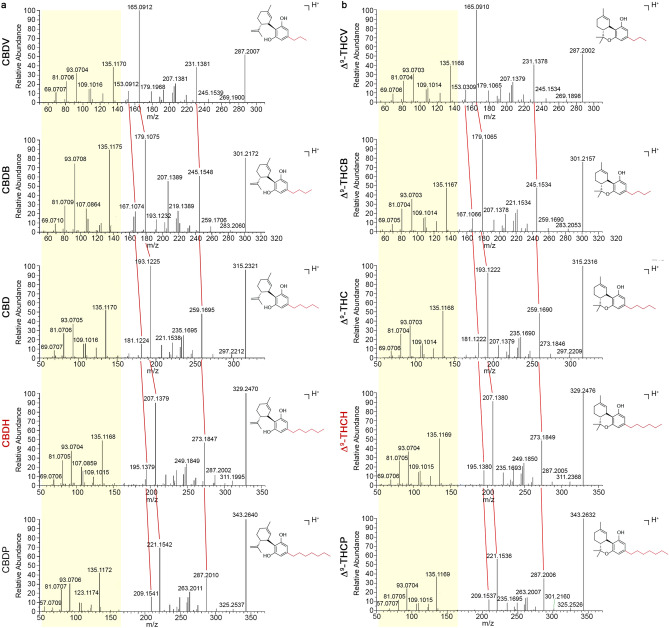
MS/MS spectra library of CBD and Δ9-THC homologs by UHPLC-HESI-Orbitrap. Comparison of the high-resolution fragmentation spectra in positive (ESI+) mode for CBD (panel A) and Δ9-THC (panel B) homologs. The pale-yellow box point out the constant terpenic portion. The red lines highlight the shift of some fragments corresponding to the loss of a methylene portion (CH2, m/z = 14) moving from CBDP (or Δ9-THCP) to CBDV (or Δ9-THCV).
Figure 3
Figure 3
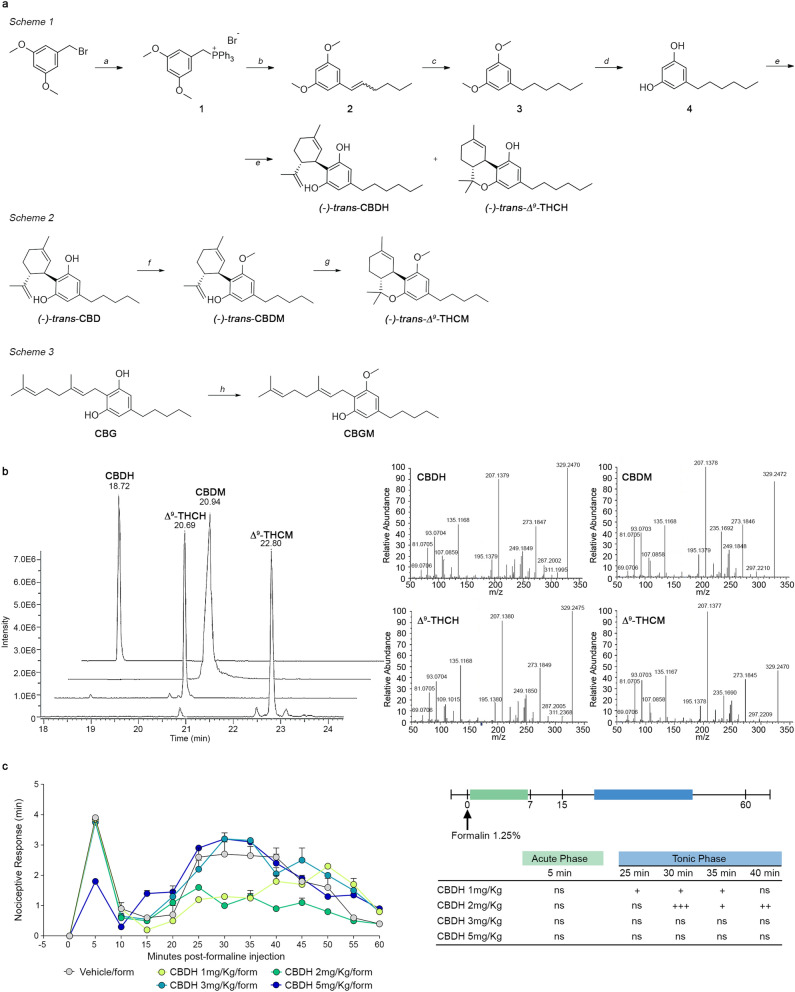
Synthesis and UHPLC-HRMS identification of CBDH, CBDM, Δ9-THCH and Δ9-THCM, and in vivo activity of CBDH. (A) Scheme 1. Reagents and conditions: (a) triphenylphosphine (1.1 equiv.), toluene, reflux, 6 h, quant. yield; (b) valeraldehyde (1.5 equiv.), 0.1 M K2CO3 aq. (10 mL per mmol of 1), reflux, 5 h, 81% yield; (c) H-Cube ThalesNano H2-Pd/C, EtOH, 30 °C, 20 bar, 1 mL/min, 91% yield; (d) BBr3 1 M in DCM (2.2 eq.), anhydrous DCM, N2 atmosphere, − 15 °C → r.t, 24 h, quant. yield; (e) (1S,4R)-1-methyl-4-(prop-1-en-2-yl)cycloex-2-enol (0.9 equiv.), pTSA (0.1 equiv.), DCM, r.t., argon, 2 h, 17% yield for (−)-trans-CBDH and 20% yield for (−)-trans9-THCH. Scheme 2. Reagents and conditions: dimethylsulphate (0.5 equiv.), K2CO3 (1 equiv.), DMF, r.t. 62% yield for (−)-trans-CBDM and 57% yield for CBGM. Scheme 3. Reagents and conditions: p-TSA (0.1 equiv.), dry DCM, r.t., 1 h, 43% yield. (B) Superimposition of extracted UHPLC-HRMS ion chromatograms (EICs) of synthetic cannabinoid n-hexyl and monomethyl ether homologs. and relative fragmentation spectra, in positive ionization mode. EICs were chosen based on the exact mass calculated for C23H32O4. (C) Effects of CBDH (1, 2, 3, and 5 mg/kg, i.p.) or vehicle in the formalin test in mice. The total time of the nociceptive response was measured every 5 min and expressed in min (see “Experimental” section). Data are represented as means ± SEM (n = 5–6). +,+++indicate statistically significant differences versus veh/form, p < 0.05 and p < 0.001, respectively. 2-way ANOVA followed by Bonferroni’s post hoc tests was used for statistical analysis.

References

    1. Zhu L, et al. Effect and mechanism of quorum sensing on horizontal transfer of multidrug plasmid RP4 in BAC biofilm. Sci. Total Environ. 2020;698:134236. doi: 10.1016/j.scitotenv.2019.134236. - DOI - PubMed
    1. Citti C, et al. Analysis of impurities of cannabidiol from hemp. Isolation, characterization and synthesis of cannabidibutol, the novel cannabidiol butyl analog. J. Pharm. Biomed. Anal. 2019;175:666. doi: 10.1016/j.jpba.2019.06.049. - DOI - PubMed
    1. Citti C, et al. Chemical and spectroscopic characterization data of ‘cannabidibutol’, a novel cannabidiol butyl analog. Data Br. 2019 doi: 10.1016/j.dib.2019.104463. - DOI - PMC - PubMed
    1. Citti C, et al. A novel phytocannabinoid isolated from Cannabis sativa L. with an in vivo cannabimimetic activity higher than Δ9-tetrahydrocannabinol: Δ9-Tetrahydrocannabiphorol. Sci. Rep. 2019;9:1–13. doi: 10.1038/s41598-019-56785-1. - DOI - PMC - PubMed
    1. Cerrato A, et al. A new software-assisted analytical workflow based on high-resolution mass spectrometry for the systematic study of phenolic compounds in complex matrices. Talanta. 2020;209:120573. doi: 10.1016/j.talanta.2019.120573. - DOI - PubMed

Publication types