. 2020 Dec 16;10(1):22054.
doi: 10.1038/s41598-020-79052-0.

Characterization of the erythrocyte GTPase Rac1 in relation to Plasmodium falciparum invasion

Affiliations

Characterization of the erythrocyte GTPase Rac1 in relation to Plasmodium falciparum invasion

Silvio Paone et al. Sci Rep. .

Abstract

Malaria is still a devastating disease with 228 million cases globally and 405,000 lethal outcomes in 2018, mainly in children under five years of age. The threat of emerging malaria strains resistant to currently available drugs has made the search for novel drug targets compelling. The process by which Plasmodium falciparum parasites invade the host cell has been widely studied, but only a few erythrocyte proteins involved in this process have been identified so far. The erythrocyte protein Rac1 is a GTPase that plays an important role in host cell invasion by many intracellular pathogens. Here we show that Rac1 is recruited in proximity to the site of parasite entry during P. falciparum invasion process and that subsequently localizes to the parasitophorous vacuole membrane. We also suggest that this GTPase may be involved in erythrocyte invasion by P. falciparum, by testing the effect of specific Rac1 inhibitory compounds. Finally, we suggest a secondary role of the erythrocyte GTPase also in parasite intracellular development. We here characterize a new erythrocyte protein potentially involved in P. falciparum invasion of the host cell and propose the human GTPase Rac1 as a novel and promising antimalarial drug target.


Conflict of interest statement

The authors declare no competing interests.

Figures
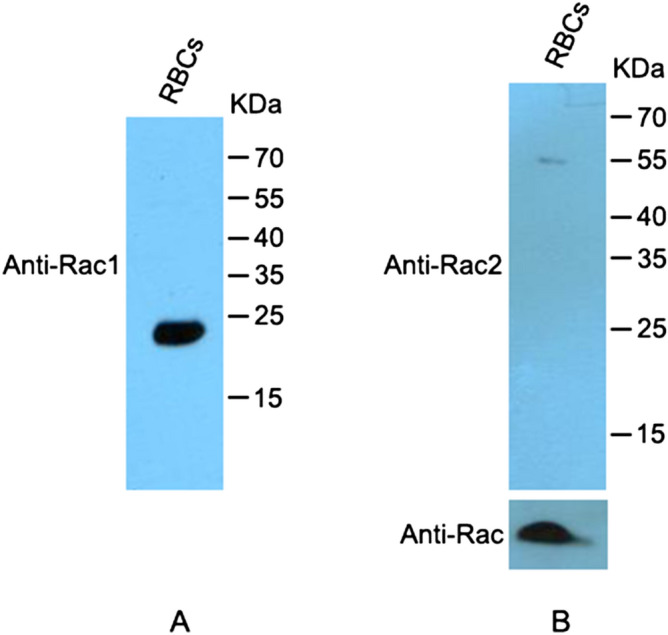
Figure 1
Figure 1
Rac expression in human erythrocytes. (A) Proteins extracted from of 5 × 107 erythrocyte membranes were hybridized with a monoclonal antibody specific for Rac1 (R1-ab#2). The signal was detected at about 21 kDa, as expected. (B) In a different gel, same amounts of erythrocyte membranes were probed with the monoclonal anti-Rac2 specific antibody; no signal was detected. The same filter was then probed with an anti-Rac antibody (recognizing Rac1-3 proteins) (R1-ab#1), used as a loading control (bottom). The full lanes are shown in Fig. S10.
Figure 2
Figure 2
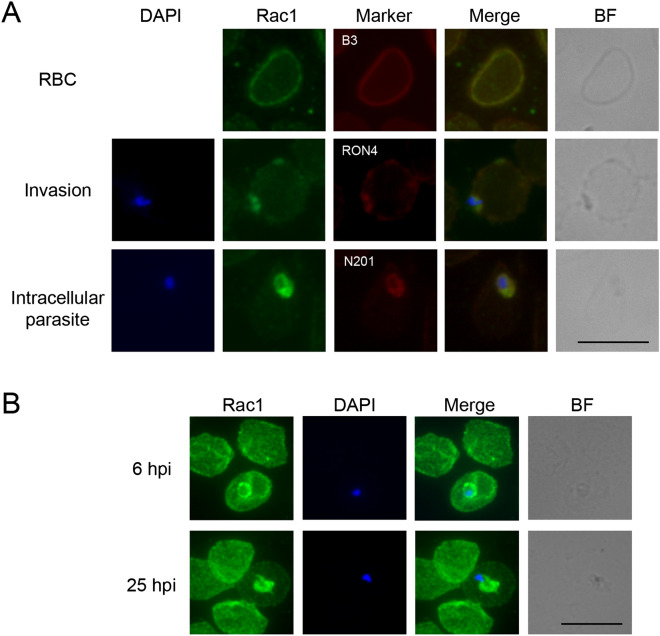
Rac1 subcellular localization. (A) IFAs of infected and non-infected human erythrocytes. Anti-Rac1 polyclonal antibody (ab#4) was used together with a primary antibody against Band3 (B3), as a marker of erythrocyte membrane, anti-RON4 antibody as a marker of the moving junction and anti-N201 as a marker of the PVM. RBC: non-infected erythrocyte. Invasion: parasite invading an erythrocyte. The nucleus has the typical bilobed shape. Intracellular parasite: parasite inside the parasitophorous vacuole. BF: Bright field. Nuclei are stained with DAPI. Different exposure times were used in each image. Scale bar: 10 µm. (B) IFA of synchronous parasites at 6 hpi and 25 hpi stained with the monoclonal anti-Rac1 R1-ab#3. BF: Bright field. Nuclei are stained with DAPI. Scale bar: 10 µm.
Figure 3
Figure 3
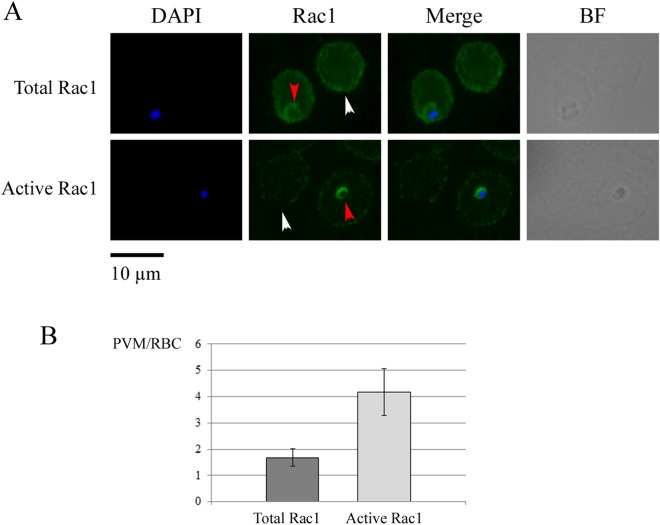
Rac1 activation state in infected erythrocytes. (A) IFA of an asynchronous parasite culture hybridized with anti-Rac1 (R1-ab#3) and anti-Rac1/GTP (R1-ab#6). BF: Bright field. Nuclei are stained with DAPI. Red arrows point at PVMs and white arrows point at non-parasitized erythrocytes. Scale bar: 10 µm. (B) Histogram showing the ratio between PVM and non-infected erythrocyte fluorescence, respectively with the anti-Rac1 (R1-ab#3) and the anti-Rac1/GTP (R1-ab#6). Student’s T-test: P < 10−13.
Figure 4
Figure 4
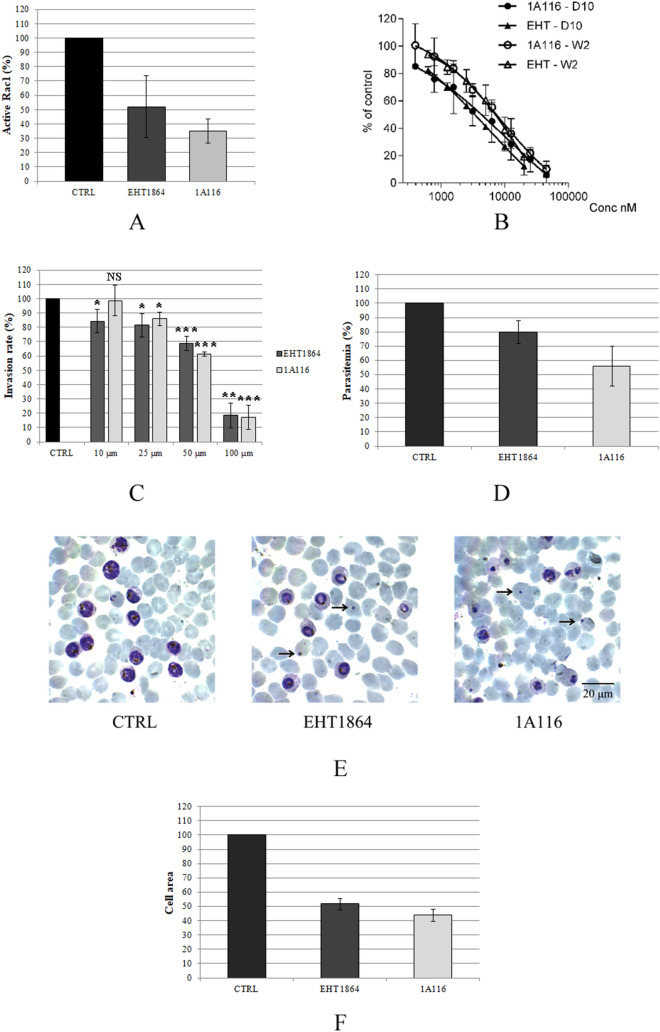
Rac1 functional analysis. (A) Histogram showing the G-LISA test results of erythrocytes treated with the Rac1 inhibitors EHT1864 and 1A116, as a percentage of the untreated control. Student’s T-test with both inhibitors: P < 0.05. (B) Growth curves for IC50 determinations. (C) P. falciparum invasion rates in the presence of the Rac1 inhibitors EHT1864 and 1A116. The number of newly infected erythrocytes at the end of the assay was normalized on the control. Data shown here are the result of three independent experiments, each performed in three technical replicates. Student’s T-test: NS: non-significant; * =  P < 0.05; **  < 0.01; *** ≤ 0.005. (D) Effect of Rac1 chemical inhibitors on P. falciparum intraerythrocytic growth. Blood smears of a synchronous parasite culture were taken at 39 hpi, corresponding to almost mature schizont stages. Parasitemia was normalized on the control. Data shown for EHT1864 are the result of three independent biological replicates, while for 1A116 the data are the result of two biological replicates. Student’s T-test: P < 0.05 with both inhibitors. (E) Giemsa-stained smears of synchronous P. falciparum parasites at 39 hpi, treated with the Rac1 chemical inhibitors EHT1864 and 1A116. Arrows point at possible residues after parasite death. Scale bar: 20 µm. F. Histogram showing parasite cell areas in the inhibitor-treated samples, normalized on the untreated control. These data are the result of two biological replicates. Student’s T-test: P < 0.05 with both inhibitors.

References

    1. WHO. (2019).
    1. Dondorp AM, et al. Artemisinin resistance in Plasmodium falciparum malaria. N. Engl. J. Med. 2009;361:455–467. doi: 10.1056/NEJMoa0808859. - DOI - PMC - PubMed
    1. Ariey F, et al. A molecular marker of artemisinin-resistant Plasmodium falciparum malaria. Nature. 2014;505:50–55. doi: 10.1038/nature12876. - DOI - PMC - PubMed
    1. Plowe CV, et al. Mutations in Plasmodium falciparum dihydrofolate reductase and dihydropteroate synthase and epidemiologic patterns of pyrimethamine-sulfadoxine use and resistance. J. Infect. Dis. 1997;176:1590–1596. doi: 10.1086/514159. - DOI - PubMed
    1. Trape JF, et al. Impact of chloroquine resistance on malaria mortality. C. R. Acad. Sci. 1998;III(321):689–697. doi: 10.1016/s0764-4469(98)80009-7. - DOI - PubMed

Publication types

MeSH terms

Substances