


Curcumin in Depression: Potential Mechanisms of Action and Current Evidence-A Narrative Review
- PMID: 33329109
- PMCID: PMC7728608
- DOI: 10.3389/fpsyt.2020.572533
Curcumin in Depression: Potential Mechanisms of Action and Current Evidence-A Narrative Review
Abstract
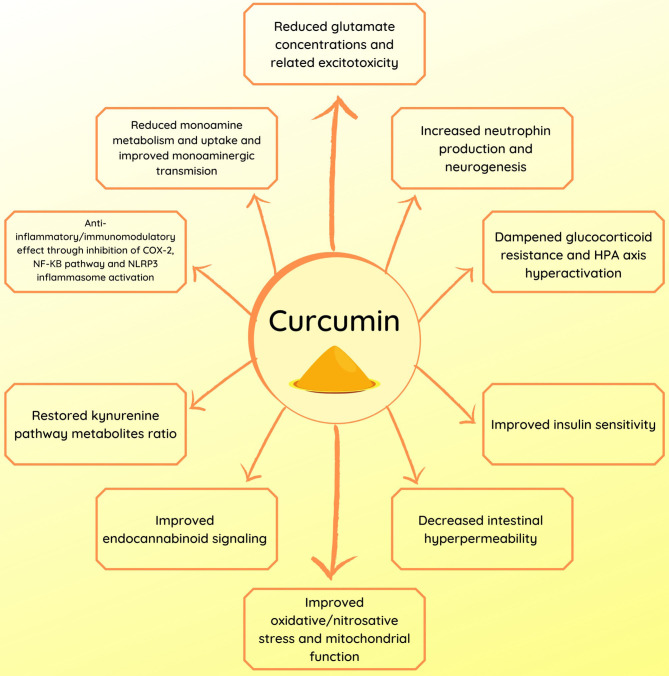
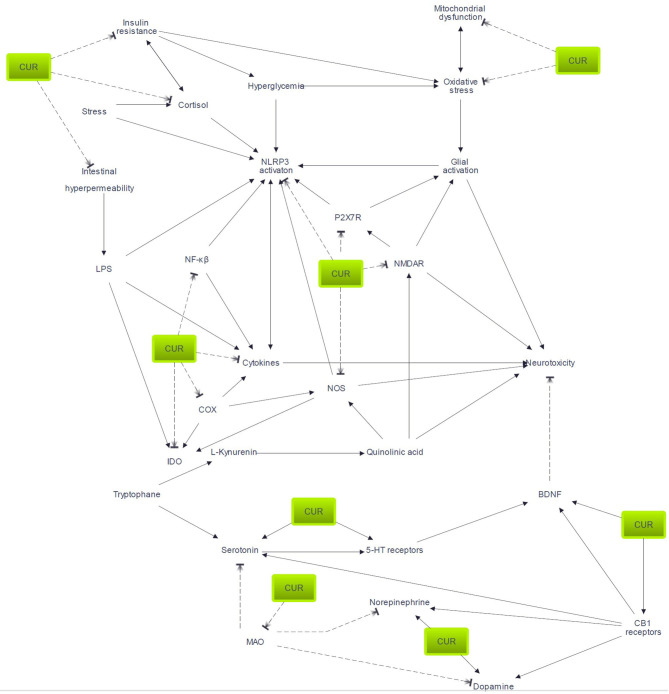
Major depressive disorder (MDD) is one of the most prevalent and debilitating disorders. Current available treatments are somehow limited, so alternative therapeutic approaches targeting different biological pathways are being investigated to improve treatment outcomes. Curcumin is the main active component in the spice turmeric that has been used for centuries in Ayurvedic medicine to treat a variety of conditions, including anxiety and depressive disorders. In the past decades, curcumin has drawn researchers' attention and displays a broad range of properties that seem relevant to depression pathophysiology. In this review, we break down the potential mechanisms of action of curcumin with emphasis on the diverse systems that can be disrupted in MDD. Curcumin has displayed, in a number of studies, a potency in modulating neurotransmitter concentrations, inflammatory pathways, excitotoxicity, neuroplasticity, hypothalamic-pituitary-adrenal disturbances, insulin resistance, oxidative and nitrosative stress, and endocannabinoid system, all of which can be involved in MDD pathophysiology. To date, a handful of clinical trials have been published and suggest a benefit of curcumin in MDD. With evidence that is progressively growing, curcumin appears as a promising alternative option in the management of MDD.
Keywords: NLRP3; curcumin; depression; dietary supplement(s); inflammation; mechanism of action; neuroprotective agent; turmeric.
Copyright © 2020 Ramaholimihaso, Bouazzaoui and Kaladjian.
Conflict of interest statement
The authors declare that the research was conducted in the absence of any commercial or financial relationships that could be construed as a potential conflict of interest.
Figures
References
-
- James SL, Abate D, Abate KH, Abay SM, Abbafati C, Abbasi N, et al. Global, regional, and national incidence, prevalence, and years lived with disability for 354 diseases and injuries for 195 countries and territories, 1990–2017: a systematic analysis for the global burden of disease study 2017. Lancet. (2018) 392:1789–858. 10.1016/S0140-6736(18)32279-7 - DOI - PMC - PubMed
-
- World Health Orgazination Depression: Let's Talk. (2017). Available online at: https://www.who.int/news-room/detail/30-03-2017–depression-let-s-talk-sa... (accessed May 14, 2020).
-
- Cipriani A, Furukawa TA, Salanti G, Chaimani A, Atkinson LZ, Ogawa Y, et al. . Comparative efficacy and acceptability of 21 antidepressant drugs for the acute treatment of adults with major depressive disorder: a systematic review and network meta-analysis. Focus. (2018) 16:420–9. 10.1176/appi.focus.16407 - DOI - PMC - PubMed
-
- John Rush A, Jain S. Clinical implications of the STAR*D trial. In: Macaluso M, Preskorn SH. editors. Antidepressants: From Biogenic Amines to New Mechanisms of Action. Cham: Springer International Publishing; (2019) p. 51–99.
Publication types
LinkOut - more resources
Full Text Sources
Miscellaneous
