


Effective and resource-efficient strategies for recruiting families in physical activity, sedentary behavior, nutrition, and obesity prevention research: A systematic review with expert opinion
- PMID: 33331106
- PMCID: PMC7613433
- DOI: 10.1111/obr.13161
Effective and resource-efficient strategies for recruiting families in physical activity, sedentary behavior, nutrition, and obesity prevention research: A systematic review with expert opinion
Abstract
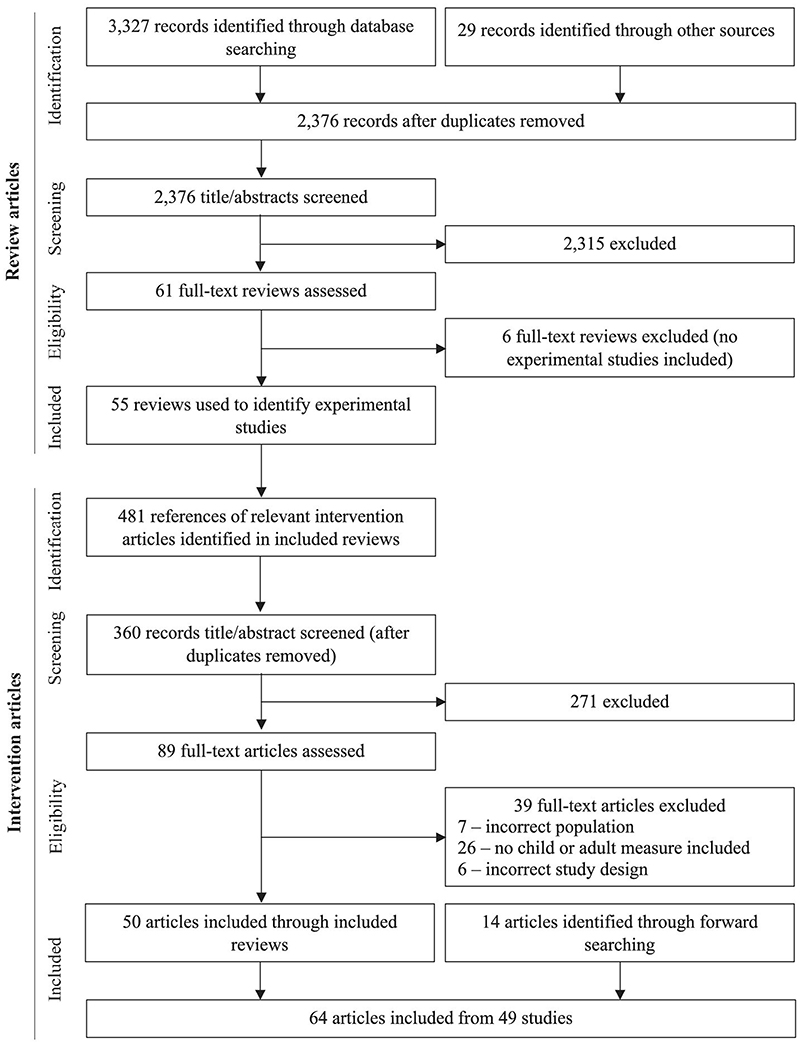
We systematically identified effective and resource-efficient strategies for recruiting families into health promoting intervention research. Four databases were searched for reviews. Interventions were extracted from included reviews. Additionally, a Delphi study was conducted with 35 experts in family-based research. We assessed extracted data from our review and Delphi participants' opinions by collating responses into overarching themes based on recruitment setting then recruitment strategies to identify effective and resource-efficient strategies for recruiting families into intervention research. A total of 64 articles (n = 49 studies) were included. Data regarding recruitment duration (33%), target sample size (32%), reach (18%), expressions of interest (33%), and enrollment rate (22%) were scarcely reported. Recruitment settings (84%) and strategies (73%) used were available for most studies. However, the details were vague, particularly regarding who was responsible for recruitment or how recruitment strategies were implemented. The Delphi showed recruitment settings, and strategies fell under six themes: school-based, print/electronic media, community settings-based, primary care-based, employer-based, and referral-based strategies. Underrecruitment in family-based trials is a major issue. Reporting on recruitment can be improved by better adherence to existing guidelines. Our findings suggest a multifaceted recruitment approach targeting adults and children with multiple exposures to study information.
Keywords: Delphi study; healthy eating; physical activity; screen time.
© 2020 The Authors. Obesity Reviews published by John Wiley & Sons Ltd on behalf of World Obesity Federation.
Conflict of interest statement
The authors declare that they have no conflicts of interest. The views expressed are those of the author(s) and not necessarily those of the National Health Service, the National Institute for Health Research, or the Department of Health and Social Care.
References
-
- Abarca-Gómez L, Abdeen ZA, Hamid ZA, et al. Worldwide trends in body-mass index, underweight, overweight, and obesity from 1975 to 2016: A pooled analysis of 2416 population-based measurement studies in 128.9 million children, adolescents, and adults. The Lancet. 2017;390(10113):2627–2642. - PMC - PubMed
-
- Hallal PC, Andersen LB, Bull FC, et al. Global physical activity levels: surveillance progress, pitfalls, and prospects. The Lancet. 2012;380(9838):247–257. - PubMed
-
- Aubert S, Barnes JD, Abdeta C, et al. Global matrix 3.0 physical activity report card grades for children and youth: Results and analysis from 49 countries. Journal of Physical Activity and Health. 2018;15(S2):S251–S273. - PubMed
Publication types
MeSH terms
Grants and funding
LinkOut - more resources
Full Text Sources
Medical
