


Foodborne Botulism in Ukraine from 1955 to 2018
- PMID: 33332209
- PMCID: PMC8060719
- DOI: 10.1089/fpd.2020.2826
Foodborne Botulism in Ukraine from 1955 to 2018
Abstract
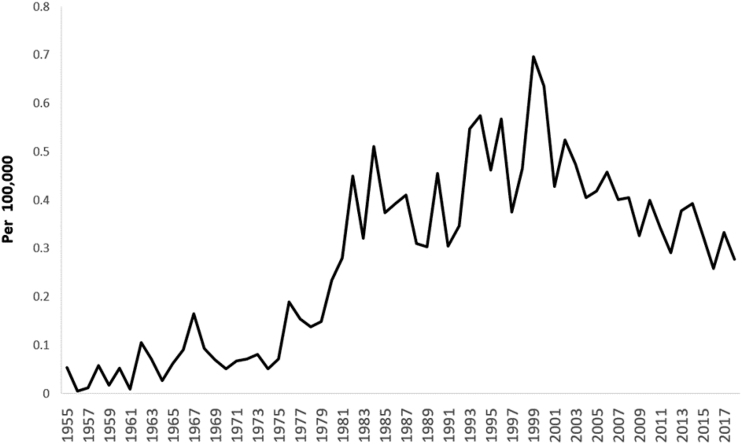
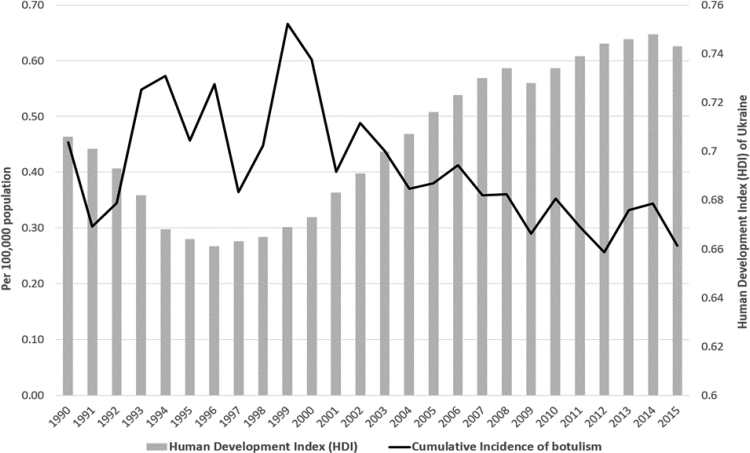
We aim to identify possible biological, social, and economic factors that could influence the prevalence of foodborne botulism (FB). The objective of this article is to assess epidemiological peculiarities of FB in Ukraine from 1955 to 2018 using national epidemiological surveillance data. This article presents an epidemiological descriptive population-based study of the epidemiology of FB using correlation analysis. From 1955 to 2018, 8614 cases of botulism were recorded in Ukraine causing 659 deaths. The distribution of types of botulism toxins is represented by type A (7.97%), B (59.64%), suspected as C (0.56%), E (25.47%), others (5.33%), and unidentified (1.04%). From 1990 to 2015, the rate correlation between Human Development Index (HDI) and incidence of botulism was -0.75 ± 0.20. Homemade canned meat and fish continue to be the leading causes of botulism in Ukraine. Cases related to commercial food were rare or absent, but in recent years (2017-2018), their percentage has increased to 32.56%. The HDI and botulism have an inverse mathematical correlation and predictable logical relationship: with an HDI increase, the incidence of FB decreased. In general, food botulism in Ukraine is related to traditional socioeconomic factors related to cultural food habits. In the face of declining living standards and uncertainty that food products will be physically or economically available, homemade preservation increases. Home food preservation is a major cause of botulism in Ukraine. The elimination of FB is possible in Ukraine only with the complete cessation of home canning and state control over the manufacture and sale of commercial canned products.
Keywords: Ukraine; foodborne botulism; retrospective study.
Conflict of interest statement
No competing financial interests exist.
Figures
References
-
- Arnon SS, Schechter R, Inglesby TV, et al. . Botulinum toxin as a biological weapon: Medical and Public Health Management. JAMA 2001;285:1059–1070 - PubMed
-
- Barash JR, Arnon SS. A novel strain of Clostridium botulinum that produces type B and type H botulinum toxins. J Infect Dis 2014;209:183–191 - PubMed
-
- [CDC] Centers for Disease Control and Prevention. Botulism in the United States, 1899–1996. Handbook for Epidemiologists, Clinicians, and Laboratory Workers. Atlanta, GA: Centers for Disease Control and Prevention, 1998
-
- CDC, USA. 2018. Available at: https://emergency.cdc.gov/agent/agentlist-category.asp accessed November1, 2020
MeSH terms
LinkOut - more resources
Full Text Sources
Medical
