


Zika, dengue and chikungunya population prevalence in Rio de Janeiro city, Brazil, and the importance of seroprevalence studies to estimate the real number of infected individuals
- PMID: 33332373
- PMCID: PMC7746276
- DOI: 10.1371/journal.pone.0243239
Zika, dengue and chikungunya population prevalence in Rio de Janeiro city, Brazil, and the importance of seroprevalence studies to estimate the real number of infected individuals
Abstract
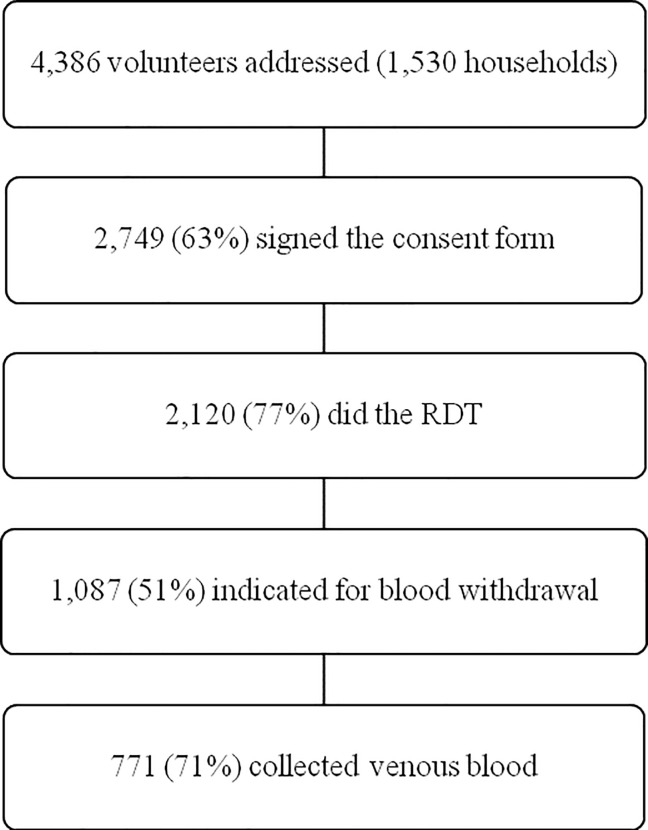
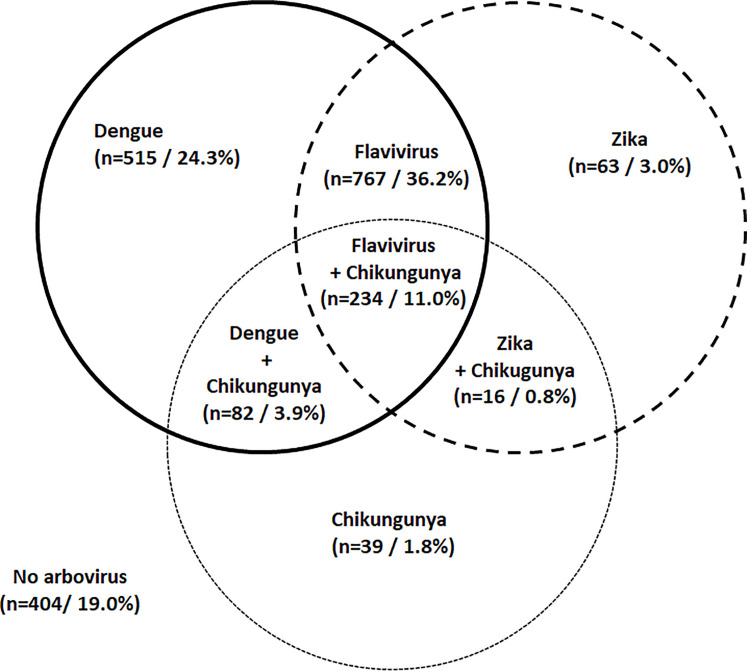
In the last 40 years, Latin America countries, including Brazil, have suffered from the emergence and reemergence of arboviruses, first Dengue (DENV) and recently Zika (ZIKV) and Chikungunya (CHIKV). All three arboviruses are currently endemic in Brazil and have caused major outbreaks in recent years. Rio de Janeiro city, host of the last Summer Olympic Games and the Football World Cup, has been specially affected by them. A surveillance system based on symptomatic reports is in place in Rio, but the true number of affected individuals is unknown due to the great number of Zika, Dengue and Chikungunya asymptomatic cases. Seroprevalence studies are more suitable to evaluate the real number of cases in a given population. We performed a populational seroprevalence survey in Rio, with recruitment of a sample of volunteers of all ages and gender from July to October 2018, within randomly selected census tracts and household. A total of 2,120 volunteers were interviewed and tested with rapid immunochromatographic test for ZIKV, DENV and CHIKV. Individuals with positive results for IgG and/or IgM from only one virus were classified accordingly, while those with test results positive for both ZIKV and DENV were classified as flaviviruses. We corrected for sample design and non-response in data analysis, and calculated point estimate prevalence and 95% confidence intervals for each virus. Arbovirus prevalence in the Rio's population (n = 6,688,927) was estimated at 48.6% [95% CI 44.8-52.4] (n = 3,254,121) for flaviviruses and at 18.0% [95% CI 14.8-21.2] (n = 1,204,765) for CHIKV. Approximately 17.0% [95% CI 14.1-20.1] (n = 1,145,674) of Rio´s population had no contact with any of the three arboviruses. The reported cases of Zika, Dengue and Chikungunya by the current surveillance system in place is insufficient to estimate their real numbers, and our data indicate that Zika seroprevalence could be at least five times and Chikungunya 45 times bigger. The high number of individuals having never been infected by any of the three arboviruses, may indicate a proper scenario for future outbreaks.
Conflict of interest statement
The authors have declared that no competing interests exist.
Figures
References
-
- Braga IA, Valle D. Aedes aegypti: histórico do controle no Brasil. 2007;16(2):113–8. 10.5123/S1679-49742007000200006. - DOI
-
- Brady OJ, Osgood-Zimmerman A, Kassebaum NJ, Ray SE, de Araújo VEM, da Nóbrega AA, et al. The association between Zika virus infection and microcephaly in Brazil 2015–2017: An observational analysis of over 4 million births. PLOS Med. 2019;16(3):e1002755 10.1371/journal.pmed.1002755 - DOI - PMC - PubMed
-
- Kuper H, Lopes Moreira ME, Barreto de Araújo TV, Valongueiro S, Fernandes S, Pinto M, et al. The association of depression, anxiety, and stress with caring for a child with Congenital Zika Syndrome in Brazil; Results of a cross-sectional study. PLoS Negl Trop Dis. 2019;13(9):e0007768 http://dx.plos.org/10.1371/journal.pntd.0007768. 10.1371/journal.pntd.0007768 - DOI - PMC - PubMed
Publication types
MeSH terms
LinkOut - more resources
Full Text Sources
Medical
